

 Articles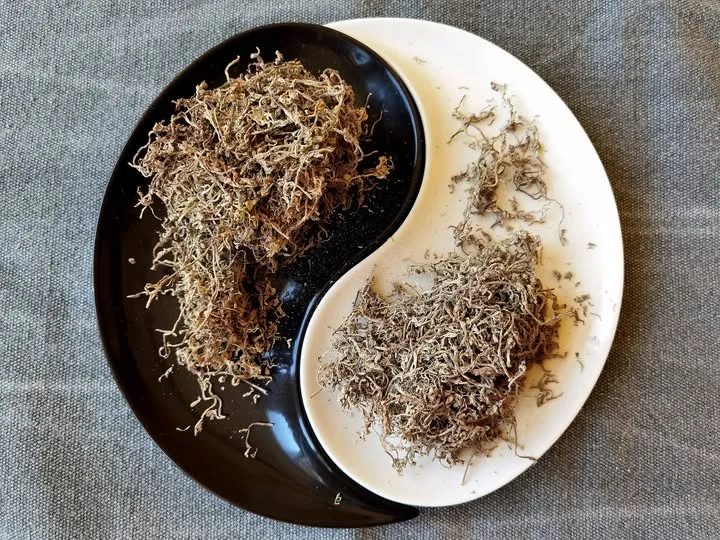

Chinese Ethnobotany: Vine Tea (Ampelopsis grossedentata); a Medicinal Vine of Southern China between Tradition, Science, and Longevity
Ampelopsis grossedentata, often also called vine tea, Teng Cha (藤茶), or Mei Cha (莓茶), is an interesting climbing plant from the grape family that grows mainly in the mountainous regions of southern China. Although it has become more widely known outside Asia only in recent decades, people in certain Chinese provinces have used it for centuries. In modern times, it has attracted researchers’ attention primarily because of its exceptionally high flavonoid content, especially dihydromyricetin (DHM), which is considered one of its most important bioactive compounds.
Unlike most herbal teas, vine tea contains exceptionally high concentrations of polyphenols and flavonoids. The dried leaves are often covered with a distinctive whitish layer, which inexperienced observers sometimes mistake for mold. In fact, these are crystallized flavonoids, among which dihydromyricetin predominates. Some analyses show that flavonoids make up more than 30 percent of the plant’s dry mass, which is significantly higher than in many other traditional teas.
In the folk medicine of southern China, vine tea has long been used to support liver function, relieve coughs and throat irritation, reduce the feeling of “internal heat,” support digestion, and aid recovery after drinking alcohol. This connection with liver protection and alcohol metabolism is one of the reasons the plant has become the subject of numerous scientific studies in recent years.
Laboratory research and animal studies show that dihydromyricetin acts as a powerful antioxidant. It effectively reduces oxidative stress, which is associated with aging processes and many chronic diseases. One of the most extensively studied areas is its effect on the liver. Researchers have found that it may help reduce liver damage associated with alcohol, fatty liver disease, and certain inflammatory processes.
Findings on its effects on the cardiovascular system are also promising. Some studies suggest the possibility of beneficial effects on blood pressure, LDL cholesterol levels, blood vessel function, and fat metabolism. In addition, laboratory experiments indicate anti-inflammatory activity, which may explain its traditional use for respiratory problems and an irritated throat.
The effect of dihydromyricetin on alcohol metabolism has also attracted particular interest. Some research suggests that it may influence certain metabolic pathways and receptors in the brain associated with intoxication, which is why DHM today often appears in dietary supplements for hangovers. Nevertheless, experts caution that it is not a miraculous protection against the consequences of excessive alcohol consumption.
Although modern research is promising, it should be emphasized that many potential health effects still await confirmation in larger clinical studies in humans. Even so, Ampelopsis grossedentata is considered one of the richest natural plant sources of flavonoids and an important part of the traditional Chinese herbal heritage.
This tea has a special place in the region of Zhangjiajie, where it is known as Mao Yan Mei (茅岩莓茶). Local chronicles mention its use going back several centuries. It was reportedly gathered on steep rocky slopes and used mainly by hunters, foresters, and residents of remote mountain villages. They drank it to reduce fatigue, refresh themselves, and relieve thirst during long journeys through the mountains. Some modern Chinese publications even mention a tradition of use spanning more than a thousand years, but such claims should be approached with caution, as for the earliest periods they often rely mainly on oral tradition.
Interestingly, vine tea is not among the best-known plants of the classical Chinese pharmacopoeias. In major medical works such as Shennong Bencao Jing 神农本草经 (Shennong’s Classic of Materia Medica) and Bencao Gangmu 本草纲目 (Compendium of Materia Medica), it does not appear as an important independent remedy. The reason is probably mainly geographical. The plant grows in limited mountainous areas of southern China and for centuries remained part of regional folk medicine. It never became as widespread a trade commodity as ginseng, astragalus, or green tea, which is why it is encountered much more often in local chronicles and oral tradition than in imperial medical collections.
Over time, a rich folk tradition developed around this tea, especially among the Tujia people in the area around Zhangjiajie. One of the most beautiful traditional nicknames is Tujia Ganlu Cha (土家甘露茶), “Tujia tea of heavenly dew.” According to legend, during a drought the locals noticed that the dew gathering on the plant relieved thirst and restored strength. They therefore began to associate it with a heavenly blessing and called it “sweet dew.”
Another folk name is Guanyin Cao (观音草), “plant of the goddess Guanyin.” According to local tradition, the goddess of compassion revealed the healing properties of this vine to people, so some still associate it today with longevity, health, and protection from illness.
The taste of the tea itself also carries special symbolism. In the Zhangjiajie area, the saying “first bitter, then sweet” (先苦后甜) is popular. Vine tea initially has a distinctly bitter taste, followed by a long-lasting sweet aftertaste known as hui gan (回甘). This quality has become a symbol of life wisdom: perseverance and patience bring their reward only after initial trials.
Some locals also call it Changshou Teng (长寿藤), “vine of longevity.” The name is probably not ancient, but comes from the observation that older residents of mountain villages often drank it every day. Over time, an association between the tea and longevity developed in this way.
The story of today’s name Mei Cha is also interesting. Older locals are said to have once called the plant “moldy tea” (霉茶), because the dried leaves have a characteristic white coating. When wider sales began, such a name proved rather unappealing. The written character was therefore replaced with the identically pronounced character 莓, which means berries. This is how the present-day name Mei Cha (莓茶) came about.
In the traditional culture of the Tujia people, high-quality vine tea was also an important gift. Offering it to a guest expressed respect, hospitality, and a sincere welcome. In some villages it is still described today as a drink that “teaches patience” — an unusually poetic description for a medicinal tea, yet one that perfectly captures its nature: first bitterness, then sweetness.
An interesting, though less well-known, aspect of the history of vine tea is its connection with Daoist hermits and adepts of inner alchemy (Neidan). Although there is no evidence that Ampelopsis grossedentata was part of the central Daoist alchemical formulas, Daoists have always valued plants that grew on hard-to-reach mountain slopes, believing that such environments contained a particularly pure and refined vital energy. In the mountainous areas of southern China, where vine tea also grows, hermits often sought plants that helped maintain clarity of mind, calmness, and bodily balance during long periods of meditation. Because the tea is naturally caffeine-free, refreshing, and pleasantly cooling according to traditional Chinese classification, some modern experts associate it with the Daoist ideal of “clearing internal fire” and nurturing a calm spirit. Although these are primarily cultural and symbolic connections, they beautifully reflect the way Chinese people have understood the relationship between medicinal plants, nature, and spiritual practice over the centuries.
Vine tea is therefore not only an interesting subject of modern scientific research, but also part of the rich cultural heritage of southern China. It brings together folk medicine, local legends, the symbolism of longevity, and respect for nature. It is precisely in this interweaving of traditional knowledge and modern research that the reason lies for the continuing growth of interest in it, both in China and elsewhere in the world.
Sources and recommended literature:
Scientific sources
Carneiro, R., Ye, L., Baek, N. et al. (2021). Vine tea (Ampelopsis grossedentata): A review of chemical composition, functional properties, and potential food applications. Journal of Functional Foods, 76, 104317. A comprehensive review of the chemical composition, dihydromyricetin content, antioxidant properties, and potential food applications.
Ye, L., Wang, H., Duncan, S. E. et al. (2019). Antioxidant Properties of a Traditional Vine Tea, Ampelopsis grossedentata. Antioxidants, 8(8), 295. A study of the antioxidant properties and flavonoid content in vine tea samples from different regions of China.
Liu, Y. et al. (2023). China Medicinal Plants of the Ampelopsis grossedentata—A Review of Their Botanical Characteristics, Use, Phytochemistry, Active Pharmacological Components, and Toxicology. An extensive review of the plant’s botany, traditional use, phytochemistry, and pharmacological effects.
Fan, B. et al. (2025). Vine tea (Ampelopsis grossedentata) — A different kind of tea hidden deep in the mountains of China. Trends in Food Science & Technology. The most recent review of research on its nutritional value, traditional use, and possible applications in functional foods.
Kou, X. and Chen, N. (review literature on dihydromyricetin). To understand the biological effects of the main active compound in vine tea, reviews of research on dihydromyricetin, or ampelopsin, are also important.
Historical and cultural sources:
Local chronicles of the Zhangjiajie area (湖南张家界地方志) contain numerous references to Mao Yan Mei tea (茅岩莓茶), its use among residents of mountainous areas, and its connection with the Tujia people. Some of these records are available mainly in Chinese and in regional publications.
Regional ethnological studies on the Tujia, Miao, and Yao peoples describe the use of vine tea as an everyday drink, a medicinal plant, and an important part of local hospitality.
Note on historical sources:
Although modern Chinese authors often cite a tradition of vine tea use extending over more than a thousand years, it should be emphasized that there is little direct written evidence for the earliest periods. The most reliable historical data come from regional chronicles and the folk tradition of southern China, while the plant is not prominently represented in classical pharmacopoeias such as Shennong Bencao Jing 神农本草经 (Shennong’s Classic of Materia Medica) or Bencao Gangmu 本草纲目 (Compendium of Materia Medica). For this reason, historians of medicine generally treat it as a regional medicinal plant with several centuries of documented use.
On the Daoist tradition:
The connection between vine tea and Daoist inner alchemy is based mainly on the cultural context of mountain hermit communities in southern China and on the Daoist respect for plants that grow in remote mountainous areas. There is currently no direct historical evidence that Ampelopsis grossedentata was part of the central Daoist alchemical formulas. Nevertheless, the plant fits well into the broader Daoist tradition of seeking herbs to preserve vitality, clarity of mind, and longevity.


