

 Articles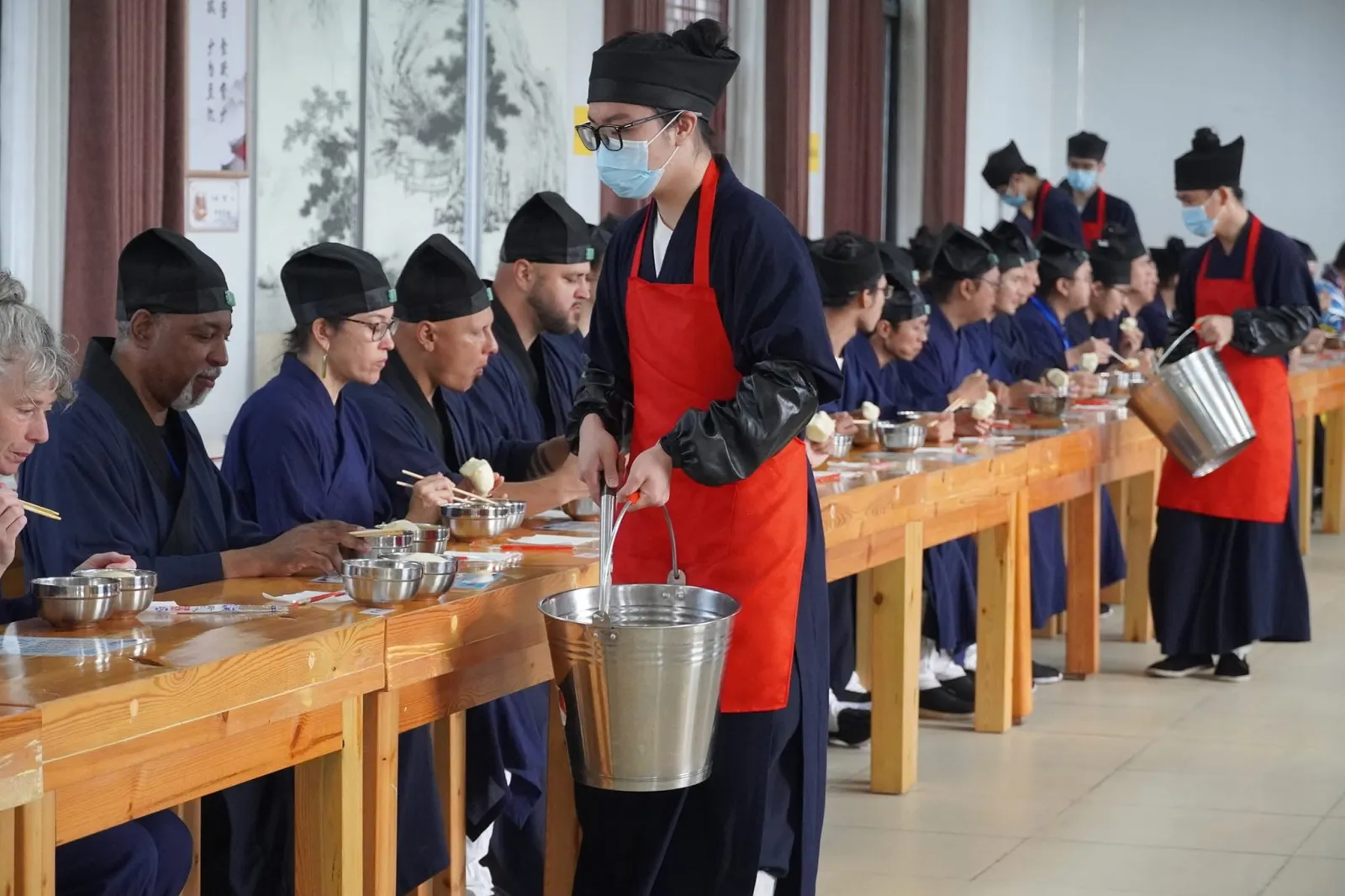
The Daoist approach to eating
The Daoist attitude toward eating arises from the basic premise that life is not separate from the natural order, but is its temporarily condensed activity. Food is therefore not merely biological intake, but one of the fundamental relations in which the Dao is realized as the maintenance of the body, the spirit, and their mutual alignment. In this sense, eating is not a “private” or merely physical activity, but part of a broader cosmic circulation of giving and receiving, which includes the basic conditions for producing food (earth, water, sun), patient growers (farmers), and careful preparers (the kitchen).
The Daoist tradition understands human vitality as an interweaving of two basic sources of Qi: Gu Qi (榖气), which arises from food and carries the “yin” component of nourishing and forming the body, and Zong Qi (宗气), which arises from breath and has a more “yang” nature of movement and dynamism. From their synthesis arises Zhen Qi (真气), true or complete Qi, which enables the functioning of the body, awareness, and perception. Eating is therefore one of the key points where the cosmic and the bodily meet in everyday practice.
For this reason, the Daoist approach to food always includes an ethical and perceptual dimension. Food is not understood as an isolated object, but as the result of a network of relationships: the earth, the weather, the farmers, the hands that cultivate, and the hands that prepare. Respecting these relationships also means respecting life itself, which continues in food. When a person eats, they participate in this circulation; therefore, the manner of eating and respect for the possibility of eating are as important as eating itself.
From this perspective, ritual practices also develop, such as so-called ritual recitation, which reminds us of the inner orientation of awareness. Its function is not magical in an external sense, but the disciplining of perception and the alignment of the body, breath, and heart-mind before the act of nourishment. There are several recitations. The recitation published here reminds us that eating does not begin only with chewing, but already with consciously entering into a relationship with eating.
福生无量天尊
Fúshēng wúliàng tiānzūn
May life be reborn in the boundless, heavenly dimension.
接待周(或 结斋咒)
Jiēdài zhōu / Jié zhāi zhòu
Let us receive the wholeness of circulation and conclude the fast.
五星之气,六甲之精
Wǔxīng zhī qì, Liùjiǎ zhī jīng
The vital breath of the five dynamic processes and the essence of the six cosmic structures.
This is understood as symbolic language that connects the body with the macrocosm: the internal organs, cycles, and processes are not isolated, but part of the same order of transformations.
三真天仓,青云常盈
Sān zhēn tiān cāng, qīng yún cháng yíng
The three true heavenly “storehouses” indicate the three levels of human interiority (upper, middle, and lower), where vitality is stored and transformed. The clear sky that is “constantly filling” means stable openness and flow.
黄父赤子,守中无倾
Huáng fù chìzǐ, shǒu zhōng wú qīng
The “yellow father” and the “red child” are symbolic markers of the body’s functional fields: the digestive center and the heart. Their alignment means that the warming, transformation, and circulation of food take place without inner deviation. “Maintaining the center” is the key practical principle here: awareness remains present in the act of eating, without dispersion.
The concluding repetition of 福生无量天尊 and the verse 开斋 (kāizhāi) marks the transition from ritual space into ordinary activity. Fasting is not meant as an ascetic restriction, but as a conscious regulation of one’s relationship to food.
In practical terms, this means that Daoist dietary practice is not a complicated system of rules, but a way of being present. The most fundamental rule is simple: when we eat, we eat; when we sleep, we sleep. Yet this simplicity is not trivial; it requires full concentration and uninterrupted presence.
When eating, silence (禁语) is traditionally encouraged, not as a moral prohibition, but as a protection of the calm needed for appropriate perception. Speaking, laughing, or being distracted moves awareness away from direct contact with food into secondary mental currents. Daoist training therefore directs attention to the whole process: from lifting the food to the mouth, to chewing, swallowing, and sensing the body after eating.
In this way, eating becomes a form of everyday attentiveness and gratitude. There is no need to create a special state; what matters is to remove excess tension and distraction. When this happens, food is no longer experienced as an external object, but as a direct part of the possible transformation of life.
In this sense, Daoist dietary practice does not lead to asceticism, but to clarity: eating what is needed, without attachment; being present in the act, without additional mental noise; and recognizing that in every meal the circulation of the surplus that supports our existence continues.


