

 Traditional Chinese Musical Instruments
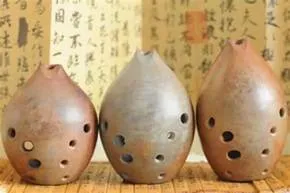

Traditional Chinese musical instruments: xūn
Name: 塤 Xūn – an ancient Chinese vessel flute and one of the oldest known musical instruments in China. Its simple shape, distinctive sound and long history give it a special place in Chinese culture.
八音 Bāyīn (the traditional Chinese classification of musical instruments by eight materials): 土 tǔ – earth.
European scientific classification of musical instruments (Hornbostel–Sachs): aerophones (wind instruments).
The xun is unique to Chinese culture and is one of the oldest musical instruments found in China.
Description of the instrument
The xūn is an ancient Chinese flute originally made from stone and bone and later from clay and ceramic. Some examples were also made from bamboo. The traditional xun is usually made of fired clay, which gives it a natural, earthy tone.
The xun is an edge-blown aerophone with a closed base, also known as a closed vessel flute. For short, we can call it a closed flute. Traditionally, it is egg-shaped with a flat base and has five finger holes in all, with at least three on the front and two on the back for the thumbs. Some modern versions have as many as ten finger holes.
We play the xun by blowing across the edge of the opening at the top, much as we would blow across the mouth of a bottle. The ocarina has a cut labium and the player blows directly into the instrument. The xun has an open mouthpiece that gives the player greater control over the airflow. On the back of the flute is an air channel, an opening that provides the airflow needed to produce sound.
There are two basic sizes of xun.
- Large xun – about the size of a goose egg, with a flat base and six holes. It produces lower notes.
- Small xun – about the size of a hen’s egg. It produces higher notes.
Types of blowing openings
The xun can have one of three types of blowing opening. Each calls for a different playing technique, so it is important to understand how they differ.
1. Round opening. This is the historical form, used on the xun for thousands of years. A perfectly symmetrical round opening is the most difficult to play. To sound every note of the scale, the player must carefully form and control the embouchure, pursing the lips precisely and directing the air across the opening. Reaching the high and low notes of the scale often requires a change in the angle of the airstream.
2. Beveled or concave opening. Its sharp edge generally makes it easier to play than a perfectly round opening. It also makes the sound more responsive to changes in the player’s embouchure. Some openings are more deeply curved than others. The angle and shape of the notch can also vary. Depending on the size and shape of the instrument, some notches are easier to play than others. The concave edge has been in use since 2013.
3. Mouthpiece with a windway (fipple type). This design appeared in the last few years. The player blows into a slot, and the instrument directs the airstream toward an edge where the air divides, producing sound. The player therefore has no need to aim the airstream at the edge of the opening with the lips. This design is characteristic of the ocarina and certain other instruments with an internal windway. It makes it easier to produce a note, although the player has somewhat less direct control over the airflow. In technical terms, this type of xun closely resembles an ocarina.
The xun is most commonly tuned to F or G, though other tunings exist.
Most modern xun have eight or ten finger holes. Versions with nine or eleven can also be found.
Sound and distinctive features of the instrument
Sometimes the simplest instrument offers the greatest scope for expression. The xun certainly fits that description. Though it is one of the more demanding folk flutes to play, its soothing sound, its history stretching back thousands of years and its many interesting variations draw us in. The simple shape of the instrument produces a captivating sound, soft and mysterious.
It is a remarkably expressive instrument, capable of conveying emotions ranging from sorrow to tranquility and joy. Its sound is often described as dark, mysterious and meditative. It suits pieces that evoke a reflective or sorrowful mood.
When playing, we hold the xun just below the lips, with its side resting against the chin. We blow across the opening at the top of the instrument, using our lips to control the direction and strength of the airstream.
This closed flute has a range of about one octave. We produce different notes and melodies by covering and uncovering the finger holes in combinations known as cross-fingering or forked fingering. The holes are arranged on the body so that we can raise or lower the pitch by changing which holes are open or closed, shaping the melody as we play. This technique also allows us to play fully chromatic scales.
The pitch of the xun’s highest note is determined by all the finger holes acting together when open. A modern eight-hole xun usually has six holes on the front and two thumb holes on the back. This arrangement allows the player to produce nine diatonic notes. The precise pitch of each note depends on the size of the blowing opening and the placement of the finger holes. The maker tunes the notes while working the clay by adjusting the size of the holes. Each instrument is unique, so no two xun have exactly the same tuning.
Playing the xun takes some skill, especially when reaching for the higher notes. One of its distinctive features is the need for precise breath control, since it has no internal windway to direct the air. Advanced techniques include shaping the airstream with the lips and producing a variety of tonal effects.
History
The xun is among China’s oldest musical instruments. Its origins date back at least 7,000 years to the Neolithic period. One origin myth links the instrument’s development to ancient hunting tools. Hunters are said to have threaded a cord through perforated stone balls called shí liúxīng (石流星). When thrown at wild animals, these tools were said to whistle as they flew through the air, a sound that may have inspired the development of early wind instruments. According to the story, the ancestors of the Chinese people adapted these tools into a musical instrument and named it the xun.
Among the earliest finds is a xun with a single blowing opening from the Neolithic site of Hemudu in Zhejiang province, where early bone flutes were also discovered. The find dates to around 5000 BCE and provides evidence of the instrument’s early use. Surviving instruments made of stone or bone, as well as later examples made of clay or ceramic, had between two and five finger holes. Some were decorated with patterns or stylized images of animals.
Archaeologists have found oval, spherical, fish-shaped and pear-shaped xun. The earliest examples had only a blowing opening or very few tone holes, so they could produce only a single note or a limited number of pitches. As the instrument developed, the pear shape gradually became its most distinctive form.
Instruments have also been found at sites dating to the Xia (c. 2070–1600 BCE) and Shang (c. 1600–1046 BCE) dynasties. Some Xia xun already had three tone holes, and a form with five appeared during the Shang period. This arrangement allowed musicians to play increasingly complex scales. Some late Shang examples could produce a complete seven-note scale as well as individual chromatic notes, indicating that musicians were already putting the instrument to sophisticated use.
During the Han dynasty (206 BCE–220 CE), the xun became a central part of traditional Chinese music. It was played at court ceremonies and in religious rites. In the 20th century, the xun underwent a revival, particularly as an instrument in its own right, and its distinctive timbre began to attract the interest of professional musicians.
The instrument and its playing techniques continue to develop today. Most modern xun have eight or ten tone holes. This design allows musicians to play chromatic scales and extends the instrument’s range to nearly two octaves in some versions. The xun is gaining recognition as a solo instrument while retaining its place in a variety of ensembles and in modern Chinese orchestras.
Related instruments
The xun and the ocarina produce sound in much the same way. Both are vessel flutes in which the air resonates inside a hollow, largely enclosed body.
- Ocarina – a vessel aerophone found throughout the world. It is often zoomorphic, shaped like a real or mythical animal important to a particular culture’s identity. In some cultures, it is also played as part of a group.
- Ipu hōkiokio (also called pu'a) is a Hawaiian nose flute traditionally associated with the performance of love poetry. It was played solo, and the performer is said to have imitated the melodic patterns of “ho’oipipo” love songs. This practice died out with the arrival of missionaries in the Hawaiian Islands in the 19th century and the profound changes in traditional Hawaiian life that followed. The instrument is rarely played today, though it is still made and sold as a symbol of ancient Hawaiian culture.
- Chigufe is a vessel aerophone of the Shona and Ndau peoples of Zimbabwe. It is made from the dried and cleaned shell of the mutamba or damba fruit. Some examples have a large blowing opening surrounded by four smaller finger holes. Similar ocarinas are found elsewhere in East Africa. Among the Chopi people of Mozambique, the instrument is called the chigowilo. It is popular with children, who play it for fun in pairs or larger groups.
Ritual and cosmological context
The xun held an important place in traditional Confucian ritual music ensembles (yayue 雅乐), which played at state ceremonies and in rites honoring the ancestors and Heaven and Earth. In the traditional system of eight materials used to produce sound (bayin 八音), the xun belongs to the clay instruments. This classification served a practical purpose and also reflected a broader Chinese cosmological understanding of materials and their relationships.
In Chinese cosmology, clay or earth (tu 土) is associated with the center and, in some cosmological systems, with the southwest and the trigram Kun (kun 坤). In the system of five phases, earth is also associated with the periods of transition between seasons. These symbolic associations formed part of various ritual and musical traditions that expressed the ideal of harmony between Heaven, Earth and humanity.
The xun has survived as part of China’s musical heritage. Today it is played both in re-creations of traditional ritual music and in contemporary compositions. Its deep, understated tone suits solo performance, chamber music and orchestral ensembles.
Alenka Zupan, member of SDT
Sources:
1. The Ultimate Guide to the Xun by Howard Fosdick © FolkFluteWorld.com. Available at https://folkfluteworld.com/article_ultimate_guide_to_the_xun/the_ultimate_guide_to_the_xun.html
2. Museum of Art. Musica and Art of China. Available at
https://www.metmuseum.org/essays/music-and-art-of-china
3. Encyclopedia Britannica. Chinese music: Classification of instruments. Available at
https://www.britannica.com/art/Chinese-music/Classification-of-instruments
4. Liang, Mingyue (1985). Music of the Billion: An Introduction to Chinese Musical Culture. New York: Heinrichshofen.
5. Grinnell College Musical Instrument Collection, Xun.
Available at https://omeka-s.grinnell.edu/s/MusicalInstruments/item/1534


