

 Articles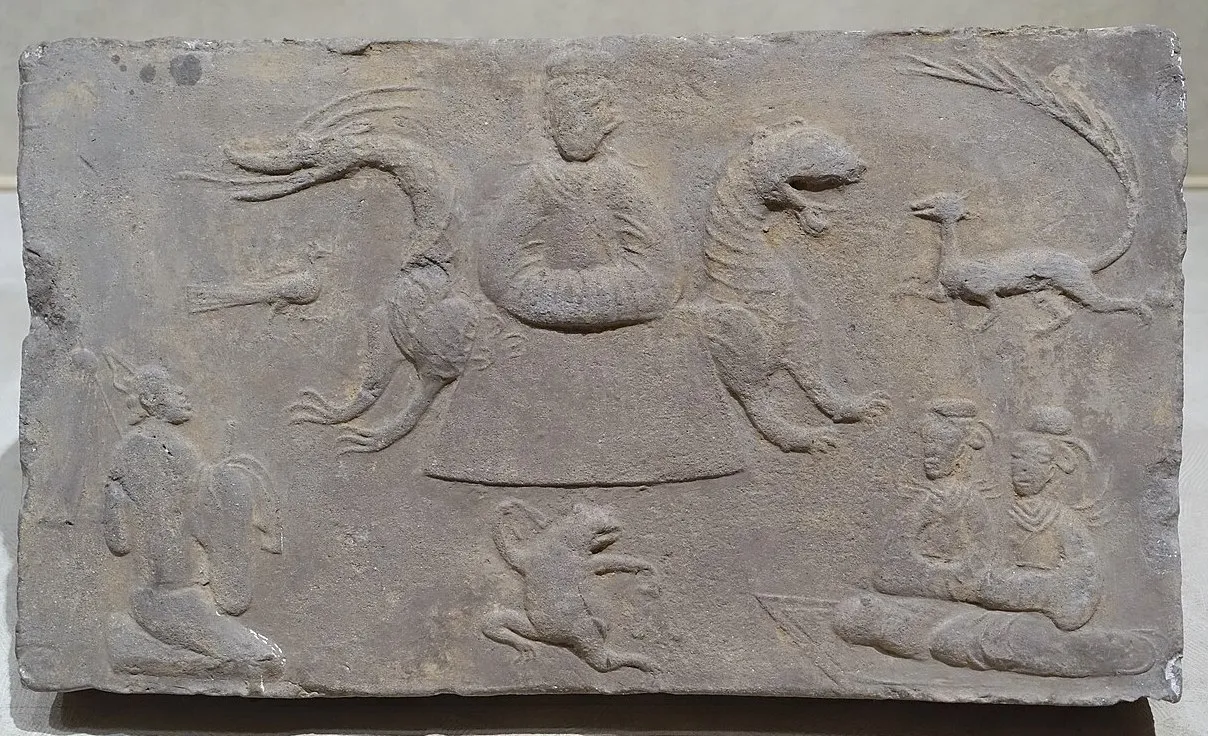
Xi Wang Mu - Queen Mother of the West
In Daoism, the woman has a special place: she is the mysterious mother, the source of all that exists and does not exist, the gateway into the manifest world and, at the same time, the way out of it. She is the fundamental principle.
This role is “embodied” by Xiwangmu (Queen Mother of the West), one of the oldest Chinese deities. Wang in her name does not mean “royalty”, but emphasizes her origin, her position as the “great
ancestress”.
She is said to have lived on the mysterious mountain Kunlun 崑崙, where an enormous tree grows, on which the peaches of immortality ripen every 3,000 years. This tree, connecting Heaven and Earth, represents the axis of the world, along which spirits and various deities descend and ascend. It touches the North Star and the Big Dipper, and represents the cradle of the world.
Throughout history, the mysterious mountain has been described in different ways: as a paradise where the four rivers of the world have their source, where immortals and various deities live; and also as a place of untamed nature, inhabited by wild and dangerous animals. The mountain is said to contain many caves, where people withdrew for self-cultivation.
The character of Xiwangmu is as enigmatic as the mysterious mountain: she rules over life and death, can cause severe illness, and can also heal it. She is the protector of women, especially at the moments when they desire and give birth to children, and at the same time she supports those who are leaving our world of phenomena.
She was often depicted as a female figure with tiger’s teeth and a leopard’s tail, expressing her primordial, untamed nature. In the mountains where she dwells (besides Kunlun, Žadasta gora and Shewushan are also named as her dwelling places), sounds are often heard: in some places described as wondrous whistling, elsewhere as an uncultivated cry, and often also as the weeping of phoenixes — called Xiao 箫 — like the sound of a bamboo flute…
Yuan Wei Heng


