

 Daoist Studies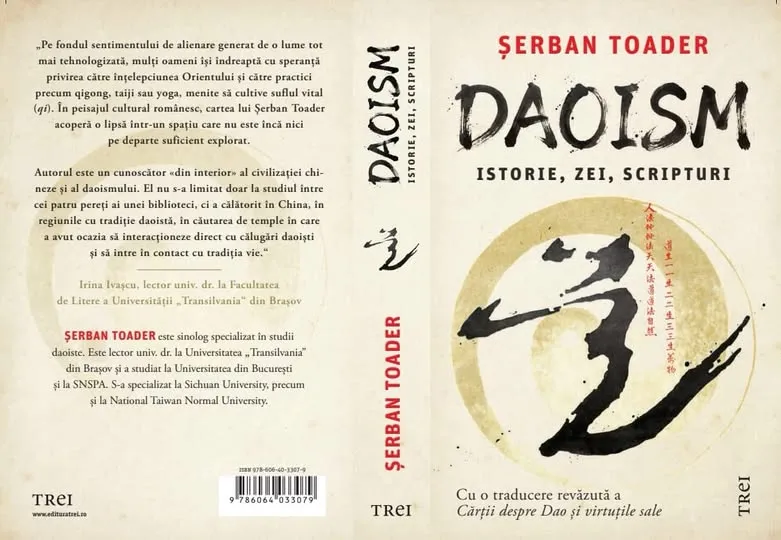
Daoism: History, deities and sacred texts
PhD. Șerban Toader (谢尔班) is a Romanian sinologist, researcher, and university lecturer. He received his doctorate in philology from the University of Bucharest in 2010, having previously completed a degree in philology and a master’s degree in cultural anthropology. From 1994 to 2007, he was a researcher at the “Sergiu Al-George” Institute for Oriental Studies in Bucharest. Today, he works as an editor for the Chinese-language service of Radio România Internațional and as a university lecturer and researcher at the Faculty of Letters of Transilvania University of Brașov.
His research focuses on Daoism, Chinese syncretic religions, spiritual communities, and Chinese language and culture. He also studies Daoist texts, inner alchemy, contemporary religious movements, and the life stories of spiritual seekers in China and the Chinese diaspora. His research has also been published in the Journal of Daoist Studies, including the articles A Romanian Spiritual Seeker’s Growth: From SciFi Readings to Neidan (2018) and A Short Tale of Louguantai (2022). In 2026, the same journal published his study Inner Alchemy in Fourteen Ideograms.
He is the author of several works on Chinese culture and religion, including the books Despre noțiunea chineză de cedare (rang) (2010) and Căutătorii Florii de Aur: Dialoguri și un studiu despre disciplinele spirituale asiatice practicate în România (2023), which is based on research into spiritual practices and communities in Romania.
In 2025, together with Prof. Livia Kohn, he co-chaired the 18th International Conference on Daoist Studies, Dao and the Dark Side: Demons, Death, and Dangers, held at Transilvania University of Brașov.
His book examines the history of Daoism, tracing the development of the Daoist religion and its institutions in close connection with social and political circumstances from the second century CE to the present day.
The history of Daoism in China reveals a broad spectrum of relationships with different forms of political authority. These relationships ranged from distance and opposition to cooperation, support, and integration into the political and social order of particular periods.
The book aims to reconsider several widespread notions about Daoism, including the idea that it is detached from social and political life, that it is individualistic, and that it is exclusively indigenous in nature.
It adopts a non-deterministic approach, understanding the history of Daoism as a dynamic process of adaptation, cooperation, and negotiation between religious communities and the wider social and political environment. The development of Daoism therefore cannot be understood separately from the historical circumstances in which individual communities and their representatives operated.
The text follows the chronological development of the Daoist religion from the second century CE onward and examines its relationship with different forms of political authority, both central and local. Particular attention is given to how Daoist communities responded to social change in different historical periods and sought their place within the wider political and cultural order.
Across the centuries, under both Chinese and foreign dynasties, the history of Daoism in China has been marked by different forms of relationship with authority. Depending on the circumstances, Daoist individuals and communities acted as critics of the existing order, cooperated with the authorities, supported particular rulers, or assumed important social and cultural roles.
On this basis, the book addresses several widespread notions and clichés about Daoism.
1. Daoism is said to have no interest in worldly affairs, including politics, but instead to encourage its followers to “go with the flow” and live “in harmony with the universe.”
The biographies of important historical figures and Daoist moral teachings present a more varied picture. Daoist leaders and practitioners were often actively involved in society and assumed a range of religious, cultural, educational, and social roles.
2. Daoism is said to be a traditional religion whose historical development can be understood primarily through the circumstances of the modern period.
A historical perspective reveals a much longer and more diverse history of the relationship between Daoism and political authority. From the formation of the first organised Daoist communities in the second century CE onward, the circumstances in which they operated changed in response to political and social conditions.
Even after the end of the imperial era, Daoism, together with other religions, underwent significant changes during the period of the Republic of China (1911–1949), and subsequently under the different political and social conditions that emerged after 1949 in the People’s Republic of China and Taiwan.
3. Daoism is said to be a “pure” Chinese religion without significant influences from other cultures.
The development of Daoism reveals a far more complex process of cultural exchange. Early Daoism adopted various beliefs and ritual practices from the wider Chinese cultural sphere, including traditions belonging to different ethnic groups. Buddhism also had a significant influence on the formation of Daoist institutions and teachings, particularly in the areas of monastic organisation, the development of the religious pantheon, and the formulation of moral codes.
Daoism can therefore be understood as an important result of a long-standing dialogue among different Chinese traditions and wider cultural influences.
4. Daoism is said to be amoral, socially individualistic, and even selfish, and to stand in opposition to Confucianism, which is oriented towards society.
The history of Daoism shows the development of highly sophisticated moral teachings and rules in which Confucian influence held an important place. Of particular significance is the concept of the “unity of the Three Teachings,” which brings together Daoism, Confucianism, and Buddhism and, during the Song dynasty (960–1279), represented an important expression of a broader tendency towards cultural and religious integration.
This history shows that the relationship among Daoism, Confucianism, and Buddhism cannot be understood solely in terms of opposition, but also as a process of mutual influence, adaptation, and dialogue.
As noted, the book adopts a non-deterministic approach. It does not understand the history of Daoism as a predetermined path, but as the result of numerous historical circumstances, social changes, and decisions made by individuals and communities.
Many Daoist thinkers, teachers, priests, and communities also played an important role in its development. Their efforts, work, and cultural contributions significantly shaped Daoism over the centuries.
Daoism is a religious and cultural tradition that, throughout its history, has engaged dynamically with other Chinese philosophical schools, folk beliefs, and religions originating outside China, particularly Buddhism. In different periods, these traditions experienced processes of competition as well as mutual influence and cooperation.
In the contemporary People’s Republic of China, Daoism is an important part of traditional Chinese culture and contemporary religious life. It also contributes to the preservation and presentation of Chinese cultural heritage and to international cultural exchange.
Despite profound historical changes, Daoism has made significant contributions to Chinese culture and society and to the wider world. Its influence extends from literature, astronomy, architecture, painting, calligraphy, and music to physical practices, body cultivation, healing traditions, and various forms of bodywork.
In the modern era, Daoist ideas have also become part of discussions about ecology, the relationship between human beings and nature, and various questions concerning our understanding of humanity and its place in the world. Both Chinese and Western scholars have developed a range of comparative and interdisciplinary approaches to the study of Daoism, including in relation to psychoanalysis, modern physics, physiology, and other fields of science.
The book thus presents Daoism as a dynamic historical, religious, and cultural tradition that has developed over the centuries in dialogue with society, political institutions, and other philosophical and religious traditions.


