Daoist Studies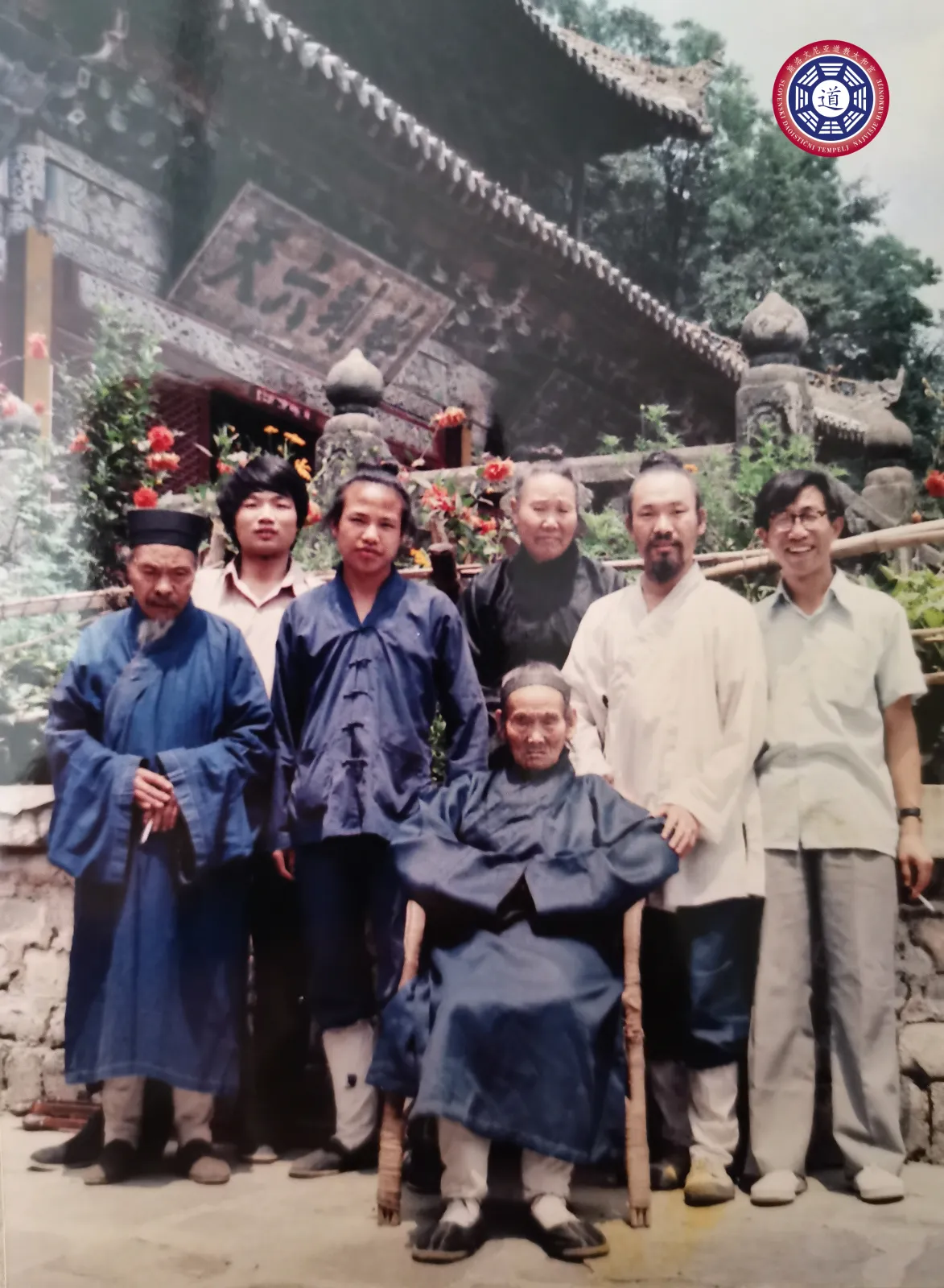
A Brief Biography of Daoist Priest Wang Jiaohua 王教化
Wang Jiaohua (26 September 1901–7 January 1989) was born into a poor farming family on the outskirts of Zhengzhou, Henan. His father died when he was eight, and his mother when he was ten. He was then cared for by his elder brother. At the age of twelve, financial hardship led Wang Jiaohua to leave home and went to work as cattle herder. Because of his family’s poverty, he never received a formal school education.
In 1920, Wang Jiaohua came to the Wudang Mountains, where he worked as a long-term hired labourer at Yuanhe Guan. In the autumn of 1926, he became seriously ill. After recovering, he resolved to enter monastic life and cultivate the Dao. He then went to Zixiao Gong and became a disciple of Daoist priest Zheng Heyu. He was entered into the lineage register of Hunyuan Zongtan, becoming a seventeenth-generation disciple of the Quanzhen Longmen school.
In the spring of 1931, the Red Army led by He Long entered the Wudang Mountains region. At the time, Daoist priest Xu Benshan headed the Wudang Daoist community and also served as Abbot of Zixiao Gong. He supported the revolutionary forces but required the Red Army to observe three rules:
Respect Daoist religious rules;
Protect cultural relics and historic sites;
Do not harm a single plant or tree in the Wudang Mountains.
The Red Army observed these rules, gradually establishing relationships of mutual trust and respect with local people and the Daoist priests of the Wudang Mountains. More than fifty Daoist priests at Zixiao Gong assisted the revolutionary army in various ways. Wang Jiaohua was assigned to nurse the sick and wounded and help treat them using traditional medicine. He was also instructed to care for the revolutionary Liu Zhixun, who at the time used the alias “Guo Fan”.
After the revolutionary forces withdrew from the Wudang Mountains region, Wang Jiaohua and the other Daoist priests remained in the mountains. Under extremely difficult conditions, they cultivated land and gathered wild vegetables to sustain themselves. Subsequently, Daoist priests who had supported the revolutionary movement were persecuted by the Kuomintang. Wang Jiaohua was severely beaten but survived; his master’s teacher, Daoist priest Xu Benshan, was eventually killed by Kuomintang forces.
When the Red Army withdrew, it gave Wang Jiaohua thirty-five silver dollars in gratitude for his help in caring for the sick and wounded and members of the revolutionary movement. After the founding of the People’s Republic of China, Wang Jiaohua handed thirty-three of them over to the state, keeping two as mementoes. He later donated these remaining two silver dollars to the Wudang Daoist Association.
After the Chinese People’s Liberation Army re-entered the Wudang Mountains region in 1949, Wang Jiaohua and others resumed Daoist activities. In 1961, he was elected the president on the second Council of the Chinese Taoist Association; in 1980, he was elected an executive member of its third Council and vice-president of the Association; and in 1986, he was again elected an executive member of its fourth Council and vice-president of the Association.
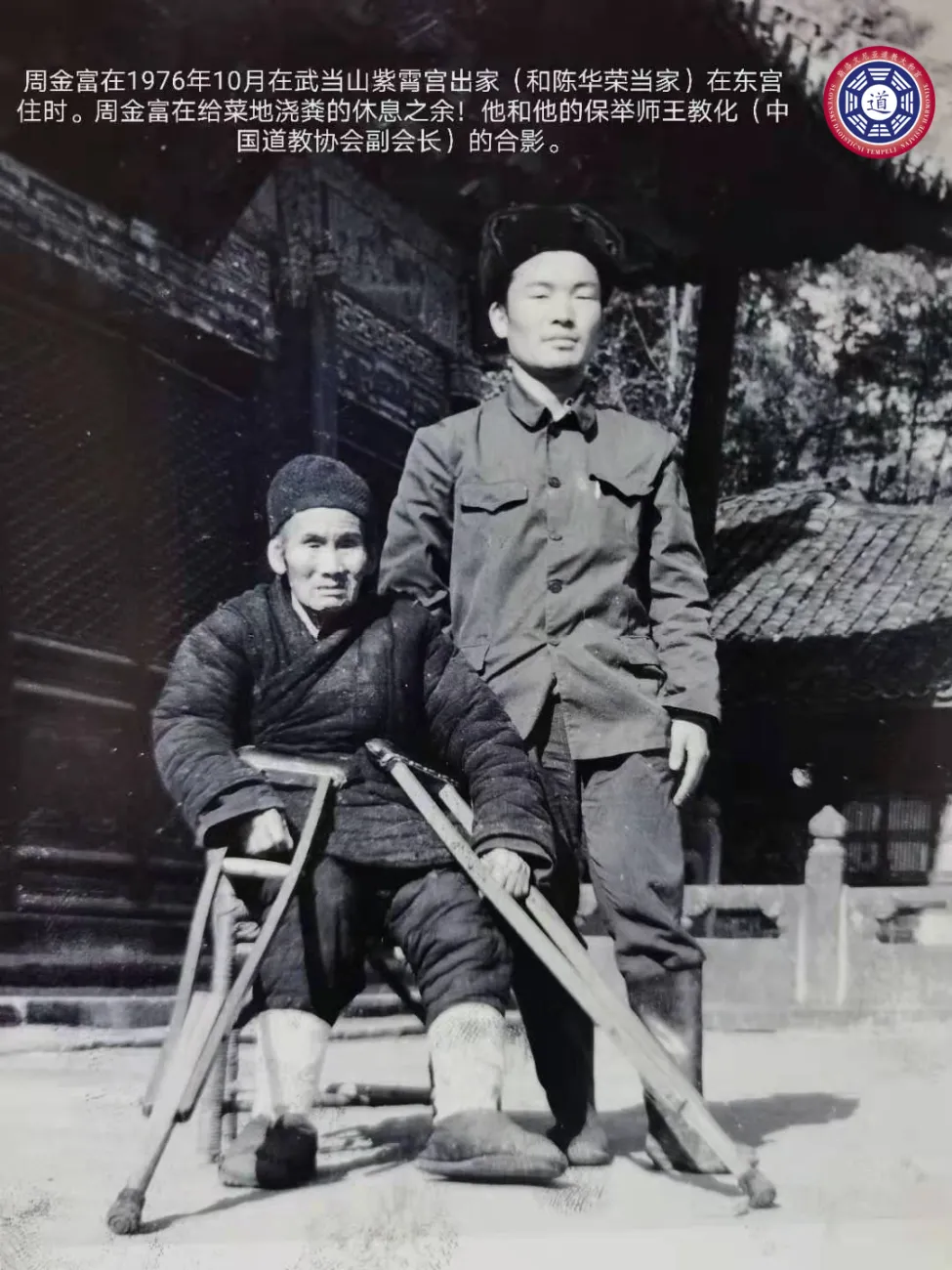
In 1977, Wang Jiaohua began instructing Zhou Jinfu (周金富) in Daoist practices. In 1981, he also began guiding Wang Guangde (王光德), a secondary school graduate, in Daoist practice. The same year Wang Guangde entered Daoist monastic life in the Wudang Mountains and later became one of the key figures in the modern revival and development of Wudang Daoism.
In 1981, Wang Jiaohua was elected vice-chairman of the Junxian Committee of the Chinese People’s Political Consultative Conference. In 1984, the Wudang Daoist Association was established, and Wang Jiaohua was elected its honorary president. In 1987, he was again elected honorary president at the Association’s second congress.
In his later years, Wang Jiaohua devoted part of his income and savings to the preservation, transmission and development of Daoism in the Wudang Mountains. From 1979 onwards, he donated the money he had saved from his living allowance to the Wudang Daoist Association to fund self-supporting enterprises. The funds were used to establish a pharmaceutical factory and restore production of the well-known traditional Wudang medicines “Zijin Ding” and “Huanglongdong Yanyao”, benefiting the wider community. Shortly before his death, he donated 6,700 RMB from his savings towards the repair of Daoist temples.
At 6:20 p.m. on 7 January 1989, Daoist priest Wang Jiaohua passed away at the age of 88.
Yuan Weiqi / 袁微琪
Expert review and image credits:
The Chinese version of this biography was reviewed and revised by Professor Yang Lizhi. Professor Yang Lizhi is a historian and researcher specialising in the history of Daoism in China and the history and culture of the Wudang Mountains. Professor Yang Lizhi is co-author, together with Wang Guangde 王光德, of the seminal work (Wǔdāng Dàojiào Shǐlüè 武当道教史略), first published in 1993. The work provides a systematic account of the historical development of Daoism on Wudangshan, the development of the worship of Xuantian Shangdi, and the history of Daoists and Daoist traditions associated with Wudangshan.
The photographs accompanying this article come from the digital archives of the Slovenian Daoist Temple of Supreme Harmony (Slovenski Daoistični Tempelj). The original photographs are held by Daoist priest Zhou Jinfu, whom we thank for allowing us to photograph the originals.