Daoist Studies
The Cross-Cultural Transmission of Daoism: Tradition, Translation and the Contemporary Value of Daoism
Introduction: Cultivating De through the Dao
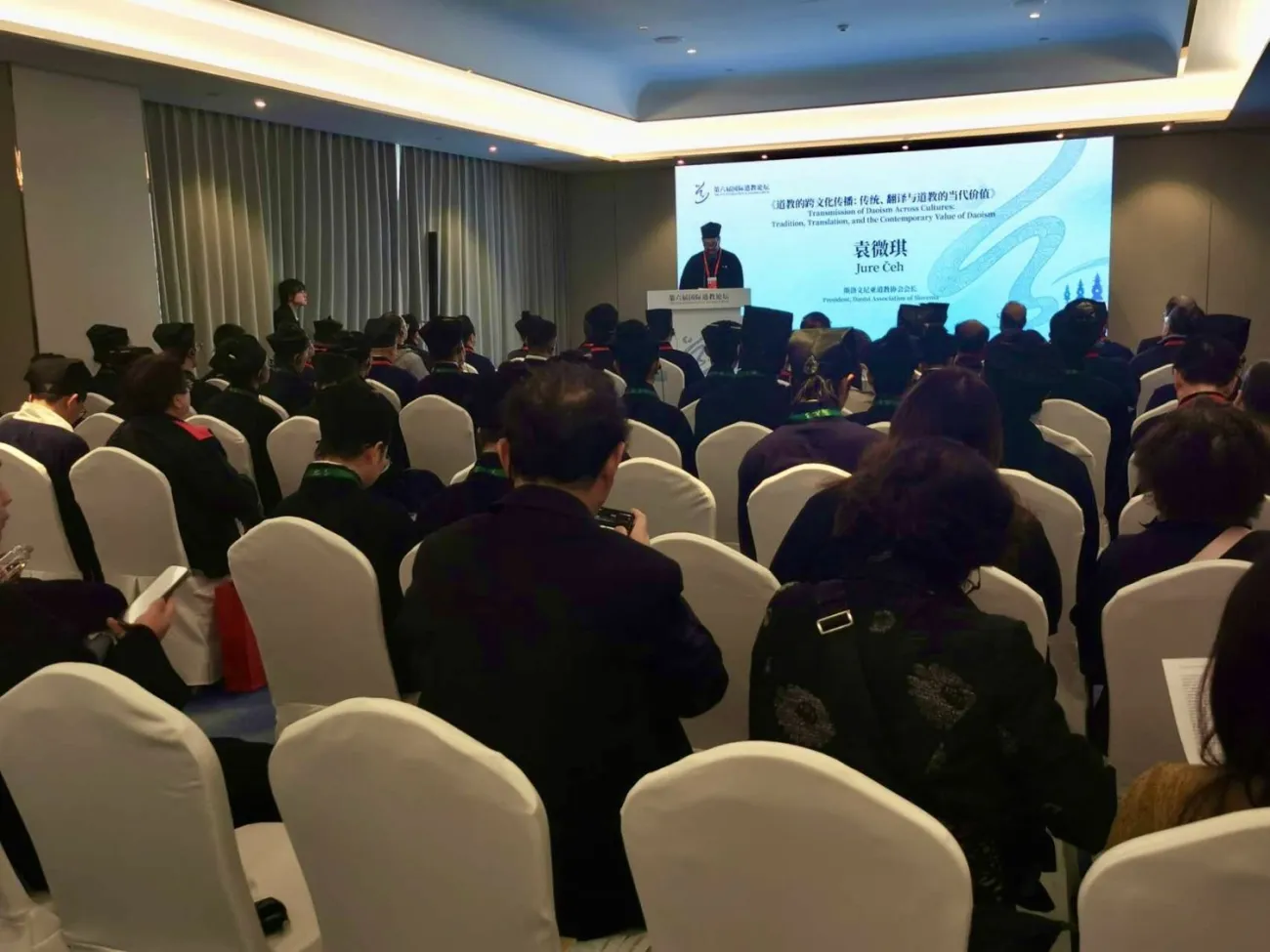
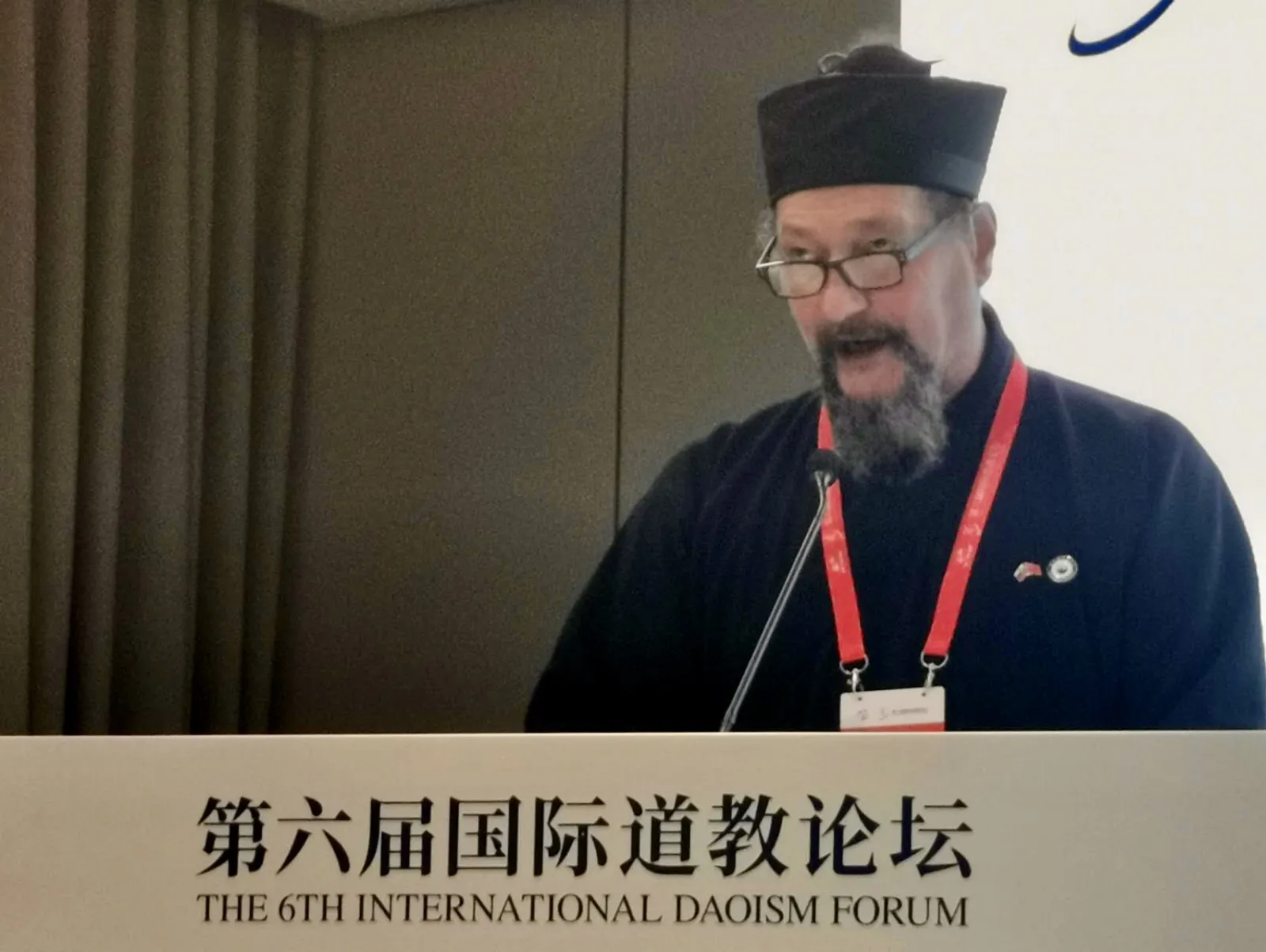
The theme of the Sixth International Daoist Forum (第六届国际道教论坛), “Cultivating De through the Dao, Bringing Harmony to the World”, contains two concepts that are especially important for understanding the contemporary transmission of Daoism: “de” and “he”, or harmony.
At first glance, the English word Virtue, or the Slovenian words Vrlina / Krepost, seem to offer a relatively familiar starting point for understanding “de”. Yet these words also present an important interpretive difficulty.
In Daoist thought, “de” cannot simply be reduced to moral virtue in the sense of an individual's ethical qualities. It is neither exclusive to human beings nor confined to conscious moral conduct. The “de” of water, for example, is not a virtue in the moral sense. What water embodies is its own distinctive “Efficacy” (inherent capacity to act): it flows, nourishes, adapts its shape to what it encounters, settles in low places, benefits things without competing, and can overcome hardness through softness.
This article therefore retains the Chinese term De (德), using primarily Efficaciousness (capacity to produce effects) as an interpretive rendering.
This is not intended to reject the customary translation of “de” as Virtue but to restore its broader semantic range, so that its original meanings are not obscured when it is understood solely in moral terms.
The Daode jing (道德经) provides an important basis for this understanding. Chapter 51 states:
“The Dao gives them life, de nourishes them, things give them form, and circumstances bring them to fulfilment.”
The Dao brings all things into being, de nourishes them, each takes its particular form, and circumstances enable them to reach fulfilment.
Here, “de” is not confined to human moral character but participates in the processes through which all things come into being, develop and receive nourishment.
“Cultivating de” can therefore also be understood as nurturing ways for human life to exist, act and exercise its capacities appropriately, in accordance with its own nature, within the overall workings of the Dao. This is especially important when Daoism enters another cultural context.
The transmission of Daoism is not merely the transfer of a set of teachings from one geographical space to another. It is also a process through which a tradition, without losing its internal coherence, finds concrete forms of expression in new linguistic, cultural, social and historical settings and becomes genuinely established within them.
The central argument of this article is therefore that the contemporary value of Daoism does not depend on whether its concepts can be reduced to established categories already familiar to modern culture. On the contrary, its value lies in retaining enough of its distinctiveness to change the questions modern people ask when seeking to understand themselves, their relationships with others, their relationship with the environment, and their own ways of acting.
The transmission of Daoism in Europe (欧洲) can thus be understood through four interrelated dimensions: tradition, translation, practice and transformation.
The practical experience of the Slovenian Daoist Temple of Supreme Harmony (斯洛文尼亚道教太和宫) offers a concrete European example of this process.
Daoism: An Ongoing Religious Tradition
Daoism is both a historical and cultural heritage and a religious tradition that continues to this day. Its historical heritage includes doctrinal classics and commentaries, temples, rituals, Daoist music, artistic traditions, bodily practices, inner cultivation, ethical teachings and institutional forms. Yet historical heritage and an ongoing tradition are not quite the same. Heritage can be preserved as an object of memory, whereas an ongoing tradition must be passed on.
If preserving Daoism means reproducing unchanged every concrete form that has existed in Chinese history, then Daoism cannot truly enter another cultural setting. But the opposite extreme is equally problematic: if each new culture can reshape Daoism at will according to its own expectations, the very concept of “tradition” loses its meaning. Between these two extremes lies the real work of transmission: maintaining the continuity of the tradition while enabling it to find new forms of expression in a new cultural setting.
The Slovenian Daoist Temple of Supreme Harmony is still young as an institutional organisation. Its origins date back to 2017, and its founding assembly was held in 2018. Yet the tradition it seeks to carry forward and embody reaches back through centuries of Daoist history. This creates a relationship marked by tension: the long history of the tradition itself on the one hand, and the youth of the institution on the other. The central question is not how to reproduce a Chinese-style Daoist temple in Slovenia (斯洛文尼亚), but rather:
What enables a Daoist community situated in a European cultural setting to retain its distinctly Daoist character?
The answer cannot be sought in any single aspect of architecture, language, ritual or doctrine. It must instead be understood through the interconnected whole formed by learning, practice, community life, ritual, cultivation, ethical conduct and transmission.
De: From Moral Virtue (Virtue) to the Efficacy of De (Efficaciousness)
The question of “de” is one of this article's central concerns. The English word Virtue and the Slovenian words Vrlina / Krepost have a long and well-founded history of use as translations of “de”. Yet these words carry particular philosophical associations that may narrow our understanding of the concept. In the history of European thought, Virtue usually refers to a praiseworthy quality possessed by a person, such as courage, justice, temperance, prudence or another form of moral excellence.
“De” in the Daoist sense has a broader meaning. It can refer to the functioning and efficacy that a particular being embodies, expresses, sustains or actually exercises in the world, in accordance with its own nature arising from the Dao. Chapter 51 of the Daode jing speaks of the “ten thousand things”, meaning all things in the world. The scope of “de” is therefore not limited to human beings. This is especially important for cross-cultural translation.
A mountain has its own distinctive way of being, and water its own characteristic way of moving and acting. A tree grows, bends, takes root, branches, blossoms and bears fruit according to its particular conditions. In the usual moral sense, none of these beings can be called “virtuous” or said to “possess virtue”; yet each displays its own distinctive way of functioning.
Water is perhaps the clearest example. Chapter 8 of the Daode jing says that water benefits all things without competing and dwells in places that others dislike, and is therefore close to the Dao. Chapter 78 observes that nothing in the world is softer or weaker than water, yet nothing surpasses it in overcoming what is hard and strong.
The point here is not that water possesses a moral virtue called “humility”, but how water naturally exercises its own capacities. Its “de” is embodied precisely in the efficacy it displays.
This also allows us to understand human cultivation differently. Cultivating “de” is not merely a matter of accumulating moral qualities. It also means cultivating one's way of acting in the world: learning how to respond appropriately to different situations, how to recognise and respect limits, how to relate to all things through nourishment rather than domination, and how to avoid unnecessary coercive action. In this sense, “de” has a direct and close relationship with “wuwei”.
De and Wuwei: Efficacy without Coercion
“Wuwei” is one of the best-known Daoist concepts, often translated as Non-action (not acting) or Non-doing (not doing). These renderings have some explanatory value, but they are incomplete.
Chapter 37 of the Daode jing states:
“The Dao always acts through wuwei, yet nothing is left undone.
The Dao always proceeds through non-coercive action, yet leaves nothing undone.”
The emphasis of “wuwei” is therefore not on doing nothing, but on a way of acting that does not depend on forceful intervention. This is particularly important when we understand “de” as a capacity to produce effects (Efficaciousness). The question then becomes:
How can we act and produce real effects without forcing things or imposing control?
Modern society often equates “effectiveness” with “control”: managing, optimising, measuring, accelerating, predicting and manipulating. Daoist thought proposes another possibility: efficacy need not depend on excessive intervention, and action need not work against the structure of a particular situation.
This is also why “de” is closely connected with the theme of this forum. “Cultivating De through the Dao” does not simply mean becoming a better person in a moral sense. It can also be understood as learning, through attunement to the Dao, to nurture and exercise the appropriate efficacy of one's own life.
This understanding opens up another dimension of the second half of the forum's theme: “Bringing Harmony to the World”. Harmony is not achieved by forcing everything into uniformity. Genuine harmony arises when different things can function according to their own characteristics while remaining interconnected.
Translating without Narrowing Meaning
The transmission of Daoism necessarily involves translation, but translation is not the same as substitution.
When “Dao” is translated as the Way it becomes more accessible, but the translation cannot encompass its full semantic range. When “de” is translated as Virtue it likewise becomes easier to understand, but risks losing some of its meaning. When “wuwei” is translated as Non-action we gain a useful approximation, but may create the mistaken impression that it means passive inactivity. When “xin” is translated as Mind, Heart or Mind-heart we introduce conceptual distinctions that do not fully correspond to the classical Chinese concept of “xin”.
The translation of “kǔ” is instructive. Rendering it as Suffering helps understanding, but may also narrow its meaning. “Kǔ” need not refer to “suffering” in an ontological or moral sense; it can also mean bitterness, hardship, and endurance or forbearance in adverse circumstances.
In early Daoist thought, especially in the thought of Laozi (老子) and Zhuangzi (庄子), experiences of bitterness, difficulty and hardship are more often understood as phenomena arising from the interaction between people, particular circumstances and specific patterns of intentionality than as a universal condition of existence. By contrast, in the soteriological frameworks of Buddhism and Christianity, “suffering” occupies a more central place within the overall structure of liberation or salvation. Early Daoist thought places greater emphasis on hardship as a situational and transitional experience. It does not necessarily understand “kǔ” as a universal condition of human existence, nor regard it as an indispensable stage in a process of salvation. Translation therefore always involves interpretation. The answer is not to abandon translation, but to translate responsibly.
One effective and relatively honest approach is to retain the original Chinese term alongside an approximate translation. This approach is becoming increasingly common. For example, 道: Dao — the Way; 德: de — efficacy, while also acknowledging the traditional rendering virtue; 无为: wuwei — non-coercive action or effortless action; 心: xin — heart-mind; 苦: kǔ — bitterness or astringency. This approach also helps make Chinese Daoist terminology more recognisable internationally. In some cases, retaining the original term is preferable to imposing a strongly interpretive translation, since a forced translation may narrow the original concept's range of meaning and impose meanings that it does not necessarily contain. Translation of this kind can preserve a productive sense of “otherness”.
Readers gain enough understanding to enter the discussion, while the Chinese concept does not disappear into a European-language concept that appears to be its exact equivalent. This is especially important as Daoism enters European contexts.
Our aim should not be to present Daoism as though everything it has always expressed coincides exactly with ideas already familiar to European philosophy, psychology, theology or contemporary wellness culture. If Daoism is ultimately explained as merely another way of expressing these existing concepts, genuine cross-cultural encounter disappears, leaving only assimilation.
Practice: Transforming Ways of Being
Daoism is not merely a tradition preserved in written texts; its vitality is expressed above all in cultivation and practice. Daoist practice involves the body, breath, mind and spirit, conduct, ritual, the environment, interpersonal relationships, Daoist communities and various forms of inner cultivation. It is therefore insufficient to understand Daoist practice solely as relaxation, breathing exercises, physical health, longevity, seated meditation or mental health. These may all have a place in the Daoist tradition, but “cultivation” has a more fundamental meaning: it involves a transformation in how a person exists and acts in the world.
This transformation does not necessarily mean continual accumulation. Sometimes, cultivation means precisely removing what prevents us from functioning appropriately. Sometimes it means becoming quieter, learning restraint, learning how to act, and learning when not to intervene rashly. For this reason, Daoist practice cannot be transmitted merely by listing methods and techniques. If a practice is detached from its intellectual, ethical, ritual and communal context, the tradition behind it may gradually disappear even if the method itself continues to circulate. Genuinely living transmission requires connections between texts and practice, transmission from master to disciple, ritual and community, and cultivation and ethical conduct.
In this context, it is worth noting that the World Federation of Daoism (世界道教联合会, WFD) recognised early on the challenges involved in spreading and transmitting the Daoist tradition across different cultural settings. The “East–West Daoist Cooperation Project (东西方道教合作项目)” emerged in response, with the aim of promoting exchange and cooperation between Daoist temples in China (中国) and Daoist communities overseas.
From China to Slovenia: A Contemporary European Example
The practical experience of the Slovenian Daoist Temple of Supreme Harmony shows concretely how such transmission can take place. Our current activities include religious and community life, education, research, lectures, workshops, Daoist music, ritual practice and cultural exchange with the public. Together, these activities create an environment in which people can learn about and practise Daoism.
One important aspect is cooperation with Daoist communities in China. In 2023, the Slovenian Daoist Temple of Supreme Harmony established friendly relations with Chongdao Gong (崇道宫) in Yichun (宜春), Jiangxi (江西), China. Since then, the two temples have continued to deepen their cooperation through education, cultural exchange, ritual practice, Daoist music and other activities. This also shows that the transmission of Daoism cannot be confined to learning about it through reading.
2026 saw two members of the Slovenian Daoist Temple of Supreme Harmony travel to Chongdao Gong for training in Daoist ritual music. The training took place within the actual religious life of a Daoist temple and combined theoretical study with practical training. The knowledge and practices acquired there were subsequently brought back to Slovenia and put to continued use. The Temple of Supreme Harmony's music ensemble continues to rehearse and to study and organise the scores and performance methods of the Quanzhen morning and evening liturgies.
This is a concrete example of transmission through embodied practice.
In this process, knowledge is conveyed through sound, memory, repeated practice, bodily participation, correction, disciplined training and interpersonal relationships. It cannot be reduced to information alone.
Another important dimension of this work takes place outside China. The Slovenian Daoist Temple of Supreme Harmony has established cooperation with two Slovenian universities: the University of Ljubljana (卢布尔雅那大学) and the University of Primorska (普利莫斯卡大学). Alongside its various practical activities, the Temple of Supreme Harmony is committed to maintaining active and sustained exchange with the academic community.
At the University of Ljubljana, for example, an international summer school on dialectical thinking was held to mark the 30th anniversary of the Department of Asian Studies at the University of Ljubljana (卢布尔雅那大学亚洲研究系). As part of the summer school's programme, the university decided to organise a visit to the Slovenian Daoist Temple of Supreme Harmony, allowing participants to encounter Daoism directly and experience its tradition.
Other forms of cooperation include an invitation from the Faculty of Education at the University of Primorska (普利莫斯卡大学教育学院) for the Temple of Supreme Harmony's music department to present its work in Daoist music and traditional Chinese music. The Faculty of Theology at the University of Ljubljana (卢布尔雅那大学神学院) also invited the Temple of Supreme Harmony to introduce Daoism to students in academic courses in religious studies.
These forms of cooperation show that spreading and transmitting Daoism in contemporary Europe involves not only preserving and practising the tradition, but also maintaining an ongoing dialogue with academic institutions and the wider intellectual and cultural community.
Harmony without Uniformity
Another important concept in the forum's theme is “he”, or harmony. “He” should not be understood as uniformity. A world in which everything becomes identical is not necessarily harmonious. Genuine harmony, in fact, presupposes difference. Different notes can form a harmony precisely because they remain distinct. Different cultural settings can likewise participate in and carry forward a shared tradition without becoming identical. This is especially important for the future development of Daoism outside China.
Daoist communities in Europe cannot simply reproduce the social conditions that developed over the course of Chinese Daoist history. This does not mean, however, that they thereby lose the authenticity of the Daoist tradition. “Authenticity” or “orthodoxy” need not mean complete identity with historical forms. It can also be expressed through preserving and continuing the fundamental relationships that constitute the tradition: between teaching and practice, masters and disciples, ritual and community, texts and active participation, and cultivation and conduct.
The task of European Daoism is therefore neither to turn itself into “China” nor to become a Western philosophy merely clothed in Daoist terminology. Its real task is to create a cultural space in Europe where the Daoist tradition can genuinely endure and continue to develop.
Transmission in the Digital Age
Contemporary Daoism is also being transmitted in a new environment: the digital world. The website of the Slovenian Daoist Temple of Supreme Harmony provides a public platform for education, research, academic publication, music, events, community affairs, and the presentation of Daoist thought and practice. The website currently offers Chinese, English, Italian and Spanish versions, allowing readers from different countries and regions to access its content.
This opens up new possibilities for cross-cultural transmission. Readers around the world can encounter Daoism and deepen their understanding of its thought and culture. Researchers can consult records of Daoist rituals and scholarly materials; musicians can listen to Daoist liturgical music; and members of other religious traditions can encounter and learn about Daoism even before entering a temple. Scholars can also use this platform to publish their research on Daoism, helping Daoist studies develop further within the wider international academic community.
Another important aspect of this work is bringing Daoism into a broader framework of academic research. The Slovenian Daoist Temple of Supreme Harmony has applied to join RESILIENCE-SI, the Slovenian national consortium of the European research infrastructure for religious studies, RESILIENCE. RESILIENCE connects research institutions, data repositories, research resources, expertise and research services, with the aim of improving access to data and materials of scholarly value for the academic study of religion.
Participation in this framework is of considerable value for Daoist studies. It can help bring Daoism more systematically into Europe's academic and research environment, while also creating opportunities to document Daoist traditions outside China, improve access to relevant research resources, and connect those resources with existing research infrastructure. If the application is approved, participation could further enrich Slovenia's academic research environment and support more systematic documentation of Daoism as a living religious tradition that continues to develop in Europe.
Digital transmission, however, also has its limits. It can convey texts, images, recordings and information, but it cannot fully transmit the relationship between master and disciple, genuinely reproduce the experience of bodily presence and participation in ritual, or replace the Daoist community itself. Digital transmission can therefore serve only as a bridge connecting people with the tradition, not as a substitute for the tradition itself.
The Garden Without an East: Encounter without Assimilation
The Garden Without an East (没有东方的花园) is one of the book projects being developed by the Slovenian Daoist Temple of Supreme Harmony. It aims to create a literary and philosophical space in which voices from different cultural and religious traditions can encounter one another. Perspectives from Daoism, Buddhism, Christianity and Islam, as well as philosophy, literature and science, come together within an open narrative space. Another important aspect of the project is that it introduces general readers to many of the world's religious and philosophical traditions in an accessible and approachable way, while placing Daoist sages within the wider landscape of human thought.
The project does not seek to claim that all traditions ultimately express the same idea. On the contrary, the encounter is meaningful precisely because their differences remain clearly visible.
Christian readers should be able to encounter Daoism without reducing it to Christianity. Muslim readers can likewise understand Daoism without confining it within established Islamic categories. Buddhist readers can recognise similarities without concluding that the two traditions are identical. Philosophical researchers can engage Daoism in conceptual dialogue without turning it into another system of Western philosophy. Sinologists can attend to Daoism's own historical and linguistic particularities. General readers, meanwhile, encounter a literary work that broadens their horizons and offers a view across the traditions of thought that have emerged throughout human history.
The project thus seeks encounter without assimilation. Its fundamental concern is to explore possibilities for harmonious and humane coexistence among different traditions. This may also be one of the most important principles for Daoism's future place in a global cultural environment.
From Academic Understanding to Lived Experience
A recent event further illustrates this approach. In September 2026, the Slovenian Daoist Temple of Supreme Harmony hosted more than 35 participants from the University of Ljubljana's International Summer School of Philosophy (国际哲学暑期学校), including scholars, doctoral researchers and postdoctoral researchers from different countries.
The visit allowed participants to build on their theoretical study of Chinese and Asian philosophy through direct contact with an actual, living religious environment. They entered the spaces of the Temple of Supreme Harmony, encountered its altars, ritual implements, library and musical instruments, and spoke directly with its members.
Academic research is indispensable. Without textual, historical, linguistic and philosophical study, Daoism can easily be misunderstood. Yet academic research alone cannot exhaust the full meaning of a tradition. The encounter between the university and the Temple of Supreme Harmony can therefore create a mutually enriching relationship: the academic community brings critical reflection and historical knowledge, while the religious community offers embodied practice and an ongoing tradition of transmission.
The Contemporary Value of Daoist Practice
Where, then, does the contemporary value of Daoism lie? It is easy to answer by listing the problems facing contemporary society for which Daoism might seem to offer a solution: ecological crisis, stress, mental health, physical health, accelerating technological development, social conflict and cross-cultural misunderstanding. These are indeed areas in which Daoist thought can engage and make a contribution.
Yet if Daoist thought is regarded merely as a set of tools for solving modern problems, we risk narrowing its value once again. Its deeper value lies in its ability to transform the way we ask questions. Rather than asking only how people should control their lives, Daoism encourages us to consider: How can we participate in processes of change that are beyond our control? Rather than treating nature as a resource to be used, Daoism draws our attention to how different beings and processes of change function according to their own characteristics within the wider order of the world. Rather than understanding cultivation as the continual accumulation of skills, Daoism encourages us to understand it as a transformation of our way of being. Rather than assuming that practical effects can be achieved only through domination and control, “wuwei” opens up another possibility: we can act and produce effects without coercion.
“De” is especially important for Daoism. The “de” of water does not lie in water being morally “good”, but in how it functions, as expressed in its distinctive ways of moving and acting. This also invites us to reconsider human cultivation: to “cultivate de” is to cultivate appropriate ways of being and acting in the world. We should therefore ask not only, “How can I become a better person?” but also, “How can I adjust my way of being and acting to make it more appropriate to the particular situations in which I participate?”
This may be one of the important reasons why Daoism remains relevant today.
Conclusion: Keeping the Tradition Alive
The cross-cultural transmission of Daoism is not merely a matter of translation history, the spread of ideas, or the establishment of Daoist communities in new cultural settings. The more fundamental question is how a tradition can remain alive after crossing its original historical and cultural boundaries. This requires translation, but translation must not erase differences. It requires adaptation to new settings, but not at the cost of distinctiveness. It requires practice, but practice must remain connected with the classics, learning, ritual, ethics and Daoist communities. It also requires dialogue, but dialogue must not depend on either side dissolving into the other.
The practical experience of the Slovenian Daoist Temple of Supreme Harmony offers one possible model for this process. Cooperation with Daoist communities in China, education, Daoist liturgical music, communal practice, research, translation, digital transmission and cross-cultural dialogue are not isolated activities. Together, they form a process through which an ancient tradition can find concrete, living forms of expression in a new cultural setting.
The theme of this forum, “Cultivating De through the Dao, Bringing Harmony to the World”, invites us to reconsider the meaning of “cultivating de” and “harmony”. From the perspective adopted in this article, “de” should not be understood solely as moral virtue; it has a more fundamental meaning. It is expressed in the way a being or phenomenon realises and exercises its own capacities, according to its particular characteristics, within the workings of the Dao.
For human beings, “cultivating de” does not mean placing ourselves morally above other beings. It means learning how to exist and act more appropriately within the larger processes in which we already participate. This also changes our understanding of “harmony”. Harmony does not require sameness; it consists in establishing appropriate relationships.
Different beings, cultures, traditions and ways of understanding can all participate in a wider network of relationships while retaining their differences. For Daoism, this may be one of the most important contributions it can make to the contemporary world.
The Dao is not merely an object that can be transmitted; it is also a path that guides us in learning how to live. “De” is not simply moral virtue, but the way the Dao manifests in concrete forms of existence and enables each to fulfil its own nature. “Harmony” is not uniformity, but the possibility of different things coexisting in relationship with one another. A tradition remains alive not because it never changes, but because it can maintain its inner continuity through change.
The cross-cultural transmission of Daoism is therefore not simply a matter of rendering a word from one language into another. It means creating the conditions in which the Dao can once again become embodied in an actual way of life. Perhaps this is where the contemporary value of Daoism lies: not in Daoism needing to become more “modern”, but in the possibility that a genuine encounter with Daoism might lead the modern world to think anew and become less certain that it already knows how human beings ought to exist.
References
老子: 《道德经》, see especially Chapters 8, 37, 51 and 78. 中国哲学书电子化计划.
王弼: 《道德真经注》.
Livia Kohn: 《道教:当代哲学研究》, Routledge, 2020.
Livia Kohn: 《道教身体修炼》, Three Pines Press, 2005.
Louis Komjathy: 《道教传统:导论》, Bloomsbury Academic, 2013.
Fabrizio Pregadio (ed.): 《道教百科全书》, Routledge, 2008.
Isabelle Robinet: 《道教:一种宗教的形成与发展》, Stanford University Press, 1997.
斯洛文尼亚道教太和宫 website: 我们的活动.
斯洛文尼亚道教太和宫 website: 太和宫成员首次赴崇道宫开展道教音乐培训.
斯洛文尼亚道教太和宫 website: 从理论到活态实践:国际哲学暑期学校参与者来访.
斯洛文尼亚道教太和宫 website: 没有东方的花园.
Yuan Weiqi (袁微琪) (Jure Čeh)
Rector of the Slovenian Daoist Temple (斯洛文尼亚道教协会)