

 Daoist Studies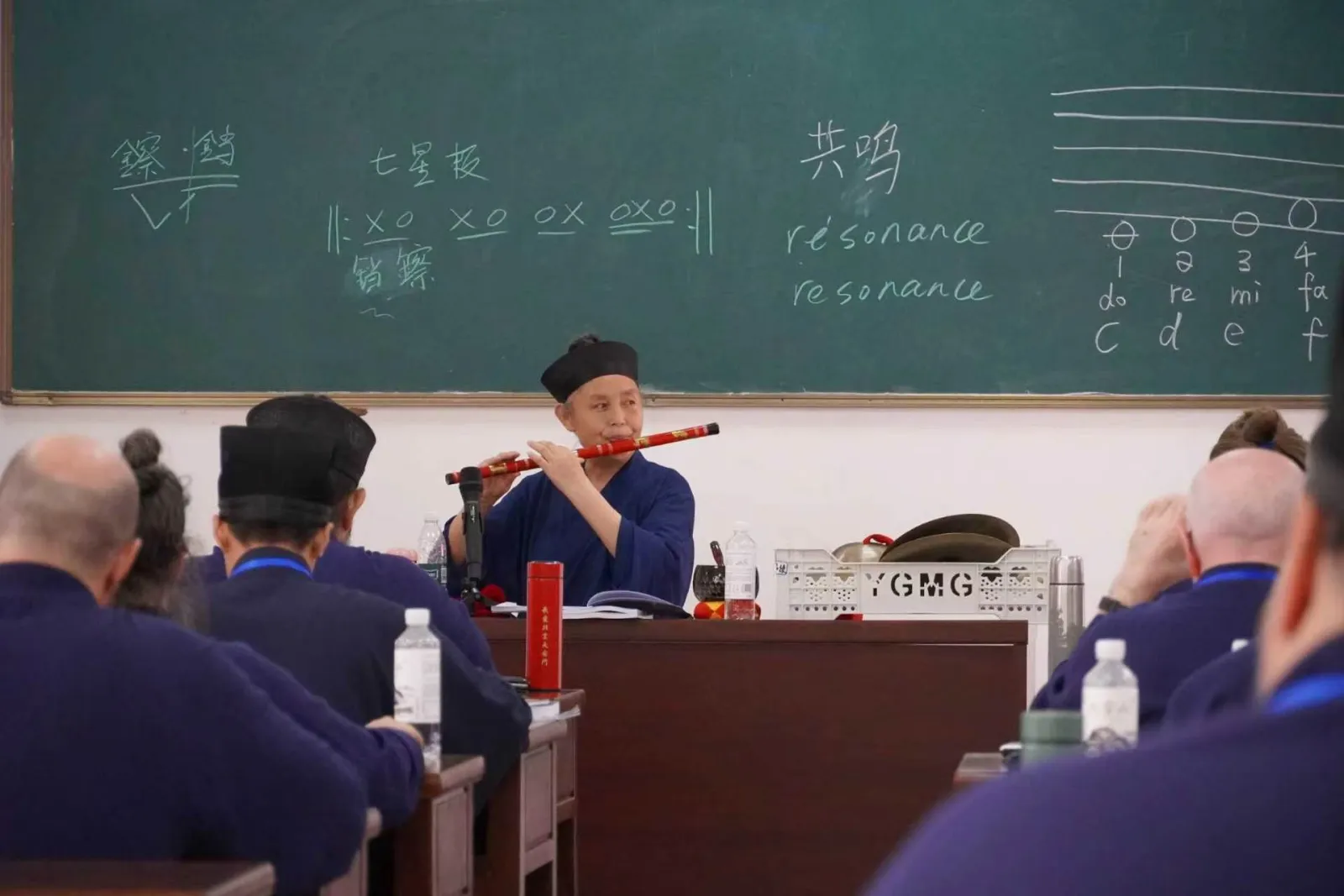
Daoist Ritual Music, Chanting, and Zhaijiao Practice: An Interview with Master Wu Junli (伍俊丽道长)
The following (research) interview offers an in-depth insight into contemporary Daoist liturgical practice from the perspective of an expert in Daoist ritual music, Prof. Wu Junli (Wu Junli Daozhang). The Master has made significant contributions to the preservation of Daoist music from the Wudang Mountains and the promotion of Daoist culture worldwide. She frequently travels to Singapore, Malaysia, Taiwan (China), Hong Kong (China), and other regions to spread Daoist culture, earning deep respect from her peers.
In addition to presenting the living tradition of liturgical music from the Wudang Mountains and the Quanzhen school, Master Junli addresses issues of ritual transmission, musical structure, liturgical terminology, and the functions of Daoist chanting. The interview was conducted during this year’s Second International Seminar on Daoist Culture. At the end of the interview you can find Terminological Glossary of Key Daoist Terms
Question: What are the differences between the Quanzhen and Zhengyi traditions in terms of ritual (keyi 科仪), liturgical music, and chanting?
Answer: Although the Quanzhen and Zhengyi traditions share a common historical origin, both preserve the fundamental forms of Daoist liturgical performance, including fengsong (讽诵), yinchang (吟唱), zanyun (赞韵), and buxu (步虚). Their principal differences arise from their respective orientations: Quanzhen places greater emphasis on inner cultivation (neixiu 内修), whereas Zhengyi primarily focuses on zhaijiao (斋醮) rituals and the transmission of fulu (符箓). Consequently, the two traditions have developed distinct systems of melodic formulae, vocal styles, and regional instrumental practices, although the liturgical functions of their ritual music remain broadly comparable.
Question: To which of the groups does Wudangshan core scripture-rhyme belong?
Answer: It belongs to the Quanzhen tradition. The chanting tradition of Quanzhen is known as the Quanzhen Zhengyun (全真正韵), also referred to as the Shifang Yun (十方韵). It is the most widely shared liturgical chant tradition within Daoism, and its melodic repertoire is commonly used in Quanzhen monasteries throughout China.
At the same time, many regions have developed their own local chant traditions, including the Northeastern style (Dongbei yun 东北韵), the Laoshan style (Laoshan yun 崂山韵), the Zhejiang style (Zhejiang yun 浙江韵), and the Wudang style (Wudang yun 武当韵). Although these traditions are also known throughout China, they are referred to as "local chant traditions" because they retain strong regional characteristics, often incorporating elements of local folk songs, operatic melodies, and other indigenous musical forms. In this respect, they differ from the more standardized Quanzhen chant tradition.
The Wudang chant tradition (Wudang yun 武当韵) has a particularly distinctive history. During the Ming dynasty, Wudangshan received exceptional imperial patronage. Eminent Daoist masters from across the country were invited to the mountain to perform state rituals, praying for the prosperity of the nation, peace among the people, favourable weather, abundant harvests, and harmony throughout the realm. As a result, Wudangshan brought together the finest ritual traditions from many Daoist lineages and gradually developed its own distinctive system of ritual transmission, one that is rooted in the Quanzhen tradition yet not entirely identical to it.
The structural classification of these chant traditions distinguishes between yangyun (阳韵) and yinyun (阴韵). Yangyun is employed in rituals of blessing (qifu 祈福), audience with the deities (chaoshen 朝神), and the morning and evening liturgical offices (zaowan ke 早晚课). Yinyun, by contrast, is used in rites dedicated to the deceased, including memorial offerings (jianwang 荐亡) and the ritual of salvation and refinement (liandu 炼度).
The vocal repertoire is further divided into several categories, including dayun (大韵), xiaoyun (小韵), chanhui yun (忏悔韵), and songjing yun (诵经韵), each serving distinct liturgical functions.
Traditionally, these chant traditions were transmitted directly from master to disciple and were not subject to arbitrary modification, thereby preserving the musical character of the ancient imperial court tradition. In response to the needs of the present era and the growing number of Daoist practitioners, Daoist associations now also organise formal training programmes for gaogong (高功) priests, ensuring the continued transmission of the tradition while responding to contemporary circumstances.
The Zhengyi tradition exhibits even stronger regional diversity, as reflected in the saying: "Within three li, the Dao differs; among ten melodies, nine are different" (有三里不同道,十曲九不同). In other words, each region has developed its own distinctive chant tradition. Examples include the Shangqing yun (上清韵) of Longhushan, the Gusu yun (姑苏韵) of Suzhou, and the Lingbao yun (灵宝韵) of the Jiangnan region (Jiangsu and Zhejiang).
These regional traditions have evolved by incorporating elements of local folk music, regional opera, percussion traditions, and the characteristic melodic styles of Jiangnan sizhu (江南丝竹), integrating them into such liturgical forms as buxu (步虚) and changzan (唱赞). Consequently, considerable melodic variation exists among the ritual chant traditions transmitted in different parts of China.
Question: How do the two traditions differ in their vocal style and melodic delivery?
Answer: Quanzhen liturgical chanting is characterised by a serene, austere, and contemplative aesthetic. Its musical style tends toward the tranquil elegance traditionally associated with "celestial music" (xianyue jingyun 仙乐静韵). The melodies generally avoid dramatic contrasts, favouring instead long, flowing melodic lines, sustained vocal phrases, and a slow, measured tempo.
The Wudang chant tradition (Wudang yun 武当韵) may broadly be divided into two complementary stylistic categories. One is distinguished by an overall musical character that is tranquil, archaic, solemn, and refined. The other is more resonant and expressive, combining grandeur with elegance while conveying an ethereal and transcendent atmosphere. In liturgical performance, particular emphasis is placed on vocal production supported by dantian (丹田) breathing.
During the Ming dynasty, Wudangshan served as an imperial Daoist sanctuary under the direct patronage of the imperial court. Court musicians and ritual performers were dispatched to the mountain, introducing elements of imperial ceremonial music into the local liturgical tradition. As a result, the melodies acquired a highly ordered structure, remarkable breadth, and an unmistakable sense of ritual dignity.
Situated at the geographical crossroads of northern and southern China, Wudangshan also became a meeting place of diverse musical traditions. From the Jiangnan region, it absorbed graceful, delicate melodic styles characterised by smooth conjunct motion, while from the Qin, Yu, Chuan, and Shaan regions it adopted a more vigorous and majestic musical expression, occasionally featuring wider intervallic leaps of a fourth or fifth. This synthesis of gentleness and strength was further enriched by the folk music of the Ba-Chu cultural region, incorporating elements of northwestern Hubei mountain songs, local folk tunes, and traditional narrative performance, thereby giving the Wudang chant tradition a distinctive regional character.
Characteristics of the integration of the two traditions
The Wudang liturgical music tradition embodies a distinctive synthesis of the Quanzhen and Zhengyi lineages, whose musical repertoires have long been performed and transmitted alongside one another. It preserves the serene, profound, and restrained character of Quanzhen liturgical music while at the same time incorporating the rich sonority, ornate style, and strong ritual expressiveness characteristic of Zhengyi liturgical music. Through this process, Wudangshan has developed a unique and distinctive system of ritual melodies (Wudang yun 武当韵).
The ritual follows a highly regular rhythmic structure based on the relatively fixed Qixing ban (七星板) percussion pattern. The ritual movements of buxu (步虚), including the circumambulation of the altar together with the prescribed kneeling and prostrations, are carefully synchronized with the liturgical cadence, while changes in tempo follow the natural flow of the chant.
The various modes of liturgical recitation are also clearly distinguished. These include sannian (散念), consisting of straightforward recitation of the scriptures; yinsong (吟诵), an intoned style of recitation with subtle melodic inflection used, for example, for ritual proclamations (gao 诰); and yongchang (咏唱), fully developed melodic chanting employed in liturgical forms such as zan (赞) and buxu (步虚).
Zhengyi Liturgical Chanting
Zhengyi liturgical chanting is characterised by a vibrant, ornate, and highly expressive musical style, featuring pronounced contrasts and dramatic melodic contours. It is particularly well suited to large-scale outdoor zhaijiao (斋醮) rituals, ceremonies for the salvation of the deceased (chaodu 超度), rites for blessings (qifu 祈福), offerings of thanksgiving to the deities (choushen 酬神), and community ceremonies associated with weddings, funerals, and other major life events.
Its musical style is distinguished by energetic percussion accompanying more measured vocal delivery, abundant ornamental embellishment, frequent melodic variation, and a wide melodic range. Strong emotional contrasts—between solemnity, exaltation, and joyful celebration—form an integral part of its expressive character.
The rhythmic structure is highly flexible. During ritual performance, the gaogong (高功) priest may freely adjust the tempo, introduce improvised instrumental interludes, and coordinate the music with ritual actions such as tagang budou (踏罡步斗), submitting memorials to the heavens (shangbiao 上表), burning talismans (fenfu 焚符), and summoning the celestial generals (zhaojiang 召将).
Liturgical chanting is also commonly performed in regional dialects. Local vernaculars—including Southern Min (Minnan 闽语), Cantonese (Yue 粤语), and others—are frequently employed, allowing the liturgy to resonate more naturally with the linguistic and auditory traditions of local communities.
Question: How are the accompanying instruments arranged in the morning and evening liturgical offices (zaowan gongke 早晚功课), and how do their instrumental ensembles differ?
Answer: Quanzhen tradition
The core instrumental ensemble consists primarily of ritual instruments (faqi 法器), especially percussion instruments used to regulate the liturgical performance. These include the yinqing (引磬, a small ritual chime used to guide the chanting), muyu (木鱼, the wooden percussion block), zhong (钟, ritual bell), qing (磬, ritual chime), gu (鼓, drum), dang (铛), cha (镲), nao (铙), and bo (钹). Melodic accompaniment may include wind instruments such as the sheng (笙), dizi (笛), and xiao (箫), as well as string instruments including the erhu (二胡), guzheng (古筝), and yangqin (扬琴). The overall instrumental arrangement emphasises solemnity, serenity, and refined elegance. Within the ensemble, the ritual instruments (faqi 法器) establish the rhythmic framework and regulate the tempo, while the wind and string instruments provide subtle melodic support. Their role is to enrich the liturgical atmosphere without overpowering the vocal chanting, which remains the central element of the ritual performance.
Zhengyi Tradition (chuida dayue (吹打大乐) ensemble style, with regional folk musical influences)
The Zhengyi tradition is characterised by a rich percussion ensemble, including large drums, large gongs, naobo (铙钹), cymbals (cha 镲), yunluo (云锣), and a complete set of ritual percussion instruments.
Its instrumental configuration incorporates wind, bowed, and plucked instruments. The suona (唢呐), serving as the leading instrument, is often used for creating a lively and powerful opening atmosphere. Other instruments include the dizi (笛子), erhu (二胡), sanxian (三弦), pipa (琵琶), and yueqin (月琴), forming a complete ensemble characteristic of regional folk wind-and-percussion traditions (chuida 吹打).
In terms of ritual performance settings, a distinction is made between the intimate instrumental ensemble of the inner altar (neitan 内坛) and the large outdoor wind-and-percussion ensemble of the outer altar (waitan 外坛). During ritual activities, including the opening of ceremonies, processions through the streets, and rites involving the summoning of deities or the release of souls from the underworld (po yu 破狱), the powerful sound of suona and percussion instruments is frequently used to create a solemn and impressive ritual atmosphere.
Question: What are the ritual contexts in which these instruments are used, and what musical functions do they serve within Daoist keyi (科仪) ceremonies?
Answer: Quanzhen tradition
The Quanzhen tradition is centred on inner cultivation (neixiu 内修) within resident monastic communities (changzhu gongguan 常住宫观). Its ritual activities primarily include the morning and evening liturgical offices (zaowan gongke 早晚功课), seated meditation (dazuo 打坐), daily scripture recitation, small-scale blessing rituals (qifu 祈福), rites of releasing hungry spirits (fang yankou 放焰口), and rites of salvation and refinement (liandu 炼度). Large-scale jiao rituals (jiao 醮) are comparatively less frequent.
The musical function is primarily to support inner stillness, the cultivation of vital energy (qi 气), and the refinement of one's inner nature (xinxing 心性). In this context, chanting itself is regarded as a form of cultivation. The role of entertainment and popular folk performance is therefore relatively limited. Ritual spaces are generally established within the main halls of the monastery.
Zhengyi tradition
The Zhengyi tradition is primarily oriented toward providing external ritual services (waidan zhaijiao 外坛斋醮) for the wider community. Its ritual activities include large-scale Luotian dajiao (罗天大醮) ceremonies, rites for the salvation of deceased spirits (chaodu 超度), rituals for calming spirits and protecting households (anshen zhenzhai 安神镇宅), rites for attracting prosperity and averting calamities (qiucai rangzai 求财禳灾), Daoist ritual services associated with weddings and funerals, and public processional ceremonies (youjie xingtan 游街行坛).
The musical function of Zhengyi ritual music is to enhance the dramatic and expressive dimension of the ceremony, facilitate communication between humans and deities, and strengthen the ritual atmosphere and emotional intensity. At the same time, it retains an important dimension of popular and communal performance.
The inner and outer ritual spaces are clearly distinguished. The outer altar (waitan 外坛) is characterised by a more expansive and dynamic atmosphere, with larger-scale musical ensembles and public visibility, making it particularly suitable for participation and observation by the surrounding community.
Question: What is the ultimate purpose of the morning and evening liturgical practice (zaowan gongke 早晚功课)?
Answer: Evening Liturgical Office (wan tan gongke 晚坛功课, performed during the you hour 酉时, 5–7 PM): Core Functions
The evening office is primarily associated with yin (阴). Its main characteristics are repentance and self-reflection, the salvation of beings in the unseen realms (youming 幽冥), the resolution of accumulated grievances (yuanye 冤业), and the gathering and restoration of the mind after the activities of the day. In this way, it complements the morning office, which focuses on prayers for blessings and auspicious harmony.
I. Internal Cultivation: Self-reflection, Repentance, Gathering the Mind, and Nourishing Qi (duinei xiuxing 对内修行) (Fundamental Function)
- The evening office centres on scriptures such as the Scripture of Relieving Suffering and Removing Faults (Jiuku bazui miaojing 救苦拔罪妙经) and the Scripture of Resolving Grievances and Removing Faults (Jieyuan bazui miaojing 解冤拔罪妙经). Through these recitations, practitioners review their words, actions, and arising intentions throughout the day, reflecting on faults in speech, conduct, and inner disposition. By acknowledging and correcting these imbalances of body, intention, and speech, they gradually dissolve accumulated habitual patterns and restore inner harmony.
- Conserving Yang Qi, Calming the Spirit, and Returning to the Origin (lian cang yangqi, anshen gui yuan 敛藏阳气、安神归元):As evening approaches, yang qi gradually declines while yin qi begins to increase. Through scripture recitation and the regulation of breath, practitioners harmonize their breathing, gather the scattered spirit (xinshen 心神), calm restlessness and fatigue, and bring essence, qi, and spirit (jing, qi, shen 精气神) into harmony. Through quiet nourishment of primordial harmony (yuanhe 元和), the spirit is stabilized, supporting restful sleep and preventing distracting thoughts from disturbing the dreams.
- Strengthening the Dao-heart and Advancing in Cultivation (hangshi daoxin, jingjin xiuxing 夯实道心,精进修行): Through daily recitation of scriptures and reverence toward the sacred and perfected beings (shengzhen 圣真), practitioners strengthen the Dao-heart (daoxin 道心) and prevent laxity in cultivation. Through contemplating the profound principles of the Dao (xuanli 玄理), they gradually transform habitual tendencies of desire and agitation. Long-term dedication to recitation, accumulated practice, and the cultivation of virtuous conduct form an essential foundation (zhuji 筑基) of daily Daoist cultivation.
II. Venerating the Deities and Paying Homage to the Perfected (jing shen chao zhen 敬神朝真): Expressing Gratitude to the Sacred Perfected and Safeguarding the Daoist Sacred Space.
Practitioners offer incense and pay reverential homage to Taiyi Jiuku Tianzun (太乙救苦天尊, the Heavenly Worthy Who Relieves Suffering), Doumu (斗姆, the Mother of the Northern Dipper), the Three Officials (Sanguan 三官), and other Sacred Perfected (shengzhen 圣真). In doing so, they express gratitude for the protection and guidance bestowed by the celestial deities throughout the day, ritually purify the altar, and pray that the deities continue to safeguard the temple (gongguan 宫观), preventing inauspicious influences from entering the sacred precincts.
III. Guiding the Beings of the Hidden Realms (chaodu youming 超度幽冥): Elevating the Souls of the Departed and Extending Universal Compassion to the Solitary and Afflicted (The Most Distinctive Feature of the Evening Office)
- Reciting the Scripture of Taiyi for the Relief of Bitterness (Taiyi Jiuku Jing 太乙救苦经), the Scripture of Ascending to Heaven and Attaining the Dao (Shengtian Dedao Jing 升天得道经), and the Wondrous Scripture of Resolving Grievances and Removing Faults (Jieyuan Bazui Miaojing 解冤拔罪妙经), practitioners guide the beings of the Nine Hidden Realms, the ten categories of solitary spirits, and the departed without descendants, so that, upon hearing the scriptures, they awaken, leave behind states of bitterness, and continue their journey toward renewed harmony with the Dao.
- The liturgy also seeks to resolve enduring grievances and unfulfilled obligations carried across generations, resolving grievances and untying long-standing knots, while ritually guiding departed members of one's ancestral lineage toward renewed harmony with the Dao.
- At the conclusion of the liturgy, offerings of food are ritually presented to solitary spirits (jigu shishi 祭孤施食), extending sustenance to the solitary departed and wandering spirits in the surrounding area. In this way, practitioners cultivate harmonious relationships (shan yuan 善缘), fostering concord and mutual benefit between the realms of yin and yang.
IV. Seeking Blessings and Averting Misfortunes (qifu rang’e 祈福禳厄): Resolving Calamities, Releasing Grievances, and Restoring Harmony
Beyond the ritual of repentance and the purification of past faults, the liturgy serves to resolve disputes and entangled relationships affecting oneself and one's family, release long-standing grievances and unresolved obligations from previous generations, dispel calamities and obstructions, and restore harmony to one's life. At the same time, the cultivated harmony is extended toward the peace and prosperity of the state and toward the well-being and smooth circumstances of all virtuous practitioners in the ten directions.
V. Transmission of the Daoist Cultural and Ritual Lineage (wenmai 文脉): Continuing the Lineage of Transmission (famai 法脉) and Honoring the Ancestral Masters (zushi 祖师)
Practitioners pay homage to the Sacred Declarations (baogao 宝诰) of the ancestral masters of the various Daoist traditions, commit ritual texts and scriptures to memory, preserve and continue the teachings of the Daoist tradition, honor the virtue and contributions of successive generations of ancestral masters, and sustain the continuity of the Daoist transmission lineage.
VI. Temple Community Regulations (conglin 丛林规制): Regulating Daily Discipline and Upholding the Daoist Ethos
The resident Daoist community (daozhong 道众) gathers together in the ritual hall, following a unified schedule and liturgical routine. These regulations organize the daily life of the Daoist community, strengthen communal cohesion, establish proper ritual conduct, and embody the disciplined atmosphere of cultivation within the temple.
The Main Purposes of the Daoist Morning Liturgy (zaoke 早课)
The Morning Office (zaoke 早课) is generally performed during the Mao period (5:00–7:00 a.m.). It is an essential daily liturgical practice for Daoist practitioners of both the Quanzhen and Zhengyi traditions in Daoist temples. Its fundamental purpose is to cultivate oneself through daily practice and to cultivate the Dao within oneself. Its functions may be divided into six principal categories:
I. Internal Cultivation: Refining the Self and Nurturing One’s Inner Nature (xinxing 心性) (Fundamental Function)
- Clearing away scattered thoughts and gathering the body and mind: At the beginning of the service, practitioners recite the Eight Great Divine Incantations (bashenzhou 八大神咒), including the Purifying Heart Incantation (Jingxin zhou 净心咒), the Purifying Mouth Incantation (Jingkou zhou 净口咒), and the Purifying Body Incantation (Jingshen zhou 净身咒). These incantations cleanse scattered thoughts arising in mind, speech, and bodily conduct, dispel the multitude of thoughts emerging at the beginning of the day, and gather and stabilize the spirit (xinshen 心神).
- Preserving Original Harmony and Nourishing Yang Qi: As Yang Qi begins to arise in the early morning, practitioners recite scriptures and regulate the breath, harmonizing essence, qi, and spirit (jingqi shen 精气神), facilitating the circulation of qi and blood, and supporting the cultivation of life and the regulation of breath.
- Comprehending the principles of the Dao and strengthening the foundation of cultivation: By reciting essential scriptures such as the Scripture of Clarity and Tranquility (Qingjing Jing 清静经) and the Wondrous Scripture of the Jade Emperor’s Heart Seal (Yuhuang Xin Yin Miaojing 玉皇心印妙经), practitioners cultivate daily insight into the Great Dao, come to understand their original heart and inherent nature (benxin benxing 本心本性), and establish the foundation of their daily practice (zhuji 筑基). As stated in the Preface to the Ritual Scriptures (Gongke Jing Xu 功课经序): “Reciting the immortal scriptures is the pathway to cultivating the Dao of immortality.”
- Strengthening the Dao-heart and Regulating Words and Conduct: Through daily reverence for the divine beings and recitation of scriptures, practitioners are reminded of their precepts and proper responsibilities, cultivate themselves by removing habitual patterns of greed, anger, and deluded attachment, and through long-term perseverance accumulate cultivated virtue and virtuous actions, thereby preventing negligence in cultivation.
II. Reverence for the Divine: Paying Homage to the Perfected and the Sacred, and Establishing Resonance with the Divine
- Practitioners burn incense and pay homage to the Three Pure Ones, the Jade Emperor, and the various celestial Perfected Beings, expressing gratitude for the blessings and protection bestowed by the divine beings, and manifesting a sincere heart of reverence and commitment to the Daoist path.
- The ritual space is purified and consecrated, the daily incense offering is initiated, and through ritual invocation the divine beings are drawn to the altar to preside over and protect the Daoist temple and ritual space.
III. Seeking Blessings and Dispelling Calamities: Welcoming Auspiciousness, Receiving Divine Grace, and Extending Life (The Morning Practice Primarily Focuses on Blessings in This Present Life)
The Morning Ritual emphasizes prayers for blessings in this present world. It invokes peace and prosperity for the nation, harmonious weather with favorable winds and timely rains, and auspicious fortune for all devotees throughout the ten directions. Practitioners further pray for personal and familial safety and health, the elimination of calamities, the transformation of adverse circumstances, longevity, and the accumulation of blessings.
IV. Governance of the Daoist Community: Upholding Traditional Regulations and Preserving the Daoist Ethos
All resident Daoist priests gather together in the temple hall for scripture recitation. This practice forms part of the traditional Daoist monastic management system, regulating daily routines, strengthening the cohesion of the Daoist community, and embodying the disciplined spiritual ethos of the temple. It also represents a daily expression of the ordained Daoist practitioner’s identity and commitment to cultivation.
V. Lineage Transmission: Continuing the Daoist Cultural and Ritual Heritage
Through the daily recitation of Sacred Declarations (baogao 宝诰), incantations (zhouyu 咒语), and scriptures (jingwen 经文), practitioners become familiar with Daoist ritual protocols, sacred names and titles, and teachings. In this way, the Daoist system of cultivation and ritual transmission is preserved and passed down from generation to generation; practitioners honor the virtue and contributions of successive generations of ancestral masters and continue the Daoist lineage transmission.
Key Highlights: Morning vs. Evening Ritual Practices
The Morning Recitation:
It primarily corresponds to Yang energy and focuses on calming the mind, seeking blessings, prolonging life, receiving auspicious influences, cultivating the self, and forming affinity with the Perfected Beings. At the conclusion of the service, practitioners dedicate the accumulated virtue outward, also extending guidance to wandering spirits, resolving surrounding grievances and unresolved relations, accumulating hidden virtue, and opening a new day.
The Evening Recitation:
It primarily corresponds to Yin energy and focuses on repentance and self-reflection, removing accumulated faults, guiding beings in the unseen realms, resolving relationships of grievance and unresolved bonds, and reflecting upon the day’s words, actions, and intentions.
Question: How do you experience the international interest in Daoist music and what is your view on the participants, also considering that we come to the seminar with different prior knowledge?
Answer: Daoist music is solemn and refined, with a profound and enduring resonance. When people listen to it, it can bring tranquility to the mind-spirit and harmony to body and mind. Through active participation, practitioners may enter a state of complete absorption, transcending ordinary self-awareness and experiencing a profound harmony between Heaven, Earth, and humanity. In this way, Daoist music serves to calm the heart-mind and nurture life.
Daoist music expresses both praise of the divine beings and the Great Dao, as well as blessings and aspirations for the well-being of the world. It conveys wishes for inner tranquility, the receiving of blessings, freedom from calamities and difficulties, health and safety for all people, and harmony within every household. It also encompasses reflection and repentance of body and mind, the prolongation of life, the receiving of auspicious influences, favorable weather, safe journeys, and peace throughout the world. All these themes accord with the principles of the Great Dao. Through music, practitioners cultivate virtue, nurture benevolent intentions, restrain improper conduct, and establish communication with the divine beings as part of Daoist cultivation.
Lea Širok, director of Media center of Slovenian daoist temple
Terminological Glossary of Key Daoist Terms
I. Fundamental Daoist Concepts
1. Daoxin (道心) — the Dao-heart / heart-mind aligned with the Dao
Daoxin refers to the heart-mind consciousness oriented toward the Dao. It does not simply denote religious belief, but a cultivated inner awareness and disposition through which the practitioner aligns thoughts, intentions, and conduct with the principles of the Dao.
2. Xinxing (心性) — heart-mind and inherent nature
Xinxing refers to the unity of inner awareness, personal disposition, and original nature. In Daoist cultivation, nurturing the xinxing means refining the heart-mind, cultivating virtue, and returning toward one’s original harmony.
3. Jing qi shen (精气神) — essence, qi, and spirit
Jing qi shen refers to the three fundamental aspects of human vitality: Jing (精) — essence, the foundational substance of life; Qi (气) — vital energy and the dynamic processes of life; Shen (神) — spirit, consciousness, and spiritual clarity. The harmonization of jing, qi, and shen is a central aspect of Daoist cultivation.
4. Yuanhe (元和) — original harmony
Yuanhe refers to primordial or original harmony. It denotes the innate state of balance and coherence between human beings, nature, and the Dao.
II. Liturgical and Ritual Terms
5. Zaoke (早课) — Morning Recitation / Morning Liturgy
Zaoke refers to the daily morning Daoist liturgical service, generally performed during the Mao period (卯时, 5:00–7:00 a.m.). Associated with Yang energy, it emphasizes inner cultivation, reverence toward divine beings, prayers for blessings, prolongation of life, and the harmonious beginning of the day.
6. Wanke (晚课) — Evening Recitation / Evening Liturgy
Wanke refers to the daily evening Daoist liturgical service, generally performed during the You period (酉时, 5:00–7:00 p.m.). Associated with Yin energy, it emphasizes self-reflection, repentance, removing accumulated faults, guiding beings in the unseen realms, and gathering the mind-spirit at the end of the day.
7. Keyi (科仪) — ritual protocols / liturgical procedures
Keyi refers to formalized Daoist ritual systems or liturgical protocols, including prescribed scriptures, movements, chants, music, offerings, and ceremonial procedures.
8. Fengsong (讽诵) — rhythmic liturgical recitation
Fengsong refers to the rhythmic recitation of sacred texts, emphasizing correct pronunciation, rhythm, and the ritual transmission of scriptural language.
9. Yinchang (吟唱) — melodic liturgical chanting
Yinchang refers to melodic or intoned singing of liturgical texts, in which the words are performed through established melodic patterns.
10. Zanyun (赞韵) — liturgical hymns and praise melodies
Zanyun refers to Daoist praise hymns and liturgical chants performed according to established melodic structures, expressing reverence toward divine beings and the sacred order.
11. Buxu (步虚) — ritual liturgical circumambulation
Buxu refers to ritual liturgical movement or circumambulation performed in coordination with chanting and music. Although literally meaning “walking in emptiness,” it denotes a symbolic ritual movement aligned with the celestial order rather than simply physical walking.
12. Bugang (步罡), often Bugang tadou (步罡踏斗) — pacing the stellar pattern
Bugang refers to a ritual walking practice in which practitioners symbolically follow the pattern of celestial stars, especially the Big Dipper (Beidou 北斗). It represents the ritual enactment of cosmic order through prescribed steps and movements. Although distinct in origin and function, buxu and bugang are closely related within Daoist ritual traditions.
13. Baogao (宝诰) — Sacred Declarations
Baogao refers to formal Daoist liturgical texts praising and invoking divine beings, perfected masters, and celestial powers. They function as sacred declarations recited during ritual practice.
14. Zhou (咒) — sacred formulas / incantations
Zhou refers to sacred ritual formulas recited for purification, protection, cultivation, and communication with divine forces.
15. Jing (经) — scriptures
Jing refers to authoritative Daoist scriptures containing teachings, cosmological principles, ritual instructions, and methods of cultivation.
16. Neixiu (内修) — internal cultivation
Neixiu refers to inner cultivation or internal spiritual practice aimed at refining one’s nature, harmonizing jingqi shen, and returning toward alignment with the Dao.
17. Zhaijiao (斋醮) — Daoist purification and offering rituals
Zhaijiao refers to Daoist liturgical ceremonies of purification, offerings, and restoration of harmony between human beings and the cosmic order.
18. Fulu (符箓) — ritual talismans and registers
Fulu refers to ritual talismans, celestial registers, and the associated traditions of ritual transmission and practice.
19. Conglin (丛林) — Daoist monastic community
Conglin refers to an organized Daoist temple community with shared practices, regulations, schedules, and communal discipline.
20. Daofeng (道风) — Daoist ethos
Daofeng refers to the spiritual atmosphere, ethical character, and cultivated way of life expressed within a Daoist community.
21. Famai (法脉) — lineage transmission
Famai refers to the continuous transmission of Daoist teachings, ritual methods, and cultivation practices through successive generations of teachers and practitioners.
22. Wenmai (文脉) — cultural and textual lineage
Wenmai refers to the continuity of Daoist cultural, textual, musical, and intellectual traditions preserved across generations.
23. Zushi (祖师) — ancestral masters
Zushi refers to founding masters and previous generations of teachers who transmitted Daoist teachings, practices, and spiritual traditions.
IV. Purification and Ritual Transformation
24. Chanhui (忏悔) — self-reflection and acknowledgment of faults
Chanhui refers to the conscious examination of one’s words, actions, and intentions, recognizing disharmony and correcting oneself through inner cultivation. In Daoist contexts, it does not primarily refer to repentance for sin in a theological sense, but to self-reflection, purification of conduct, and the restoration of harmony with the Dao.
25. Yuanqin zhaizhu (冤亲债主) — unresolved relationships and bonds
Yuanqin zhaizhu refers to persons or beings with whom unresolved relationships, grievances, obligations, or entanglements remain due to past interactions. The term should not be translated as “karmic creditors,” as it does not refer simply to karmic debt, but to unresolved relational connections.
26. Jieyuan shijie (解冤释结) — resolving grievances and loosening knots
Jieyuan shijie literally means “to dissolve grievances and loosen knots.” The term refers to resolving long-standing tensions, resentments, and unresolved bonds. The character jie (结) means “knot” and functions as a metaphor for persistent attachment or entanglement.
27. Chaoba (超拔) — elevating and guiding toward a higher state
Chaoba refers to the ritual process of raising, assisting, and guiding beings toward a more harmonious and refined state. It should not be translated as “salvation,” which carries a different theological meaning.
28. Huixiang (回向) — dedicating cultivated virtue outward
Huixiang refers to directing the beneficial effects and accumulated virtue of ritual practice toward other beings, the community, and the wider world.
Terminological Note: The Meaning of Changsong (唱诵)
The term changsong (唱诵) is used broadly in Daoist contexts to refer to liturgical vocal practices. Although it is often translated simply as “chanting” in English, this translation does not fully reflect the distinctions found in Daoist terminology.
The interview distinguishes between: Fengsong (讽诵) — rhythmic liturgical recitation of sacred texts; Yinchang (吟唱) — melodic or intoned singing of liturgical texts; Zanyun (赞韵) — formal liturgical hymns and praise melodies performed according to established musical patterns.
Therefore, changsong should be understood as an umbrella term encompassing several forms of Daoist liturgical vocal expression.


