A Garden Without an East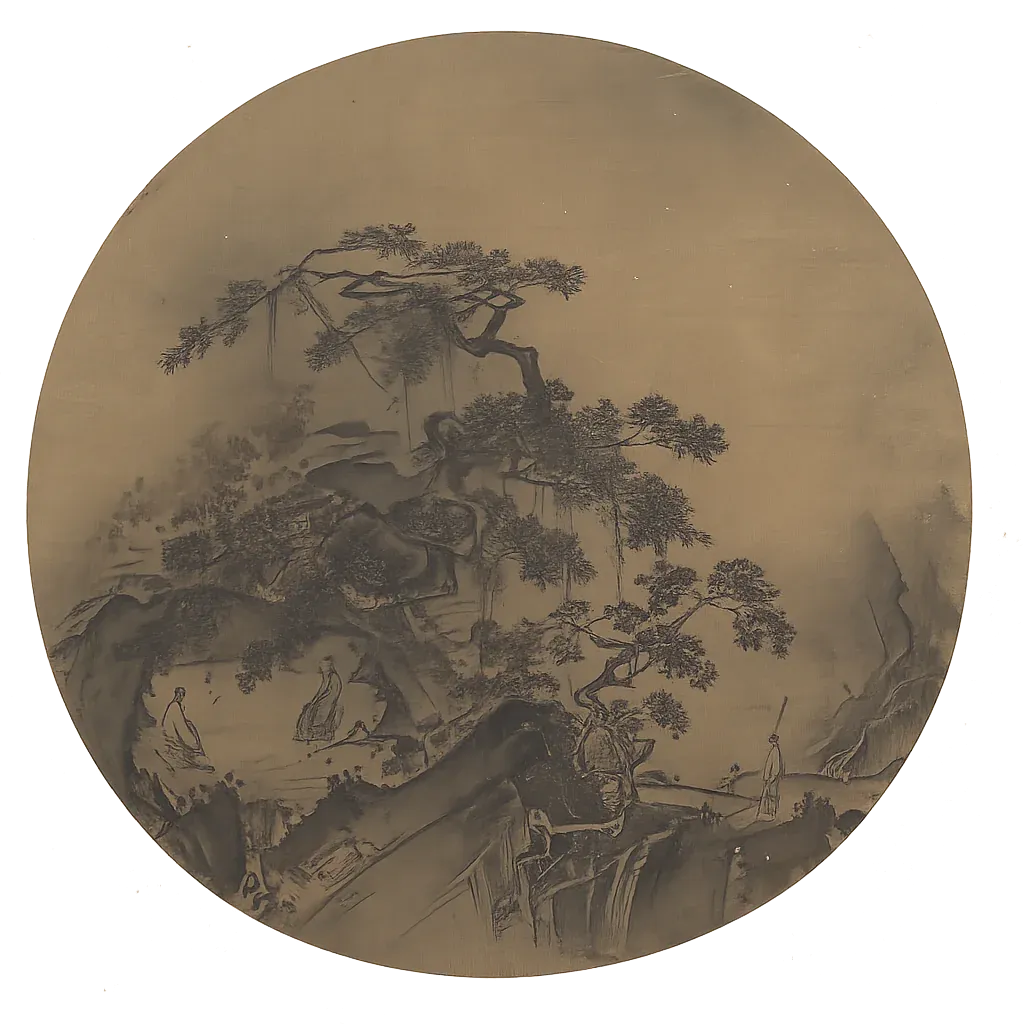
A garden without an east as an epistemological-ontological paradox
Dear readers,
As you have noticed, the text of The Garden Without an East, which was published in 13 instalments on these pages, has been removed. The reason is simple: it will soon be published as a book.
The complete text is currently with five people: Jožica Avbelj, Marko Uršič, Karel Gržan, Ines Cergol, and the printer Bojan Mljač. The forthcoming book is therefore currently being read in five different ways—from the perspectives of performance, philosophy, spiritual reflection, language, and physical book production.
Jožica Avbelj is a theatre and film actress and a long-standing professor of acting at the Academy of Theatre, Radio, Film and Television of the University of Ljubljana. Her decades-long career in acting and teaching, together with her experience in theatre performance, directing, and dramaturgy, give her a distinctive perspective from which to assess the performance potential of The Garden Without an East.
Marko Uršič is a philosopher and writer, and a retired professor in the Department of Philosophy at the Faculty of Arts of the University of Ljubljana. He introduced the field of philosophy of nature and also lectured on the philosophy of space and time and contemporary philosophical cosmology; his books and essays include numerous philosophical and literary works.
Father Karel Gržan holds a doctorate in literary studies and is a writer and commentator. His work brings together literature, spirituality, and broader reflection on human beings and their existence.
Ines Cergol is a specialist in Slavic studies, a poet, and the copy editor of the complete text of The Garden Without an East. Her task is to review the manuscript’s language and style and to oversee its final linguistic form.
Bojan Mljač is the director of Mljač Printing House in Divača, a family business with several decades of experience in printing, graphic design, and bookbinding. For The Garden Without an East, he is involved in the technical and production preparations for printing, including coordinating printing and binding solutions and the publication’s final physical form.
Here I must also acknowledge Darija Mavrič Čeh, an art historian who has taken on the role of editor. She was the first attentive reader of the text as it developed, its critical reader and adviser, a partner in discussions on numerous decisions about content and style, and an important contributor to the book’s final form. The inclusion of Dostoevsky in one of the chapters, for example, was her suggestion, and she also helped reshape the original conception. With her sense of aesthetics, visual form, and the whole, she has also made an important contribution to shaping the visual character of The Garden Without an East.
Dear readers, The Garden Without an East is built around a paradox. At first glance, it is a work strongly focused on words, concepts, teachings, historical figures, and philosophical and religious traditions. Different languages and ways of thinking meet within it; Greek, Chinese, Arabic, Latin, and Sanskrit expressions appear, alongside quotations from various traditions and concepts of emptiness, Dao, inner cultivation, mental impulses, forgetting, non-action, liberation, and insight. The text thus constantly directs the reader towards language and understanding. Yet the further the dialogue develops, the clearer it becomes that its ultimate purpose is not to formulate a new teaching. On the contrary: the Garden gradually strips authority from the very things with which it is filled—words, concepts, and theories.
Herein lies the fundamental paradox of the Garden. The Garden is a highly text-centred book that questions the absolute power of text. It speaks through a vast array of names, yet reminds us that the name is not the thing. It uses concepts, yet shows that a person can become a prisoner of a concept. It cites teachings, yet at the same time dissolves the need to cling to them. The text itself thus becomes a kind of path that ultimately invites the reader to forget that there was a path.
This is particularly evident in the closing motif of forgetting. Forgetting here means neither losing one’s memory nor erasing acquired knowledge. Sima Chengzhen says: “It does not mean that memory disappears, but that we become like a mirror that does not retain images.”
This sentence can also be understood as one of the many keys to understanding the Garden as a whole. A person can see an image without having to hold on to it. They can hear a word without having to turn it into dogma. They can understand a teaching without making that understanding into a new identity. They can arrive at an insight without having to say: this insight is mine.
That is why the Garden has no east. If it had an east, it would have a direction. If it had a direction, it would have a privileged starting point. If it had a starting point, a path and a destination could be defined. Yet the Garden is precisely the place where this need for orientation begins to dissolve. From the outset, the path is “without direction”, and in the end it becomes clear that the Garden itself has no centre either. No place is privileged, no direction is absolute, and no point is designated as the final destination.
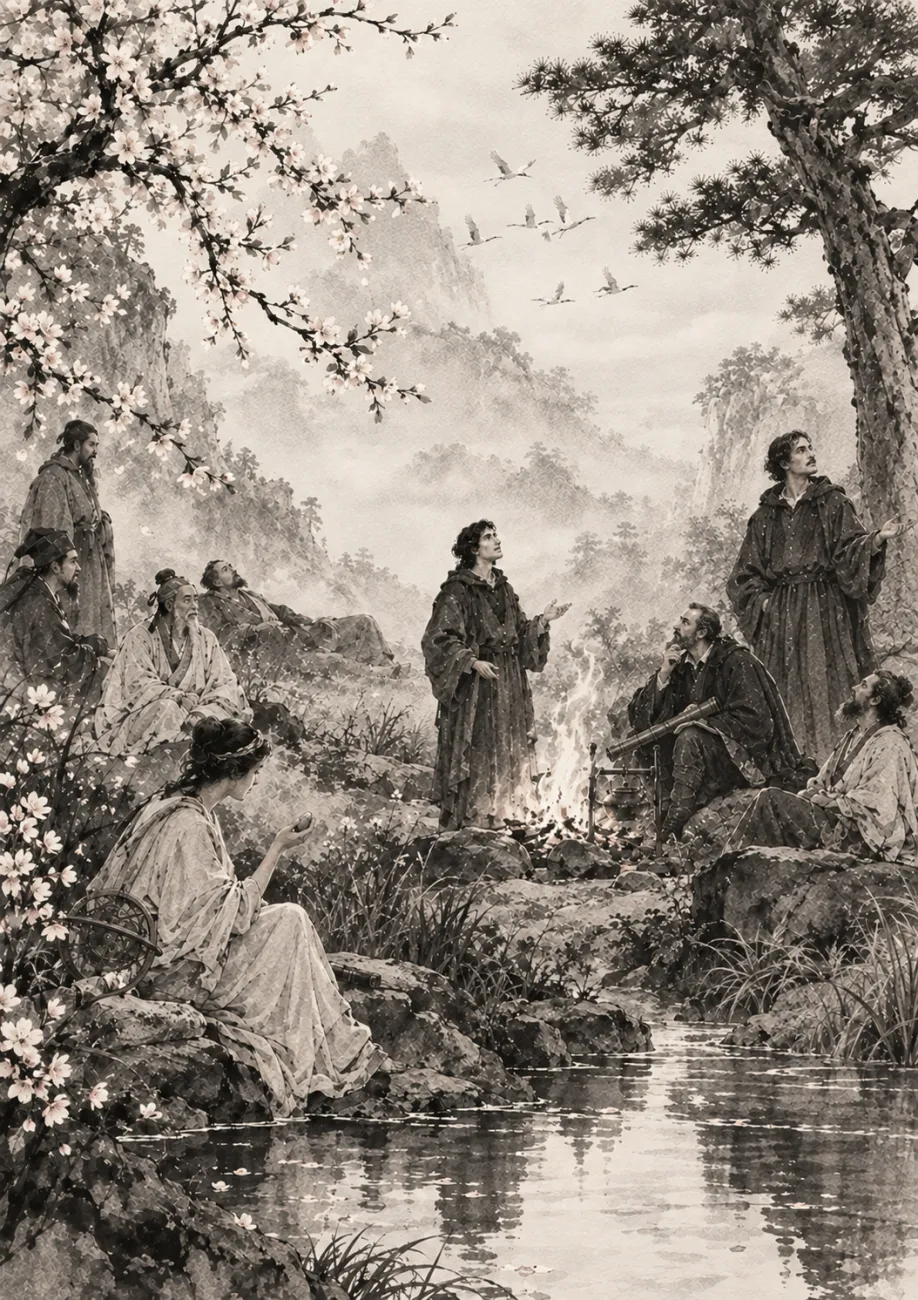
Nor is the pine tree the centre of the Garden. Although the most important conversations take place beneath it, it does not become a symbol of a new centre. It grows where it grows. Its roots reach into the earth, its branches respond to the wind, yet it explains nothing and demands nothing. That is precisely why it matters: its presence is stronger than its meaning.
Here, a third layer of the novel opens up. Nature itself begins to act as a philosophical interlocutor.
Water does not argue. The wind does not explain. The pine tree offers no proof. Yet their presence prevents the dialogue from becoming confined to a world of pure concepts. Philosophical questions keep returning to something that cannot be reduced to a philosophical proposition. Nature is therefore not a decorative backdrop to the philosophical exchanges. It is intended as a quiet corrective to the human need to explain.
When the characters speak of Dao, emptiness, forgetting, cultivation, liberation, or non-action, the Garden is doing something else all the while: it simply exists. The stream flows without explaining why. Clouds change without needing a theory of their transformation. The wind moves the treetops without having to prove its action. The pine tree seeks neither enlightenment nor realisation, yet it does not reject them either. This is precisely where its ontological role lies.
This is why the insight about words also matters: a word can name water, but it cannot drink in a person’s place. It can name a fish, but it cannot become a fish. It can name a path, but it cannot walk along it. The word is necessary, but it is not the thing itself.
And this is where another paradox of the Garden emerges: without words, we could not even arrive at these questions, yet words alone cannot take the final step. They can point like a finger towards the moon, but they cannot replace the experience—the moon. They can create a map, but they cannot walk. They can formulate a doctrine, but they cannot live in a person’s place.
This is also why the quotation about the net, the rabbit, and words is so important to the structure of the ending: once the fish is caught, you can forget the net; once the meaning is understood, you can forget the words. Yet in the Garden I do something even more radical: first, I offer the reader a great many nets. I offer names, traditions, languages, quotations, philosophical categories, and historical figures. Only then do I show that none of these nets is the fish. In this way, the Garden avoids becoming yet another doctrine.
The Garden does not construct a new doctrine about what constitutes ultimate truth. In fact, I gradually try to undermine the need for such a doctrine. As readers move through the work, they encounter an ever-growing number of answers, until it becomes clear that no answer can take the place of their own experience.
This is the central paradox of The Garden Without an East: the path of liberation can itself become an object of attachment. This is what I sought to avoid. That is why the Garden did not want to end with an explanation. Had it ended with a definitive teaching, it would have betrayed its own internal logic. I ended it by removing the need for any theory at all.
And that is why the final question is so important:
“What now?”
This question comes after all the discussions of cultivation, Dao, emptiness, war, forgetting, thoughts, liberation, the universe, and humanity. After all the knowledge. After all the words. This ending came to me in the early hours one morning, and later, over coffee, I shared my thought with Darija. Its directness appealed to her immediately.
Then Laozi simply smiles. “The world will go on.”
This is precisely why The Garden Without an East does not close at the end, but opens up. It does not offer a final answer, but removes the need for a final answer to exist at all. Its final paradox is that a book built from words must ultimately point beyond them.
Yuan Weiqi