

 Articles
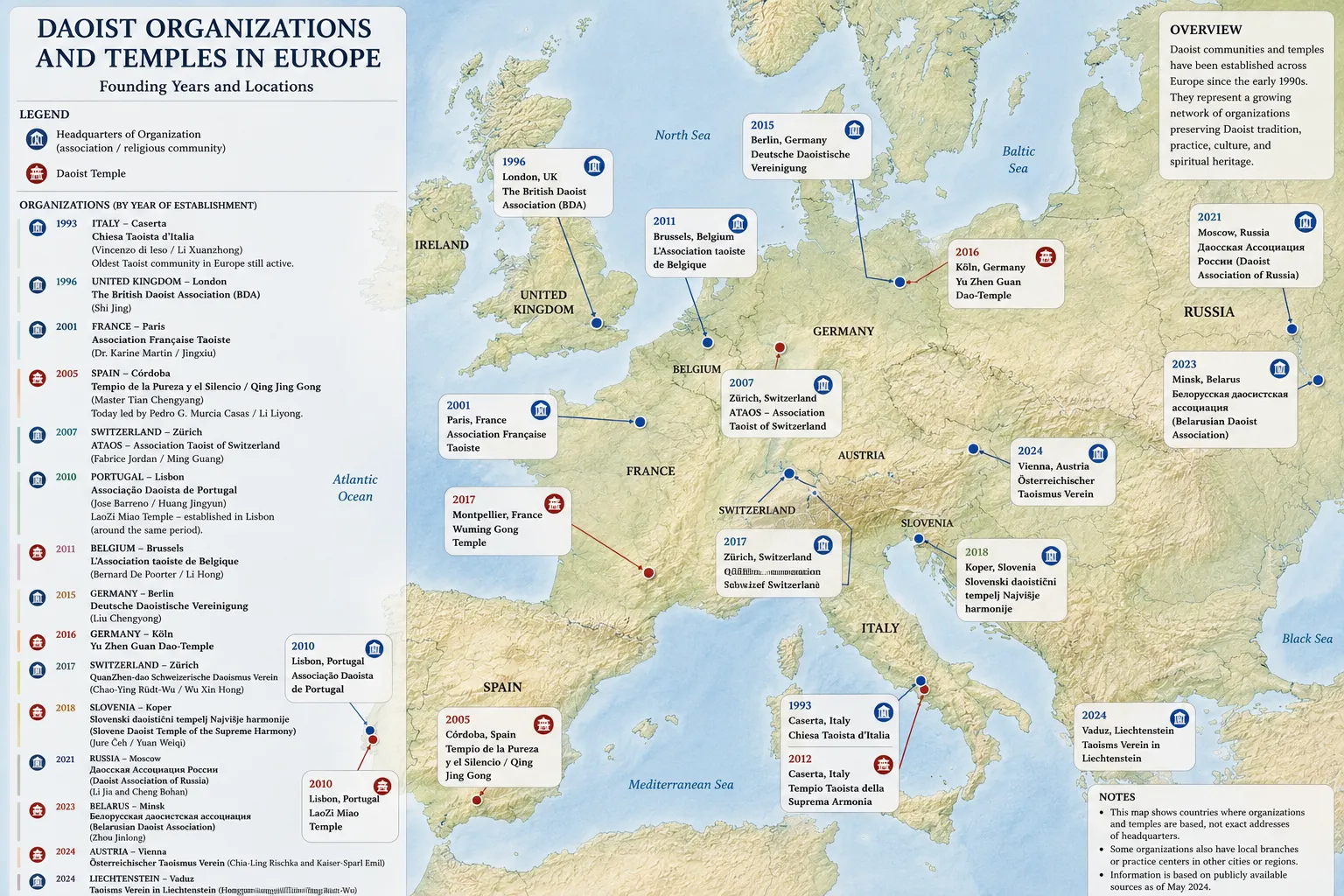


Legal Status of Daoist Communities Registered in Europe: Data from November 2026
The study at a glance
- 13 country profiles
- 15 organisations
- 3 entered in a state register of religious communities
- 5 with documented registration under private law
- 7 with no registration confirmed
Highest confirmed registration by country
Confirmed registration by organisation
Year of establishment or first registration
The charts summarise the findings of the country profiles below. “Not confirmed” means that no official evidence was available for this study; it does not mean that the status does not exist.
Overview of the organisations
| Country | Organisation | Year | Legal form | Confirmed registration | Category |
|---|---|---|---|---|---|
| Slovenia | Slovenian Daoist Temple of Supreme Harmony | 2018 | A registered church or other religious community and a legal person under private law | State register of religious communities | I |
| Spain | Daoist Union of Spain – Wudang Gong Palace | 2018 | Church, religious community or denomination (Iglesia, Comunidad o Confesión) | State register of religious communities | I |
| Spain | Daoist Community of Purity and Silence | 2018 | Church, religious community or denomination | State register of religious communities | I |
| Italy | Daoist Church of Italy | — | — | Not confirmed | special case |
| Great Britain | British Daoist Association (BDA) | 1996 | An unregistered membership association (unincorporated members' association) | Not confirmed | III |
| Switzerland | Ming Shan / Swiss Daoist Association | 2019 | Legal form of the centre: Dao Shan SA, a joint-stock company | Registration under private law | II |
| Portugal | Portuguese Daoist Association (ADP) | 2010 | Association (Associação) | Registration under private law | II |
| Belgium | Belgian Daoist Association | 2011 | Association; entry in the Belgian register of legal persons as an ASBL (non-profit association) has not been confirmed | Not confirmed | III |
| Germany | German Daoist Association e.V. (DDV) | 2016 | Registered non-profit association (eingetragener Verein – e.V.) | Registration under private law | II |
| Switzerland | QUANZHEN-DAO Swiss Daoism Association | 2017 | Private-law association (Verein) | Registration under private law | II |
| Russia | Даосская Ассоциация России – Daoist Association of Russia | 2021 | The legal form has not been independently confirmed | Not confirmed | III |
| Russia | Русская Даосская Ассоциация – Russian Taoist Association | 2014 | A separate legal form has not been independently confirmed | Not confirmed | III |
| Belarus | Belarusian Daoist Association | 2023 | The official legal form has not been independently confirmed | Not confirmed | II |
| Austria | Austrian Daoist Association | 2024 | Presumed to be a private-law association (Verein); official register confirmation has not been obtained | Not confirmed | III |
| Liechtenstein | Daoism Association in Liechtenstein | 2024 | Private-law association (Verein) | Registration under private law | III |
Year: establishment or first registration as stated in the study. Legal form: the wording of the country profile. Category: the classification proposed in the conclusion.
Country profiles
Slovenia – Slovenian Daoist Temple of Supreme Harmony
Final legal finding
The Slovenian Daoist Temple of Supreme Harmony is an officially registered Daoist religious community in the Republic of Slovenia. On 15 June 2018, the Ministry of Culture entered it in the Register of Churches and Other Religious Communities under entry number 57, by decision No. 021-6/2018/6.
Through registration, it acquired the status of a legal person under private law pursuant to Slovenia's Religious Freedom Act. Its legal status is therefore officially documented and verifiable in the state register.
Key data
| Organisation | Slovenian Daoist Temple of Supreme Harmony |
|---|---|
| Website | www.slovenski-daoisticni-tempelj.si |
| Registered office | Kozina, Istrska ulica 3, Slovenija |
| Leadership or representatives | Jure Čeh (Yuan Weiqi) and Darija Mavrič Čeh (Yuan Weiheng) |
| Establishment and registration | officially registered on 15 June 2018 |
| Competent authority | Ministry of Culture of the Republic of Slovenia |
| Registration number | 57 |
| Registration decision number | 021-6/2018/6 |
| Legal form | a registered church or other religious community and a legal person under private law |
| Statutes | it has its own rules or statutes; the latest recorded amendment was approved on 10 July 2025 |
| Religious activities | Daoist religious rituals, spiritual education, meditation, Daoist religious practice, cultural and other religious activities |
| Registration as a religious entity | CONFIRMED |
| Legal personality | acquired through registration under the Religious Freedom Act |
Sources: the official register of the Ministry of Culture and the temple's website.
Explanation of Slovenian legislation
Slovenian legislation allows religious communities to be established and registered on the basis of the constitutional freedom of conscience and religion and the Religious Freedom Act (ZVS). A religious community may also operate without registration, but registration grants it the status of a legal person under private law and the ability to exercise specific rights guaranteed by law to registered religious communities. Registration is handled by the Ministry of Culture through an administrative procedure.
The Slovenian Daoist Temple of Supreme Harmony successfully completed this procedure in 2018. Its registration constitutes official recognition of its status as a religious community within the Slovenian legal system.
Official legal sources: Ministry of Culture – Religious Communities and Registration Procedure under the Religious Freedom Act.
Spain – Daoist religious communities (Taoísmo)
According to scholarly surveys, Spain has three Daoist organisations entered in the state register of religious entities (Registro de Entidades Religiosas – RER).
Final legal finding
Spain has documented entries of Daoist religious communities in its state register of religious entities. For two organisations, we have direct official register extracts confirming their registration as a church, religious community or denomination.
Registration under Spain's RER system grants a religious organisation legal personality under civil law. The legal basis consists of Organic Law 7/1980 on Religious Freedom and Royal Decree 594/2015 on the Register of Religious Entities.
A. Daoist Union of Spain – Wudang Gong Palace
| Organisation | Daoist Union of Spain Wudang Gong Palace |
|---|---|
| Website | an official website has not been confirmed |
| Registered office | Avenida Gasteiz 48, Vitoria, Álava, Španija |
| Representative | Patxi Marta Blanco |
| Registration | 7 November 2018 |
| Registration number | 024394 |
| Statutes | approved on 30 October 2018 |
| Legal form | church, religious community or denomination (Iglesia, Comunidad o Confesión) |
| Register | General Section – Minority Religions |
Source: Official extract from the Spanish register – 024394.
B. Daoist Community of Purity and Silence
| Organisation | Daoist Community of Purity and Silence |
|---|---|
| Website | an official website has not been confirmed |
| Registered office | Paz de Belgrado 5 B, Cartagena, Murcia, Španija |
| Representatives | Rafael David Aguilar Martínez and Pedro Germán Murcia Casas |
| Registration | 28 March 2018 |
| Registration number | 024023 |
| Statutes | approved on 27 March 2018 |
| Legal form | church, religious community or denomination |
| Register | General Section – Minority Religions |
Source: Official extract from the Spanish register – 024023.
Explanation of Spanish legislation
Spanish legislation allows religious communities to register under Organic Law 7/1980 in the state register of religious entities (RER), maintained by the competent ministry. Through registration, they acquire legal personality under civil law and the capacity to act independently in legal matters. Registration takes place in the General Section (Sección General), while religious communities with cooperation agreements with the state are entered in the Special Section (Sección Especial).
The Daoist organisations Daoist Union of Spain and Daoist Community of Purity and Silence are entered in the General Section of the register as religious communities. This means that they have officially registered religious status and legal personality under civil law, but registration alone does not constitute a special agreement with the state or recognition of notorio arraigo status (a religious community's broader social and historical rootedness).
Comparative finding
Alongside Slovenia, Spain is an important European example where a Daoist religious community is officially entered in a state register. However, a distinction must be made between Spanish registration in the RER and special forms of state recognition.
Italy – Daoist Church of Italy
Final legal finding
The Daoist Church of Italy is an active, institutionally organised Daoist religious community with its own statutes, temple and religious rituals. However, we have no official evidence that it has the status of a state-recognised religious community in Italy. For the purposes of the comparative study, we therefore classify it among Daoist religious organisations whose special state recognition has not been confirmed.
Key data
| Organisation | Chiesa Taoista d'Italia (Daoist Church of Italy) |
|---|---|
| Website | www.daoitaly.org |
| Headquarters | Caserta, Italy |
| Leader | master Li Xuanzong (Vincenzo di Ieso) |
| Statutes | presented in 2013 |
| Temple | a Daoist temple in Caserta; the consecration of a new temple in Prato on 25 June 2026 is also documented |
| Religious activities | Daoist rituals, a religious hierarchy and organised activities |
| Registration as a religious entity | special state recognition under Italian legislation has not been confirmed |
| Agreement with the Italian state (Intesa) | not confirmed |
Explanation
Italian legislation provides for three basic forms of legal status for religious communities. The first is a freely operating religious community under Articles 8 and 19 of the Italian Constitution, which may have its own statutes, leadership, adherents and temple, and conduct religious rituals without special state recognition. The second option is to obtain recognised legal personality under Law No. 1159/1929 and implementing Decree No. 289/1930. The third option is to conclude a special agreement with the state (Intesa) under Article 8 of the Constitution, which is approved by law.
According to the documentation currently available, the Daoist Church of Italy falls among independently operating Daoist religious organisations. It has its own statutes, leadership, religious organisation and temples, but neither special state recognition of its legal personality nor the conclusion of an Intesa agreement has been confirmed. This does not mean that its religious activities are unlawful, but rather that its higher formal legal status within the Italian system has not yet been demonstrated.
Great Britain – British Daoist Association (BDA)
Final legal finding
The British Daoist Association is an organised Daoist religious community operating within the British right to freedom of religion and association. Its organisational and religious activities are separate from the question of formal legal recognition. Registration with HMRC does not constitute state recognition of a religious entity, so for the European comparative study we cannot currently classify it among Daoist religious communities with verified state recognition.
Key data
| Website | www.daoists.co.uk |
|---|---|
| Founded in 1996 | |
| Organisation | British Daoist Association (BDA) |
| Headquarters | it has no permanent temple or religious headquarters of its own |
| Leadership | president Alan Redman (Shi Jing) |
| Legal form | an unregistered membership association (unincorporated members' association) |
| Statutes | it has its own constitution or governing document |
| Activities | Daoist meditation, inner cultivation, Daoist exercises and spiritual retreats |
| Recognition | the organisation states that it has been recognised by Kitajsko daoistično združenje (Chinese Taoist Association) |
| Tax registration | it reports registration with the British HMRC |
| State recognition as a religious community | not confirmed |
Sources: the BDA's official website and constitution.
Explanation of British legislation
British legislation allows several forms of legal organisation for religious communities. The first is a freely operating religious community in the form of an informal association (unincorporated association), which may have its own constitution, leadership and members, and carry out religious activities without special state registration. The second option is to establish a legal person, such as a limited liability company (company limited by guarantee) or an incorporated charitable organisation (Charitable Incorporated Organisation – CIO). The third option is to obtain charitable status (charity) from the competent Charity Commission, provided the organisation meets the public benefit requirements and has exclusively charitable purposes, including the advancement of religion. In England and Wales, religious premises may also be separately registered as a place of religious worship under the Places of Worship Registration Act 1855. This registration does not constitute recognition of the entire religious organisation.
According to the information currently available, the British Daoist Association (BDA) falls into the first category, namely freely operating, unregistered membership associations. Its organisational structure and religious activities are possible under the general right to association and religious freedom. Any registration with HMRC concerns its tax status, not special state recognition of a Daoist religious community. We therefore cannot yet classify the BDA among verified registered religious legal persons or religious charities.
Note: the arrangements described apply primarily to England and Wales; Scotland and Northern Ireland have separate legal and registration systems.
Switzerland – Ming Shan / Swiss Daoist Association
Final legal finding
Ming Shan is an active Daoist centre and temple established in 2019. Three legally separate organisational forms are connected with it: Dao Shan SA, which operates the centre and website; the Ming Shan Foundation, established in 2015 to promote Daoist arts in Switzerland and abroad; and the Swiss Daoist Association, registered in 2024 to connect Daoist practitioners.
The Swiss Daoist Association has registered statutes and is entered in the commercial register of the canton of Vaud. This gives it formal status as an association, but does not constitute special state recognition as a religious community.
Key data
| Organisation | Ming Shan – a Daoist centre and temple; the Swiss Daoist Association is also connected with it |
|---|---|
| Website | www.mingshan.ch |
| Registered office | Chemin de l'Étoile Polaire 3, 1453 Bullet, canton of Vaud, Švica |
| Founder and head of the centre | master Fabrice Jordan |
| Head of education | Sarah Blanc |
| Centre began operating | 2019 |
| Legal form of the centre | Dao Shan SA, a joint-stock company |
| Company registration | CHE-300.958.554, commercial register of the canton of Vaud |
| Associated religious organisation | Swiss Daoist Association |
| Establishment of the association | 5 December 2023 (statutes); registration on 15 May 2024 |
| Association registration number | CHE-277.833.295 |
| President of the association | Fabrice Jordan |
| Purpose of the association | connecting Daoist practitioners in Switzerland and abroad and cooperating with the Chinese Taoist Association and other related organisations |
| Temple | Ming Shan has its own Daoist temple within the centre in Bullet |
| Religious activities | teaching the Daoist tradition, meditation, internal Daoist practices, spiritual education and ritual activities |
| Registration as a religious entity | the Swiss Daoist Association is a registered association in the commercial register, but special state recognition as a religious community has not been confirmed |
| State recognition | recognition as a religious community under public law in the canton of Vaud has not been confirmed |
Explanation of Swiss legislation
Swiss legislation allows several forms of legal status for religious communities. The first is independent operation on the basis of freedom of religion, guaranteed by Articles 15 and 16 of the Swiss Federal Constitution. The second option is to establish a private-law association (Verein/Association) under Article 60 of the Swiss Civil Code (ZGB), which may acquire legal personality on the basis of its statutes without special state recognition. The third option is to establish a foundation (Stiftung/Fondation), which is entered in the relevant register. Special recognition of religious communities under public law is regulated by individual cantons under Article 72 of the Federal Constitution.
According to the available information, Ming Shan or the Swiss Daoist Association falls among Daoist institutions and associations organised under private law. In the canton of Vaud, it is possible for a religious community to obtain recognition as an institution of public interest, but such recognition has not been confirmed for the Swiss Daoist Association.
Comparative finding
Switzerland has an organised Daoist community with its own centre, temple, foundation and registered association. Its registration under private law is documented, but special recognition as a religious community under public law has not been demonstrated. There is therefore an important difference in the type of legal status compared with the Slovenian Daoist Temple.
Portugal – Portuguese Daoist Association (ADP)
Final legal finding
The Portuguese Daoist Association is an organised Daoist association established in 2010 in Lisbon under the leadership of José Barreno (Huang Jingyun). Its activities include spreading Daoist teachings, translating religious texts, teaching and conducting rituals. The LaoZi Miao temple is also connected with the organisation.
The association has a recorded legal form as an association (Associação) and tax number 509313507. However, we currently have no official evidence that it is entered in Portugal's special register of religious legal persons. We therefore cannot confirm its registration as a religious entity.
Key data
| Organisation | Associação Daoista de Portugal (Portuguese Daoist Association) |
|---|---|
| Website | a dedicated official website has not been reliably confirmed; an older blog exists at Portuguese Daoist Association |
| Establishment | 17 March 2010, Lisbon |
| Founder | José Barreno, Daoist name Huang Jingyun |
| Headquarters | Lisbon, Portugal; the precise current address has not been confirmed |
| Legal form | association (Associação) |
| Tax or registration number | NIF 509313507 |
| Statutes | the existence of founding documents requires further verification |
| Temple | LaoZi Miao (Laozi Temple) in Lisbon; its establishment around 2010 is mentioned in secondary sources, but the date and official documentation of its consecration have not been confirmed |
| Religious activities | spreading Daoism, translating Daoist texts into Portuguese, teaching Daoist doctrine and conducting religious rituals |
| International cooperation | a connection with the European Daoist network and cooperation with other Daoist organisations are reported |
| Registration as a religious entity | entry in the Portuguese register of religious legal persons (Registo de Pessoas Coletivas Religiosas) has not been confirmed |
| Special state recognition | not confirmed |
Explanation of Portuguese legislation
Portuguese legislation allows several forms of legal status for religious communities. The first is the free operation of a religious community on the basis of constitutionally guaranteed religious freedom. The second option is to establish an ordinary private-law association under civil legislation. The third option is registration in the special register of religious legal persons (Registo de Pessoas Coletivas Religiosas) under Religious Freedom Act No. 16/2001, through which a religious community acquires a special form of legal personality. The fourth option is to obtain the status of a religious community rooted in the country (comunidade religiosa radicada), which requires compliance with additional legal conditions, generally including at least 30 years of organised presence in Portugal.
According to the information currently available, the Portuguese Daoist Association falls among associations organised under private law. Its registration as a special religious legal person under Act No. 16/2001 has not yet been demonstrated. This does not mean that its religious activities are unlawful, but rather that its special legal status within the Portuguese system remains unverified.
Comparative finding
Portugal has an organised Daoist association and, according to available sources, the LaoZi Miao Daoist temple. We currently have no official evidence of the Portuguese organisation's registration in the state register of religious legal persons.
Belgium – Belgian Daoist Association
Final legal finding
The Belgian Daoist Association is an organised Daoist community established in 2011, engaged in spreading Daoist teachings, meditation, qigong, religious rituals and educational activities.
We currently have no official evidence that the association is registered as a religious legal person or has special state recognition. Nor has its ASBL status been confirmed, although this is the usual legal form for non-profit associations in Belgium.
Key data
| Organisation | L’Association taoïste de Belgique (Belgian Daoist Association) |
|---|---|
| Website | www.taobelgium.be |
| Establishment | 2011 |
| Founder | according to the available information, Bernard De Poorter (Daoist name Li Hong) |
| Leadership | Bernard De Poorter (Li Hong); his current role and representative authority require further confirmation |
| Headquarters | the precise current location has not been confirmed |
| Legal form | association; entry in the Belgian register of legal persons as an ASBL (non-profit association) has not been confirmed |
| Statutes | a publicly available founding document or statutes have not been confirmed |
| Temple | a permanent Daoist temple of its own has not been confirmed |
| Religious activities | Daoist meditation, qigong, rituals, lectures, seminars, the study of classical Daoist texts and the presentation of traditional Chinese culture |
| International cooperation | connections with the European Daoist community |
| Registration as a religious entity | special registration or state recognition as a religious community has not been confirmed |
| State recognition | Daoism is not among the officially recognised religious communities in Belgium |
The association's establishment in 2011 and its activities are confirmed by its own presentation.
Explanation of Belgian legislation
Belgian legislation is based on religious freedom, guaranteed by Articles 19 and 21 of the Belgian Constitution. Religious communities may freely establish organisations, adopt statutes, conduct rituals and carry out religious activities without special state recognition.
The second option is to establish a non-profit association (Association sans but lucratif – ASBL), which acquires legal personality under the Belgian code of economic law and associations. The third option is to obtain special state recognition as a religious community. This is decided by the federal state through the Ministry of Justice, and recognition must be approved through a legislative procedure. Recognised religious communities may acquire certain rights, including state funding for religious representatives.
Belgium officially recognises the Catholic, Protestant, Anglican, Orthodox, Jewish and Islamic faiths, as well as organised secular humanism. Daoism is not among the recognised religious communities.
According to the information currently available, the Belgian Daoist Association therefore falls among freely operating Daoist organisations without confirmed special state recognition.
Comparative finding
Belgium has an organised Daoist association with its own religious and educational activities, but the Daoist community does not have confirmed status as an officially recognised religious community. This legally distinguishes it from the Slovenian Daoist Temple of Supreme Harmony, which has been entered in the Slovenian register of religious communities since 2018.
Germany – German Daoist Association e.V. (DDV)
Final legal finding
The German Daoist Association e.V. is an organised Daoist religious community with its own statutes, president, temple and regular religious activities. It has been officially registered as a non-profit association (eingetragener Verein – e.V.) since 15 November 2016.
The association also reports recognition by the Chinese Taoist Association, but this is not recognition by the German state. Nor has it been demonstrated that it has acquired the special status of a religious corporation under public law (Körperschaft des öffentlichen Rechts).
Key data
| Organisation | Deutsche Daoistische Vereinigung e.V. (German Daoist Association) |
|---|---|
| Website | www.deutsche-daoistische-vereinigung.de |
| Establishment | 13 August 2016 |
| Association registration | 15 November 2016 |
| Founder and president | master Liu Chengyong (劉诚勇) |
| Registered office | Germany; the current official registered address must be checked in the register of associations |
| Legal form | registered non-profit association (eingetragener Verein – e.V.) |
| Registration | entered in the German register of associations (Vereinsregister) |
| Statutes | it has its own statutes and organisational structure |
| Temple | Yu Zhen Guan (遇真观), also known as Wudang Temple Germany |
| Establishment of the temple | the organisation's website states that it opened in 2019; 2016 has not been confirmed as the temple's opening date |
| Religious activities | Daoist rituals, meditation, initiations, internal alchemy, qigong, Daoist education and spiritual practice |
| International recognition | the association reports recognition by Kitajsko daoistično združenje (Chinese Taoist Association) |
| Registration as a religious entity | status as a religious community with special state recognition has not been confirmed |
| Status as a religious corporation under public law (Körperschaft des öffentlichen Rechts) | not confirmed |
Sources: the DDV's official website and presentations of the association and temple.
Explanation of German legislation
German legislation provides for three basic forms of legal status for religious communities. The first is the free operation of a religious community under Article 4 of the German Constitution (Grundgesetz), which guarantees freedom of religion and religious organisation. The second option is to establish a private-law association, which may be registered as an eingetragener Verein (e.V.) under the Civil Code (BGB). The third option is to obtain the special status of a religious corporation under public law (Körperschaft des öffentlichen Rechts) under Article 140 of the German Constitution in conjunction with Article 137 of the Weimar Constitution. To obtain this status, a religious community must meet certain conditions concerning its organisation, permanence and number of members.
According to the available documentation, the German Daoist Association e.V. falls among associations registered under private law. Its registration grants it legal personality, but does not constitute the acquisition of a religious community's special public-law status. This does not restrict its right to conduct religious activities independently.
Comparative finding
Germany has an organised Daoist community with a registered association and its own Yu Zhen Guan temple. However, special state recognition in the form of a religious corporation under public law has not been confirmed. In comparison with the Slovenian Daoist Temple, the important distinction is that the German organisation is registered as an association, while the Slovenian organisation is registered as a religious community in the state register.
Note on dates: the DDV's official website states that the association was established in 2016 and that the Yu Zhen Guan temple opened in 2019. I would therefore not equate these dates with 2015 and 2016 as given in some secondary presentations.
Switzerland – QUANZHEN-DAO Swiss Daoism Association
Swiss Association of Quanzhen Daoism
Comparative finding
The QUANZHEN-DAO Swiss Daoism Association is an organised Daoist community in Switzerland belonging to the Quanzhen (全真) tradition.
The association was established in 2017 and was entered in the commercial register of the canton of Zurich on 24 February 2017 under identification number CHE-207.149.325.
Its registered office is in Wetzikon, and Chao-Ying Rüdt-Wu (Wu Xin Hong), who is listed in the register information as a board member and authorised signatory, plays a leading role.
Its registration confirms the existence of a legally organised private-law association. However, entry in the commercial register does not automatically confer special state recognition as a religious community.
Nor has it been confirmed that the association has acquired public-law status as a religious community in the canton of Zurich or that it has a permanent Daoist temple of its own.
Key data
| Organisation | QUANZHEN-DAO Schweizerischer Daoismus Verein (Swiss Association of Quanzhen Daoism) |
|---|---|
| Website | a dedicated official website for the association has not been confirmed |
| Establishment | 2017 |
| Registration | entered in the commercial register of the canton of Zurich on 24 February 2017 |
| Founder and leader | Chao-Ying Rüdt-Wu (Wu Xin Hong) |
| Registered office | Buchgrindelstrasse 28, 8620 Wetzikon, canton of Zürich, Švica |
| Legal form | private-law association (Verein) |
| Registration | entered in the commercial register of the canton of Zurich (Handelsregisteramt des Kantons Zürich) |
| Registration number | CHE-207.149.325 |
| Additional register identifier | CH-020.6.002.243-0 |
| Status | active association according to the available register information |
| Leadership | Chao-Ying Rüdt-Wu is listed as a board member and authorised signatory. Stefan Yea Shouh Rüdt is also listed among the board members |
| Latest recorded change in leadership | 7 March 2024, when Stefan Yea Shouh Rüdt was entered as a board member without sole signing authority |
| Statutes | the association must have written statutes in accordance with the Swiss Civil Code. To verify their content conclusively, the current statutes or the association's documentation must be obtained |
| Temple | a permanent Daoist temple of its own has not been confirmed |
| Religious activities | the study of Daoist classics, internal alchemy, Daoist health-maintenance practices, educational courses and the performance of Daoist rituals |
| Organised activities | the registered description of its purpose mentions approximately four educational courses annually, lasting one day or a weekend, and a Daoist ritual conducted once a year together with masters from China |
| Registration as a religious entity | registration as a private-law association is confirmed; special registration or public-law recognition as a religious community has not been confirmed |
| State recognition | special public-law recognition of the Daoist community in the canton of Zurich has not been confirmed |
| International cooperation | the association is listed in the context of European Daoist networking and cooperation among Daoist organisations |
Sources: the Swiss commercial register, information about the organisation, the Swiss Civil Code, Global Daoism Archive and a survey of Daoist communities in Europe.
Legal form and registration in Switzerland
The QUANZHEN-DAO Swiss Daoism Association is organised as a private-law association (Verein).
The legal basis for the establishment and operation of associations in Switzerland is the Swiss Civil Code (Schweizerisches Zivilgesetzbuch – ZGB), particularly Articles 60 to 79.
Under Article 60 of the ZGB, associations with political, religious, scientific, cultural, charitable or other non-commercial purposes acquire legal personality when their statutes demonstrate an intention to operate as a legal person.
Article 61 of the ZGB governs the entry of associations in the commercial register. Registration is mandatory in certain cases specified by law, including the conduct of commercial activities, mandatory auditing or certain forms of collecting and distributing funds abroad.
For the association under consideration, it is important that its entry in the commercial register of the canton of Zurich is officially recorded.
The records of changes also show that the association's registered office moved from Stäfa to Wetzikon in 2022. The latest recorded change in leadership in the information reviewed was published on 7 March 2024.
Registration in the commercial register confirms the association's legal and organisational record, but does not in itself constitute special state recognition of a religious community.
Explanation of Swiss legislation
The Swiss legal system differs from the German system regarding the legal status of religious communities, as individual cantons play an important role in regulating relations between the state and religious communities.
The fundamental legal guarantee is Article 15 of the Swiss Federal Constitution (Bundesverfassung der Schweizerischen Eidgenossenschaft), which guarantees freedom of religion and conscience.
This article guarantees individuals and groups the right to choose their religion freely, profess religious beliefs, belong to a religious community and engage in religious practices.
Within the Swiss system, a distinction must be made between the following forms of legal status:
1. Freely operating religious community: a religious community may operate on the basis of constitutionally guaranteed freedom of religion without having to obtain special state recognition.
2. Private-law association (Verein): a religious community may organise itself as a private-law association under the provisions of the Swiss Civil Code. Such an organisation may acquire legal personality, have statutes, leadership and members, and carry out religious activities.
3. Religious community recognised under public law: individual cantons may, under certain conditions, recognise religious communities as public-law institutions or grant them special legal status. Conditions and procedures vary according to cantonal legislation.
It is important to note that Switzerland does not have a uniform national system for recognising religious communities comparable to those of some other European countries. Responsibility for regulating relations between the state and religious communities is largely left to the cantons.
The canton of Zurich also provides possibilities for special legal recognition of religious communities, but such recognition must be distinguished from the ordinary registration of a private-law association.
According to the available information, the QUANZHEN-DAO Swiss Daoism Association is organised as a private-law association. However, it has not been confirmed that it has acquired special public-law status as a religious community in the canton of Zurich.
This does not mean that the association has no right to conduct religious activities. Its right to perform Daoist rituals, provide education and carry out other religious activities derives from constitutionally guaranteed freedom of religion.
Russia – Daoist religious associations (Даосизм)
Two Daoist organisations are documented in Russia and must be considered separately. Their establishment, leadership and organisational details differ. Based on the information currently available, state registration as a religious organisation has not been confirmed for either.
Final legal finding
Two different Daoist organisations are presented in Russia: the Daoist Association of Russia, established in 2021, and the Russian Taoist Association, which states that it has been operating since 2014.
The first is an internationally active organisation that cooperates with Daoist communities in China and other countries. The second is an independent Russian Daoist organisation led by Aleksej Hohlov.
Based on the documentation reviewed, entry in the state register as a religious organisation under Russian Law No. 125-FZ on Freedom of Conscience and Religious Associations cannot be confirmed for either organisation.
Their public activities, organisational structure and religious activities do not in themselves demonstrate the acquisition of legal personality or special state recognition.
A. Даосская Ассоциация России – Daoist Association of Russia
| Organisation | Даосская Ассоциация России (Daoist Association of Russia) |
|---|---|
| Website | https://www.daorussia.org |
| Establishment | 2021 |
| Founders | Li Jia and Cheng Bohan |
| President | Cheng Bohan (成柏翰), listed on the current website as permanent president and chief executive officer; Li Jia is listed as the founding president |
| Registered office | Russia; the official registered address has not been confirmed |
| Legal form | the legal form has not been independently confirmed |
| Registration | entry in the Russian state register of legal persons (ЕГРЮЛ) has not been confirmed |
| Statutes | the existence of officially adopted statutes has not been confirmed |
| Temple | a permanent Daoist temple of its own has not been confirmed |
| Religious activities | the study of Daoist classics, internal practice, translation of Daoist texts, spiritual education and Daoist rituals |
| Religious tradition | the Zhengyi (正一) tradition, among others |
| International cooperation | networking with Chinese and other international Daoist organisations |
| International recognition | the association reports participation in the Fifth International Daoist Forum in 2023 and membership of the World Federation of Daoism |
| Registration as a religious entity | not confirmed |
| State recognition | special state recognition as a religious organisation has not been confirmed |
Sources: the official website of the Daoist Association of Russia, Global Daoism Archive and presentations of international Daoist cooperation.
B. Русская Даосская Ассоциация – Russian Taoist Association
| Organisation | Русская Даосская Ассоциация (Russian Taoist Association) |
|---|---|
| Website | https://taoist.ru |
| Establishment | 2014, according to the organisation |
| Founder and president | Aleksej Aleksejevič Hohlov (Хохлов Алексей Алексеевич) |
| Registered office | Russia; the current official registered address has not been confirmed |
| Legal form | a separate legal form has not been independently confirmed |
| Registration | state registration as a religious organisation has not been confirmed |
| Registration number | not confirmed |
| Statutes | publicly available information does not allow the current statutes to be confirmed |
| Temple | a permanent Daoist temple of its own has not been confirmed |
| Religious activities | presenting and spreading Daoist teachings, education, spiritual practices and bringing together people interested in Daoism |
| Religious tradition | the Daoist tradition; precise formal affiliation with a particular Daoist school has not been confirmed |
| Registration as a religious entity | not confirmed |
| State recognition | special state recognition of the religious community has not been confirmed |
Sources: the official website of the Russian Taoist Association and the publicly available presentation of the organisation.
Explanation of Russian legislation
Russian legislation allows two basic forms of religious organisation. The first is a religious group (религиозная группа), which may operate without acquiring legal personality but must comply with legal obligations to notify the competent authorities. The second is a religious organisation (религиозная организация), which acquires legal personality through state registration under the provisions of Federal Law No. 125-FZ of 26 September 1997.
The legal basis is supplemented by Article 14 of the Russian Constitution, which establishes the secular nature of the state and the equality of religious associations before the law, and Article 28, which guarantees freedom of religion.
The Daoist organisations could operate as religious groups or registered religious organisations, but their specific legal status cannot be conclusively determined without official registration documents.
Comparative finding
Russia has several organised Daoist communities that represent the Chinese Daoist tradition and develop international cooperation. However, special state recognition or registration as religious organisations has not been confirmed for the two organisations considered.
In comparison with the Slovenian Daoist Temple, the essential distinction is that the Slovenian community has a documented entry in the state register of religious communities, while such an entry has not been confirmed for the Russian organisations.
Note on dates: the comparative discussion must consistently distinguish between 2014 for the Russian Taoist Association and 2021 for the Daoist Association of Russia. These are two different organisations and must not be combined into a single legal or organisational entity.
Belarus – Belarusian Daoist Association
Belarusian Daoist Association and Baixuan temple (白玄宫)
Final legal finding
The Belarusian Daoist Association is a Daoist association established in March 2023 under the leadership of Daoist priest Zhou Jinlong. An important part of its work is the Baixuan Guan Daoist temple project, envisaged as a permanent religious, cultural and educational centre for Daoism in Belarus.
The association presents itself as an organised Daoist community with international connections, particularly with the Chinese Taoist Association and other Daoist institutions.
However, the available sources do not allow its registration as a legal person or religious organisation with the Belarusian state authorities to be confirmed. Nor have its registration number, official registered office or acquisition of special state recognition been confirmed.
For Baixuan Guan temple, a distinction must be made between the presented construction project and a completed religious building. The publicly available presentation describes its construction, but the temple's completion and official legal status have not been independently confirmed.
The organisation must therefore currently be described as a publicly presented Daoist association with a planned or developing temple, whose formal legal status in Belarus has not yet been confirmed by documentation.
Key data
| Organisation | Белорусская даосистская ассоциация (Belarusian Daoist Association) |
|---|---|
| Website | a dedicated official website for the association has not been confirmed; a presentation is published on the website of the Slovenian Daoist Temple |
| Establishment | March 2023 |
| Founder and president | Daoist priest Zhou Jinlong |
| Registered office | Belarus; the official registered address has not been confirmed |
| Legal form | the official legal form has not been independently confirmed |
| Registration | entry in the state register of legal persons or registration with the Ministry of Justice of Belarus has not been confirmed |
| Registration number | not confirmed |
| Statutes | the existence and content of officially adopted statutes have not been confirmed |
| Temple | Baixuan Guan, also called Baixuan Palace |
| Temple location | Minsk or the surrounding area, Belarus; the precise address has not been confirmed |
| Religious activities | Daoist rituals, the study and preservation of traditional Chinese Daoist culture, religious education, spiritual practice and international cooperation |
| Religious tradition | orthodox Chinese Daoism; a connection with the Zhengyi (正一) tradition requires further documentary confirmation |
| International cooperation | cooperation with the Chinese Taoist Association and other Daoist organisations in Europe and worldwide |
| International recognition | the organisation reports participation in the World Daoist Forum and international academic meetings organised by the Chinese Taoist Association |
| Registration as a religious entity | special state registration as a religious organisation has not been confirmed |
| State recognition | special state recognition of the Daoist religious community in Belarus has not been confirmed |
Sources: the presentation of the Belarusian Daoist Association and Baixuan temple, Global Daoism Archive, and Belarusian legislation on freedom of conscience and religious organisations.
Explanation of Belarusian legislation
Belarusian legislation regulates the status of religious communities primarily through Law No. 2054-XII on Freedom of Conscience and Religious Organisations (О свободе совести и религиозных организациях).
Another important legal basis is Law No. 334-Z of 30 December 2023, which substantially changed the rules governing the registration and operation of religious organisations. The new rules began to apply in July 2024.
The Belarusian system distinguishes between religious communities and religious associations or their hierarchical organisational structures. Mandatory state registration is required for religious organisations to operate lawfully, and through it they acquire legal personality.
The new legislation tightened registration requirements. Establishing a religious community requires, among other things, at least 20 adult citizens of Belarus residing in the same or neighbouring localities. Establishing a nationwide religious association is subject to additional conditions concerning the number and geographical spread of local religious communities and their prior activities.
It is particularly important that the law required existing religious organisations to re-register. The re-registration deadline expired on 5 July 2025.
For the Belarusian Daoist Association, it is therefore not enough to establish that it was founded in 2023. It would also be necessary to verify whether it was registered under the legislation in force and whether it meets the conditions for conducting religious activities.
As such documentation has not currently been confirmed, its legal status cannot be equated with that of an officially registered religious organisation.
Comparative finding
Belarus offers an interesting example of the development of a Daoist community in Eastern Europe, as the association led by Zhou Jinlong is developing its own Baixuan Guan temple project.
The Belarusian example thus shows the development of Daoist religious infrastructure and international connections, but without confirmation of special legal status from the Belarusian state authorities.
Note on the verifiability of information: a definitive legal assessment would require an extract from the Belarusian state register of legal persons, the decision registering the religious organisation, the association's current statutes and documentation of the legal status of Baixuan Guan temple. In particular, it is necessary to verify whether the association acquired the appropriate legal status following the legislative changes in 2024 or the re-registration deadline in 2025.
Austria – Austrian Daoist Association
Austrian Daoist Association
Final legal finding
The Austrian Daoist Association is an Austrian Daoist association established in March 2024 under the leadership of Chia-Ling Rischka and Kaiser-Sparl Emil.
The organisation is listed in a survey of European Daoist communities, but its registration in the Austrian Central Register of Associations (ZVR) has not been independently confirmed on the basis of the information reviewed so far.
Nor has it been confirmed that it is registered as a religious community with the Austrian state authorities or has acquired the status of a legally recognised religious community.
A distinction must therefore be made between the existence of an organised Daoist association and its formal legal status in Austria.
Key data
| Organisation | Österreichischer Taoismus Verein (Austrian Daoist Association) |
|---|---|
| Website | a dedicated official website for the association has not been confirmed |
| Establishment | March 2024 |
| Founders or leadership | Chia-Ling Rischka and Kaiser-Sparl Emil |
| President or representative | the precise division of roles between the two named individuals has not been confirmed |
| Registered office | Austria; the official registered address has not been confirmed |
| Legal form | presumed to be a private-law association (Verein); official register confirmation has not been obtained |
| Registration | entry under this name in the Austrian Central Register of Associations (Zentrales Vereinsregister – ZVR) has not been confirmed |
| Registration number | the ZVR-Zahl has not been confirmed |
| Statutes | the existence and content of official statutes have not been confirmed |
| Temple | a permanent Daoist temple of its own has not been confirmed |
| Religious activities | a more detailed description of rituals, education and spiritual practices has not been independently documented |
| Religious tradition | Daoism (Taoismus); affiliation with a specific Daoist school has not been confirmed |
| International cooperation | the association is listed in a European survey of Daoist communities |
| Registration as a religious entity | entry in the register of state-registered religious communities (Staatlich eingetragene religiöse Bekenntnisgemeinschaften) has not been confirmed |
| State recognition | status as a legally recognised religious community (gesetzlich anerkannte Kirche oder Religionsgesellschaft) has not been confirmed |
Sources: a survey of European Daoist communities, the Austrian Central Register of Associations (ZVR), and the Austrian government's overview of religious communities.
Explanation of Austrian legislation
Austrian legislation provides for three basic forms of legal status for religious communities.
1. Private-law association (Verein): establishment and operation are governed by the Austrian Associations Act 2002 (Vereinsgesetz 2002). An association may acquire legal personality after completing the establishment procedure and meeting the legal conditions. Registration is recorded in the Central Register of Associations (ZVR).
2. State-registered religious community (staatlich eingetragene religiöse Bekenntnisgemeinschaft): this is a special legal form of religious organisation. Obtaining this status requires appropriate statutes, at least 300 adherents resident in Austria and compliance with other legal conditions.
3. Legally recognised church or religious community (gesetzlich anerkannte Kirche oder Religionsgesellschaft): this is a higher form of state recognition. The conditions generally include at least 20 years of activity in Austria, including at least ten years of organised activity and at least five years as a state-registered religious community, alongside other legal requirements.
It is important to note that registration of an ordinary association does not automatically confer the status of a religious community.
The Austrian Daoist Association could operate as a private-law association, but its entry in the ZVR cannot yet be confirmed. Nor has it been confirmed that it has acquired any of the special statuses available to religious communities.
Comparative finding
Austria is an example of a European country in which a Daoist community may be organised as a private-law association or as a specially state-registered religious community.
According to the available information, the Austrian Daoist Association was established in March 2024 under the leadership of Chia-Ling Rischka and Kaiser-Sparl Emil.
Note on the verifiability of information: a definitive legal assessment requires an extract from the Austrian ZVR, the current statutes, information about the registered office, founders and representatives, and any decision registering a religious community.
Particular care must be taken not to confuse the Austrian Daoist Association with other Austrian organisations that include Daoist or Taoist content, such as I Kuan Tao Association Austria.
Liechtenstein – Daoism Association in Liechtenstein
Daoist Association in Liechtenstein
Final legal finding
The Daoism Association in Liechtenstein is an organised Daoist association in the Principality of Liechtenstein, established in 2024. It was registered in the commercial register on 1 July 2024 under number FL-0002.726.811.
The association is led by Chao-Ying Rüdt-Wu as president and Hongyan Kong-Näff as vice-president. The register information also confirms the adoption of the statutes on 30 May 2024.
The association's purpose is to promote inner harmony, equality, justice, and physical and mental health.
Legally, it is organised as a private-law association (Verein). Its registration provides a legal organisational framework, but does not automatically confer special state status as a religious community.
Nor has it been confirmed that the association has acquired special public-law recognition or has a permanent Daoist temple of its own.
Key data
| Organisation | Taoismus Verein in Liechtenstein (Daoist Association in Liechtenstein) |
|---|---|
| Website | a dedicated official website for the association has not been confirmed |
| Establishment | July 2024 |
| Registration | 1 July 2024 |
| Founders or leadership | Hongyan Kong-Näff and Chao-Ying Rüdt-Wu |
| President | Chao-Ying Rüdt-Wu |
| Vice-president | Hongyan Kong-Näff |
| Registered office | Gamprin-Bendern, Principality of Liechtenstein; the precise address must be checked in a current register extract |
| Legal form | private-law association (Verein) |
| Registration | entered in the commercial register of Liechtenstein (Handelsregister) |
| Registration number | FL-0002.726.811 |
| Statutes | adopted on 30 May 2024; the register information confirms that the statutes are recorded |
| Purpose of the association | promoting inner harmony, equality and justice among people, and working towards physical and mental health |
| Temple | a permanent Daoist temple of its own has not been confirmed |
| Religious activities | a more detailed programme of Daoist rituals, education and spiritual practices has not been independently documented |
| Religious tradition | Daoism (Taoismus); affiliation with a specific Daoist school has not been confirmed |
| Registration as a religious entity | registration as a private-law association is confirmed; special registration as a state-recognised religious community has not been confirmed |
| State recognition | special public-law status as a religious community has not been confirmed |
Sources: information from the Liechtenstein commercial register, a presentation of European Daoist communities, and official explanations from Liechtenstein's public administration.
Explanation of Liechtenstein legislation
The legal basis for the establishment and operation of associations in Liechtenstein is the Persons and Companies Act (Personen- und Gesellschaftsrecht – PGR), particularly Articles 246 to 260.
Liechtenstein legislation allows associations with religious, scientific, cultural, charitable or other non-commercial purposes to organise themselves as legal persons under private law.
A distinction must be made between the following options:
1. Private-law association (Verein): under Article 246 of the PGR, it acquires legal personality when its written statutes indicate an intention to operate as a legal person. Entry in the commercial register is generally voluntary for such associations, except in cases specified by law.
2. Registered association: an association may be entered in the commercial register (Handelsregister), where its name, registered office, purpose, statutes and leadership are recorded. For associations subject to mandatory registration, legal personality arises upon entry.
3. Religious community with special state status: Liechtenstein distinguishes between the private-law organisation of religious communities and their special position within the state's legal system. The Roman Catholic Church has a special position within the constitutional system, while other religious communities may also operate in an organised manner as private-law associations.
For the Daoism Association in Liechtenstein, it is important that its entry in the commercial register is confirmed. Its registration enables it to act as a legally organised association, but does not demonstrate the acquisition of special public-law status as a religious community.
Changes to Liechtenstein's legislation on associations that entered into force on 1 January 2025 and extended registration obligations for certain non-profit organisations must also be taken into account.
Comparative finding
Liechtenstein is an interesting European example, as it has a Daoist association that was established in 2024 and also officially entered in the commercial register.
The Liechtenstein example confirms that a Daoist community may organise itself as a private-law association and acquire legal personality without necessarily having to obtain special status as a state-recognised religious community.
Note on dates and the verifiability of information: a distinction must be made between the adoption of the statutes on 30 May 2024 and the registration of the association on 1 July 2024. For definitive legal documentation, it is advisable to obtain a current official extract from the commercial register, the current statutes and information about powers of representation.
CONCLUSION
Comparative assessment of European Daoist communities in relation to Chinese religious legislation, with particular emphasis on non-profit character, religious institutionalisation and the status of temples
1. Fundamental basis of the comparative assessment
Based on the information collected on Daoist organisations in thirteen European countries, we can conclude that Daoism in Europe is developing in various legal, organisational and institutional forms. There are significant differences between them in legal status, non-profit character, religious leadership, the existence of temples and the actual performance of traditional Daoist rituals.
In assessing these organisations, the traditional Chinese model of Daoist religious organisation, governed by specific legislation of the People's Republic of China, must also be taken into account.
The Chinese system is particularly important because it treats Daoism as one of the five officially recognised religions and establishes a special legal status for Daoist religious organisations, temples and religious representatives.
An important legal starting point is Article 52 of China's Regulations on Religious Affairs (宗教事务条例), which stipulates that religious organisations, institutions of religious education and religious premises are non-profit organisations. Their assets and income may be used for activities consistent with their purposes and for public-benefit and charitable activities, but may not be distributed among individuals.
In addition, Article 53 prohibits investment in religious premises and their commercial operation under contract, as well as commercial advertising in the name of religion. Article 58 lays down financial and accounting obligations for religious organisations and premises.
An important principle follows from these provisions: religious premises and religious organisations must serve religious, spiritual, educational and public-benefit purposes, rather than the generation and distribution of private profit.
This principle is one of the most important criteria for the comparative assessment of European Daoist communities.
2. Non-profit character as a fundamental criterion for a Daoist religious organisation
When comparing European Daoist organisations with Chinese religious legislation, particular attention must be paid to the question of non-profit character.
In the Chinese legal system, the non-profit character of a religious organisation is expressly prescribed by law. A religious community may accept voluntary contributions, donations and other lawful income. It may also generate income from certain religious services and the sale of religious objects. However, this income must be used for the organisation's activities and its religious or public-benefit objectives.
The essential distinction is therefore between generating income to fund religious activities and generating profit for the private benefit of individuals.
For European Daoist organisations, it is therefore necessary to verify:
- whether their statutes specify a non-profit religious purpose;
- whether the distribution of generated profits among founders, members or leadership is prohibited;
- whether income is used for temple maintenance, the performance of rituals and religious education;
- whether donations are used transparently and for their intended purposes;
- whether economic activity merely supports the religious organisation or constitutes its main activity;
- whether there is a separation between the religious organisation and any business company providing commercial services.
It is important to emphasise that paid seminars, courses, accommodation, education or the sale of Daoist literature do not in themselves indicate a profit-oriented approach. The decisive factors are the legal purpose, the way income is managed and the actual use of assets.
Non-profit character is therefore not merely a formal legal form, but a fundamental operating principle of a religious organisation.
3. Official temple consecration as evidence of religious institutionalisation
A second important criterion for comparison is the existence of a Daoist temple and its official religious consecration.
In traditional Chinese Daoism, a temple is not merely a place for meditation, qigong, lectures or cultural activities. It is a religious institution in which Daoist rituals are performed, religious tradition is preserved, religious representatives serve and the Daoist spiritual heritage is transmitted.
For European organisations, a distinction must therefore be made between:
- An officially consecrated and actively functioning Daoist temple.
- A religious centre where Daoist rituals are performed, but official consecration is not documented.
- A cultural or educational centre that presents Daoist teachings but has no confirmed institutional function as a temple.
- A commercial or service centre offering Daoist content, courses or other paid activities.
Documentary evidence must be used to verify who performed the consecration, when it took place, which Daoist tradition it followed and whether an appropriate certificate exists.
Official temple consecration is important evidence of traditional religious institutionalisation, but does not in itself demonstrate state registration of religious premises or non-profit legal status.
In the Chinese system, religious consecration and state registration of a temple are two separate matters.
4. Classification of European Daoist communities
Based on the above criteria, we propose the following comparative classification.
First category: officially registered non-profit religious communities
We place in this category organisations with documented status as a religious community whose fundamental purpose is the practice of the Daoist religion.
These include:
- Slovenian Daoist Temple of Supreme Harmony;
- Daoist Union of Spain;
- Daoist Community of Purity and Silence.
A special case is Chiesa Taoista d’Italia (Daoist Church of Italy). It is an institutionally organised Daoist church with its own religious leadership, statutes, religious hierarchy, ritual activities and temples. The organisation, under the leadership of master Li Xuanzong (Vincenzo di Ieso), develops traditional Daoist religious practice and religious infrastructure. However, a distinction must be made between its institutional religious organisation and its formal legal status in Italy. Based on the documentation currently available, it has not been confirmed that the Daoist Church of Italy has acquired special state-recognised legal personality under Italian legislation or concluded an agreement with the state (Intesa). We therefore classify it among institutionally organised Daoist churches whose special state recognition has not been confirmed.
Second category: Daoist organisations registered under private law with temples or religious centres
This category includes organisations for which it is necessary to verify specifically whether their premises constitute genuine Daoist religious institutions, whether they have been officially consecrated and whether they operate on a non-profit basis.
These include, in particular:
Third category: Daoist associations and organisations without a verified permanent consecrated temple
This category includes organisations for which it is necessary to establish whether their activities are based primarily on traditional religious practice, education, cultural activities or the commercial provision of services.
We currently place the following in this category:
- British Daoist Association;
- Belgian Daoist Association;
- Austrian Daoist Association;
- Daoism Association in Liechtenstein;
- both Russian Daoist organisations considered.
This classification is exploratory and provisional. It does not mean that organisations without a confirmed temple are not religious communities or that they are necessarily profit-oriented. Such a finding would require an examination of their statutes, accounting information and documentation of religious activities.
5. Comparison with the Chinese principle of non-profit character
A comparison of European communities with Chinese religious legislation shows that three fundamental forms of organisation must be distinguished.
The first is a traditional Daoist religious institution whose primary purpose is the performance of religious rituals, spiritual education, preservation of religious heritage and operation of a temple.
The second is a non-profit Daoist association with an organised membership, statutes, leadership and religious activities, but not necessarily its own temple.
The third is a commercially or service-oriented organisation that uses Daoist philosophy, meditation, qigong or other traditional content to provide paid services.
These three forms are not equivalent in terms of their institutional religious character.
As a comparative benchmark, Chinese religious legislation particularly emphasises that a religious organisation and religious premises must not become a means of generating private profit.
This principle can also be applied as a substantive comparative criterion to European Daoist organisations, although their legal framework is assessed under the legislation of each European country.
The study shows that European Daoist communities have developed various forms of organisation, but not all can be treated as equivalent religious institutions. Some have direct state registration as religious communities, others are organised as non-profit associations, and others have temples or religious centres, while for some it remains necessary to verify whether their activities are primarily religious or commercial.
The fundamental finding is that an assessment of European Daoism must distinguish between an organisation's legal existence, its actual religious institutionalisation and its non-profit character.
The most important similarity with the traditional Chinese Daoist model is not found merely in the use of a Daoist name, the practice of meditation or the teaching of Daoist philosophy, but above all in the existence of a genuine religious community, a temple grounded in tradition, religious leadership and non-profit activities for the benefit of the religious community.
European Daoism thus represents not only the transmission of Chinese philosophy and spiritual practices to Europe, but also the development of independent religious institutions which, through their non-profit character, institutional organisation and religious mission, can express the fundamental principles of the traditional Chinese Daoist religious system.
Yuan Weiqi
P.S. Invitation to contribute, supplement and update the information
The study is based on publicly available information, official registers, organisations' online presentations and other available documentary sources. As the legal status, organisational structure, leadership and activities of religious communities change over time, we recognise that some information may not be complete, current or fully documented.
All Daoist religious communities, churches, associations, temples and other organisations mentioned in the study are therefore warmly invited to review the information presented and contribute any additions, clarifications or corrections.
If errors, inaccuracies or outdated information are identified, we ask the responsible representatives of the organisations to respond and provide the relevant current information and, where possible, the corresponding official documentation.
Information is particularly welcome on:
- the organisation's official registration and legal status;
- current statutes and non-profit character;
- the composition of the leadership and authorised representatives;
- the official consecration and legal status of Daoist temples;
- the performance of traditional Daoist rituals and religious activities;
- connections with Chinese Daoist religious institutions and other international Daoist organisations.
The purpose of the study is not to judge or challenge the religious legitimacy of individual communities, but to prepare an overview of the legal and institutional position of Daoism in Europe that is as objective, documented and comparable as possible, particularly in relation to the principles of the traditional Chinese Daoist religious system.
All additions and documented corrections received will be taken into account in future updates to the study. In this way, we aim to facilitate cooperation among European Daoist communities and contribute to greater transparency, mutual understanding and the preservation of traditional Daoist religious heritage.
The study is an open document intended for supplementation, verification and further scholarly development.


