

 Articles
Parallel Worlds
As we set off for the Sixth International Daoist Forum (第六届国际道教论坛), Europe (欧洲) behind us seemed to be sinking ever deeper into militarism, waves of protest, and almost irreconcilable social divisions. On one side were embittered older people entrenched in positions of power, caught in a web of financial interests and geopolitical strategy; on the other was a younger generation, ruthlessly stripped of the promises of the future before they had even had a chance to embrace them. Between the two lay a deep and silent gulf, as though two worlds that had once belonged to the same age had now abandoned any possibility of understanding one another. The world of the older generation was filled with selfish power games; that of the younger generation was overshadowed by bewilderment and the absence of any visible future.
Who today still truly cares about a harmonious society? Who still cares about a world that can set hopeful goals and look to the future with confidence? And who truly cares about young people eager to learn, create, and build their lives as they choose? They could have lived freely, yet they must endure political madness, ideological conflict, and all manner of absurd farces—so bizarre, distorted, and grotesque that even Ionesco (尤内斯库) might not have imagined them all. One would have thought that living, working, loving, learning, and creating—these simplest of aspirations—should be rights we could take for granted. Yet in today’s world, even such aspirations seem to have slipped beyond reach.
The European story of our time has not moved towards harmony, coexistence, light, and clarity. Mutual respect between people is wearing thin, and reverence for life itself continues to fade. In their place, uncertainty, hostility, gloom, incitement, exclusion, and division hang over everyday life. Even when rational, clear-minded voices occasionally speak out, they often go unheard or are pushed to the margins of society. The promise of the Enlightenment (启蒙运动)—égalité, fraternité, liberté, equality, fraternity, and liberty—is gradually retreating into some distant corner, like an old book deliberately set aside and then forgotten. Even the verse in the national anthem of Slovenia (斯洛文尼亚) reminding us to make our neighbours friends rather than enemies across the border increasingly sounds, at national celebrations, like words everyone knows but no one truly hears anymore.
Who is all this really for? And most importantly: how much longer will it continue?
On that overcast November day, we flew from Venice (威尼斯) to China (中国). Stars dotted the sky above us, while beneath us lay the earth that humanity inhabits. Human beings, these curious creatures, have created so much beauty and wisdom throughout their long history, yet have never found a way to live truly in accordance with what they have created. Humanity can contemplate distant galaxies, measure invisible particles, and create astonishing worlds of music, yet time and again it stumbles over the simplest of questions: how are we to live together?
After a long flight, we arrived in Hangzhou (杭州). Our first destination was nature. Perhaps, at that moment, this was the only thing we truly needed to do. Nature never argues in defence of its order, passes resolutions, or announces its intentions. It simply follows the flow of the Dao.
It was late autumn. Leaves were falling, gradually revealing the contours of the branches. The trees seemed to withdraw into quiet dormancy, silently gathering strength for a new season of growth. In the fine rain, we walked among groves of plum trees. By the following January, in the depths of winter, these trees would burst into white and pink blossom. Our footsteps eventually led us to an ancient living being, more than 1,300 years old, dwelling quietly within Daming Guan (大明观).
This ancient plum tree, known as the Tang Plum (唐梅), withstands time in a way that human beings can never truly understand. Year after year, it blooms anew in the inner courtyard of the Daoist temple, undisturbed by the small stories of generation after generation—their births and departures, ambitions and pursuits, victories and losses, and eventual disappearance. How many people have passed beside it? How many have sought happiness, answers, or simply a moment’s peace beneath the shadows of its branches? How many names, faces, and forgotten destinies has time carried away, while this plum tree continues quietly to fulfil its purpose?
I reached out to touch its moss-covered trunk and bowed deeply before it. At that moment, I felt that what I was paying homage to was far older than any human conception of wisdom. We sat beneath the eaves and listened in silence. The fine rain fell gently, making a faint yet distinct sound as it touched the earth. This ancient and venerable tree does not speak a human language. It speaks the language of life, a silent wisdom. Only those willing to pause can hear its voice.
Perhaps this is precisely our greatest difficulty: we speak so much that we have almost entirely lost the ability to listen.
We then began our gathering at a hotel with a rather unusual name: Hangzhou Parallel World Hotel (杭州平行世界酒店).
The Sixth International Daoist Forum took place in this parallel world, with the theme Cultivating Virtue through the Dao, Fostering Harmony under Heaven.
A parallel world. The name alone held an attraction difficult to put into words. As though somewhere, not far from our world yet not quite belonging to it, another possibility still existed. A world that still cherishes harmony and believes the future can be different; a world that believes people and nature can coexist, and that people can respect one another; a world that still believes in the value of wisdom, without needing winners and losers to justify itself. Here, people could remember the sages of ancient China and listen anew to the insights they left for later generations: life is not something to be ceaselessly conquered, controlled, and dominated, but something we should learn to listen to, understand, and follow.
Perhaps the very existence of such a parallel world is enough to keep us from losing hope. For even when the clouds are at their thickest, a clear, starry sky remains above them; after the long night, dawn will still arrive; and even when the sun is temporarily hidden behind the clouds, it is no less real.
The forum’s schedule was packed, with meetings, forums, exchanges, and various arrangements before the main gathering following one another in quick succession. The days seemed woven into an orderly rhythm of time, requiring everyone to keep pace with the programme and hurry from one appointment to the next. The evenings, however, brought an entirely different scene.
In the hotel’s inner courtyard, the gentle sounds of traditional Chinese instruments slowly unfolded. Students from Hangzhou Conservatory of Music (杭州音乐学院) created landscapes of sound with the erhu, pipa, xiao, guzheng, and yangqin, their melodies rising slowly into the night sky. “High Mountains and Flowing Water” (高山流水), “Wild Geese Descending on the Sandbank” (平沙落雁), “A Moonlit Night on the Spring River” (春江花月夜), and other pieces were played in turn. These melodies, carried down through the ages, needed no translation for their enduring beauty.
I sat on the balcony, sipping Da Hong Pao tea and listening quietly. Sometimes I gently closed my eyes. Thoughts came and went, as though they too were following the flow of the music. I could not help wondering: how much longer can people retain this simple ability—to sit quietly, pick up a book, read, reflect, sense the world’s richness and diversity, marvel at its countless forms of existence, and find joy in them? How much longer can people listen to music and surrender themselves to its gentle embrace? How much stillness can remain within us, allowing us truly to hear our own voices?
Perhaps this is precisely where our hope lies. As long as people can still think, read, listen, create, and marvel; as long as beauty can still touch the human heart; as long as we retain the ability to rejoice in the existence of another living being, the light will not disappear.
We cannot command the world to become better, nor can we change society through condemnation, demands, and grand declarations alone. Real change must begin elsewhere—in a place we often overlook because it is so close to us, yet asks the most of us: within ourselves.
This is not an escape from the world, but a refusal to be swept along by it or drawn into its blind madness. Perhaps this is what the Dao teaches us: not every force must be met with another force, and not every change must come at the cost of struggle. Sometimes all we need is to rediscover a proper sense of measure, listen to life, and allow it to unfold fully according to its own nature.
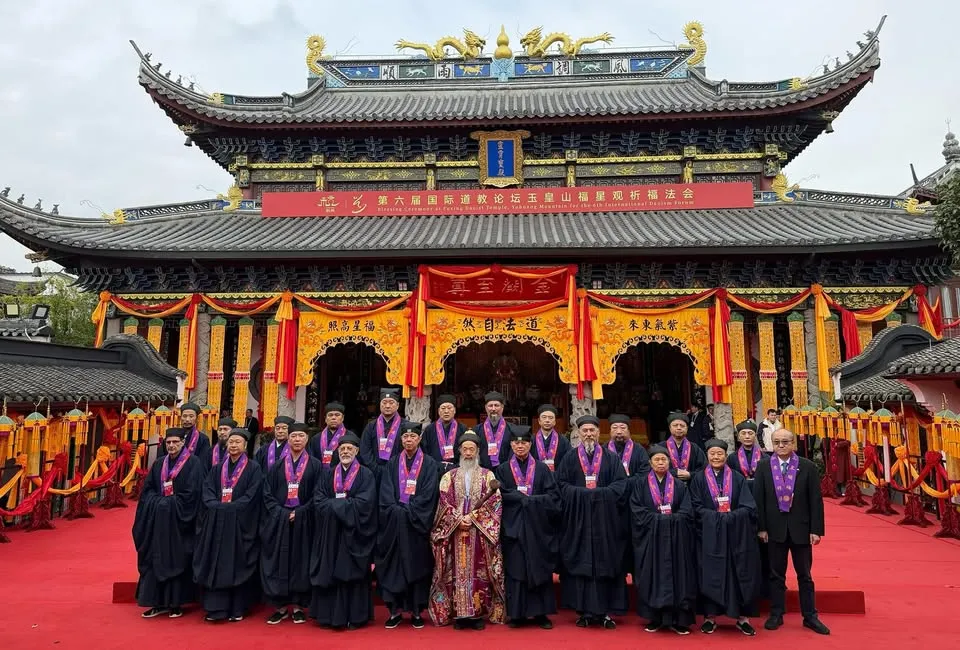
As the forum drew to a close, we went to Fúxīng Guàn (福星观). This Daoist temple stands at the summit of Yùhuáng Shān (玉皇山), or Jade Emperor Mountain, south of the famous West Lake (Xī Hú, 西湖).
There, we held a Daoist ritual intended to establish, maintain, and restore harmony between individuals, communities, nature, and the cosmic order of the Dao. The ritual was not merely the conclusion of our gathering, still less a ceremonial addition. It brought us back to the fundamental understanding that had run through the entire gathering: human beings do not exist apart from the world or in opposition to it, but are an inseparable part of it. Harmony, too, is not something that can be possessed or proclaimed, but a state we must continually cultivate, put into practice, and restore.
After the ritual came handshakes, embraces, and a light shining in one another’s eyes. It was a heartfelt joy: because we exist, because we can come together, and because, despite our many differences, we remain willing to join hands and persevere for the common good. In those simple, sincere moments, where we came from, what language we spoke, and what positions we held no longer mattered. All that remained was the pure joy of people drawing closer to one another.
Perhaps this is one of the simplest, yet most difficult, forms of harmony to achieve.
Then we each set off on our separate journeys.
We flew back, returning from that parallel world to the world we had left a few days earlier. Back to a world of worries large and small, political farce, disappointment, and endless clamour. A world where people always seem so busy proving themselves right that they no longer have the energy or willingness to listen to one another.
Yet was that supposed other world really only a parallel world? Or has it been among us all along, while we have simply lost the ability to perceive it?
Perhaps there have never been two entirely different worlds. Perhaps there has only ever been one world, with two different possibilities for living within it. One gradually loses its way in fear, power, and endless struggle; the other still remembers that people can choose to live differently. We can cultivate virtue, follow the Dao, respect differences, and seek harmony without having to erase anyone’s existence in order to achieve it.
Sometimes I feel that people do not really need very much. A little peace, a book, a piece of music, a tree that blossoms anew each year, a cup of good tea, and another person willing to share the silence.
Yet it is precisely these simplest things that seem hardest to obtain.
Next January, the ancient plum tree in Daming Guan will blossom once again. It will not ask what news the world has brought, or care who has won or lost, who is right or wrong. It will simply flower in silence.
Perhaps we, too, should learn this simple thing again.
Celestial Worthy of Boundless Blessings.


