

 Articles
How to Understand the Chinese Way of Incense
Authors: Xu Xianzeng and Zhang Liang
Xu Xianzeng (徐献增)
Xu has 17 years of experience making traditional Chinese blended incense. He is the person responsible for the Qingcheng Incense-Making Craft Intangible Cultural Heritage Project in Qingyuan, Guangdong Province, China. His work focuses on traditional incense material preparation (paozhi), incense formulas, and hands-on incense making.
Zhang Liang (张亮 / Sam)
Zhang focuses on researching Chinese blended incense culture, studying historical texts, documenting traditional craftsmanship, and writing. His work aims to preserve and organize knowledge of Chinese incense traditions and help make them better understood across cultures.
The article draws on Xu's many years of practical incense-making experience, as well as our shared research and discussions. It was written by Zhang Liang.
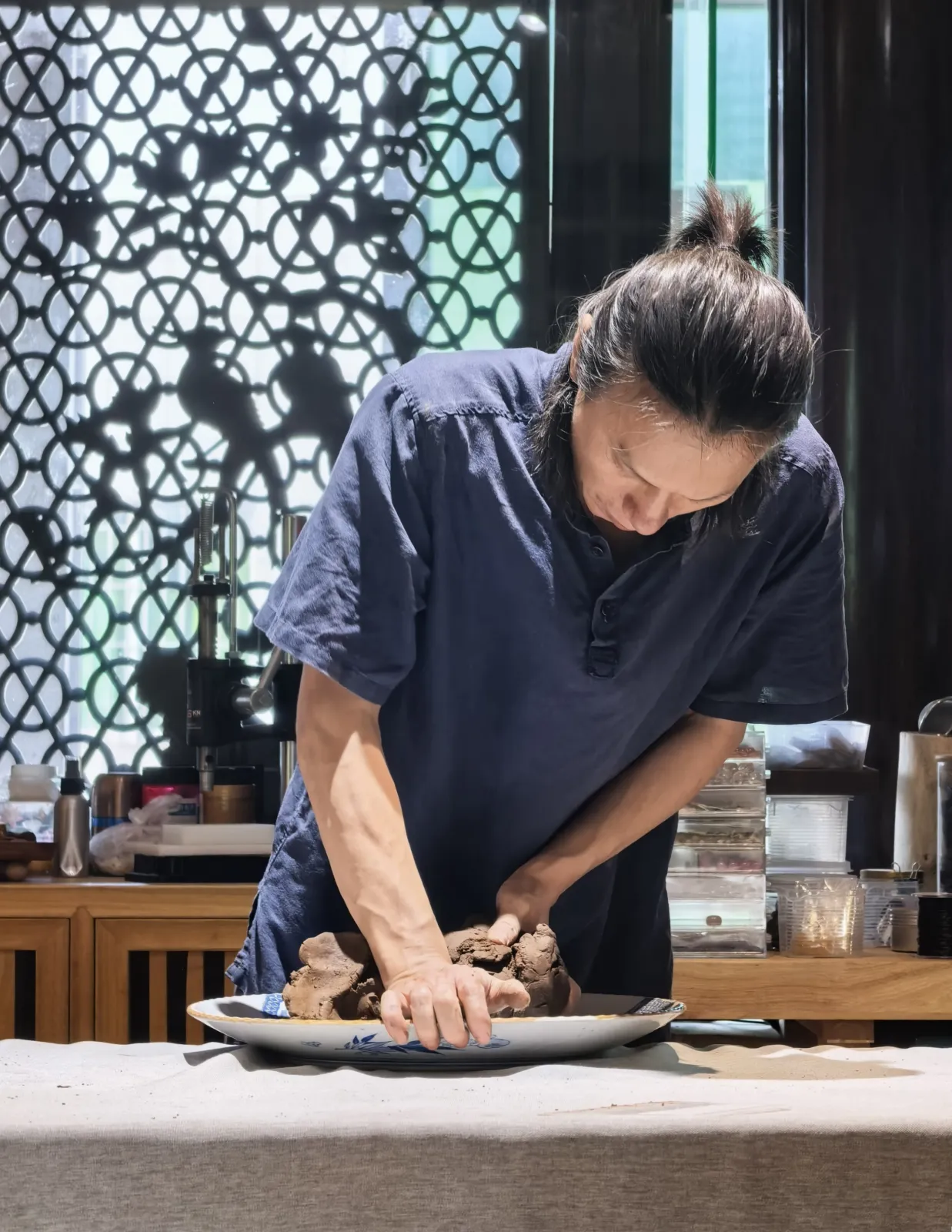
Photograps shows Xu Xianzeng working by hand with traditional incense dough.
Chapter One · What Chinese Hexiang Seeks to Achieve
As an incense maker, I believe there is a Dao in making incense.
I want to begin with an exchange I had on Reddit. A Western incense maker had been reading about traditional Chinese medicine and Daoist incense-making. She noticed that formulas arranged according to Jun–Chen–Zuo–Shi (君臣佐使)—the traditional framework of sovereign, minister, assistant, and envoy roles—often contain medicinal materials that do not seem to have been included for their fragrance. She asked me: Were these materials added for medicinal purposes? Could their constituents enter the human body and produce medicinal effects?
People in China ask similar questions. Can incense treat illness? Some merchants even make disease-treatment claims to promote and sell their incense. Illness calls for a doctor, not incense. When a stick of incense burns, its qi disperses into the air, enters the body with our breath, and returns to the air as we breathe out. To me, incense must first be harmless. Beyond that, it may change a person's state and the state of the surrounding environment. That is all.
Medicinal materials can be used in incense, but incense and medicine, though they share some of the same materials, serve different purposes. Jiangzhenxiang (降真香), for instance, has traditionally been used medicinally to stop bleeding and help wounds heal; in incense, it has been used with the intention of warding off harmful influences and epidemics. Of the thousands of materials found in Chinese medicine, only a small proportion are suitable for incense. To be used this way, a material must be able to burn, and its smoke must be harmless.
The Xiangcheng (香乘, Compendium of Incense) opens with these words:
香之为用,大矣哉!
Translation: “How vast are the uses of incense!”
The Xiang Shi De (香十德, Ten Virtues of Incense) also says:
感格鬼神,清净心身,能除污秽,能觉睡眠,静中成友,尘里偷闲,多而不厌,寡而为足,久藏不朽,常用无障。
Translation: “It moves spirits and deities; purifies mind and body; dispels impurity; awakens one from drowsiness; keeps one company in stillness; offers a moment of leisure amid worldly dust; does not weary us in abundance; is sufficient in small amounts; keeps well over time; and can be used often without hindrance.”
From early on, Chinese people understood incense within a world much wider than fragrance alone. Incense was something to be used.
This understanding also meant that incense ingredients were not limited to things that smelled fragrant on their own. The Xiangcheng describes a substance called lüyi (绿衣), also known as aina (艾纳), found on pine bark. It could be blended with other materials to help the smoke gather rather than disperse. Incense makers even added dried lotus leaves so the smoke would coil and gather, allowing someone to trace the shapes of clouds or written characters through it with a chopstick. Such ingredients were valued not for how fragrant they were, but because incense could be something to look at and play with, as well as to smell.
Every aromatic material has its own nature, but using it exactly as it comes is not necessarily the best choice. Sandalwood, for example, can be too dry and sharp when used directly. Soaking it in green tea and drying it again over heat can temper some of that dryness. Jiangzhenxiang can contain so much oil that burning it produces a smell like scorched rubber, black smoke, and sometimes causes an incense stick to go out before it has finished burning. Boiling it in water, skimming off the oil, then soaking it overnight in black tea and drying it in the sun can bring back a clean, sweet, coconut-like note. By tempering what is overly uncompromising in their character, we may allow the materials' own nature to emerge more clearly and make it easier for them to blend with others.
But paozhi (炮制)—the traditional preparation of materials to adjust their properties—is not simply a matter of removing what is undesirable. Even the same material can be taken in different directions through different methods. Take agarwood. After feishui (飞水), a water-based preparation, some of the sharpness from the pale wood mixed into it can be removed, revealing a clearer, more natural milky-sweet woody note. Agarwood prepared with alcohol has a fuller character when smelled unburned; when lit, it takes on something of a dry, steady pine forest. Agarwood prepared with honey has a borneol-like coolness when smelled unburned, so pronounced that it almost obscures the agarwood itself. Once lit, its fragrance becomes deeper and sweeter, even a little cloying. Each method brings something different, and the honey preparation is the most involved of the three.
Paozhi ultimately involves trade-offs. Sometimes, in removing the roughest part of a material, we also lose what makes it most distinctive. Frankincense becomes gentler after paozhi. Its more forceful notes settle down and are less likely to overwhelm the other ingredients. But when I work with particularly fine Omani frankincense, I often feel a little regret at doing this. What makes it precious is precisely that soaring, expansive quality. If I tame that as well, the material becomes somewhat ordinary.
A stick of Chinese hexiang (合香, blended incense) begins with the paozhi of its materials. It must then pass through grinding, peiwu (配伍)—the considered arrangement of ingredients and their relationships—kneading, shaping, air-drying, and yincang (窨藏), the period of resting and maturing during which the blended materials gradually come together. The entire process may take months, or even years, before the incense is truly finished. The Xiangcheng says:
合香之法,贵于使众香咸为一体。
Translation: “What matters in blending incense is bringing all its fragrances together as one.”
Only then does it become a good incense.
I later used a formula called Biwen Dan (避瘟丹, an incense whose traditional purpose was to ward off epidemics) to explain this to the woman on Reddit. China has a long history of burning aromatic materials to ward off what was understood as epidemic qi. The Taiyi Liujin Fang (太乙流金方) and Hutou Shagui Fang (虎头杀鬼方), recorded in Ge Hong's Zhouhou Beiji Fang (肘后备急方) of the Eastern Jin period (roughly 1,600–1,700 years ago), describe related practices. The formula we use is Bixie Biwen Dan (辟邪避瘟丹), recorded in the Siheting Jifang (饲鹤亭集方) of the Qing dynasty (roughly 100–400 years ago). It consists of eleven materials: jiangxiang (降香), sandalwood, guijianyu (鬼箭羽), danshen (丹参), maoshu (茅术), lianqiao (连翘), baizhi (白芷), xixin (细辛), danggui (当归), danpi (丹皮), and peilan (佩兰). The historical text recommends burning it during unseasonable conditions or epidemics, burning more of it at year's end to ward off harmful influences and illness, and burning it in a room that has stood empty for a long time.
To me, what this incense seeks to change can be understood through two words: qu (驱) and bi (避)—to drive away and to avoid. To drive away means to make harmful influences depart; to avoid means to keep people from being afflicted. The aim, within that traditional understanding, is not to kill something. It is to change the relationship between people and an environment that might otherwise threaten them: harmful influences move away, people can remain safely where they are, and each has its proper place. Add incense to the relationship between a person and the surrounding world, and that relationship may change. Incense thus becomes a medium.
Yet a formula is ultimately brought into being by an incense maker. Given exactly the same materials, different makers will arrive at different answers. What is the nature of each ingredient? In what direction should it be guided? How should it undergo paozhi, and how should it enter into peiwu with the others? What qi will the finished incense form, and how will that qi relate to people and their environment? All of this depends on the incense maker's understanding and judgment.
The same woman on Reddit once asked what roles baizhi, danshen, and the other materials each played in this formula. I could not give her an answer. Once these materials enter the blend, they no longer act independently. Each is within the others and the others are within it; they affect and transform one another, until they form a single, whole qi.
And yet I can clearly judge what happens if baizhi, danshen, and certain other materials are removed. The incense's qi shifts from a warming, yang-oriented character toward something colder. It becomes like a sharp spear, full of force and aggression, but lacking the protection and gentleness it once possessed.
So it is with the Dao in incense. We may never be able to explain completely what it is. But through continued understanding, practice, and choices, we can gradually learn to discern it—and to recognize when something has departed from it.
Chapter Two · The Qi and Yun of an Incense
To an incense maker, understanding a stick of incense begins with discerning its qi. The opening of Volume One of the Chen Shi Xiang Pu (陈氏香谱, The Chen Family's Incense Manual) contains the following passage:
香之遠聞曰馨,香之美者曰𩰡,香之氣曰馦,曰馣,曰馧,曰馥,曰馤,曰馤,曰馪,曰馢,曰馛,曰𩡟,曰馝,曰馞,曰馠,曰馩,曰馚,曰𩡟,曰黁,曰𩡕,曰馟,曰䭲,曰馜,曰馞,曰䭱,曰𩠿,曰𩡓,曰𩡦,曰𩠻,曰𩡔,曰馡。
Explanation: The passage uses a long succession of rare characters for different qualities of aromatic qi. Many have no natural one-word equivalents in English; the complete original is preserved here because the range of characters is itself part of the point.
The Chen Shi Xiang Pu treats “being smelled from afar,” “beauty,” and “qi” separately. It uses xin (馨) for fragrance that carries a long distance, another character for the beauty of fragrance, and a great many different characters for the qi of fragrance. The language the ancients used to describe it was far too rich to be exhausted by the single word “fragrance.”
When we describe an incense today, we often say it has woody, floral, or herbal notes, or perhaps a milky sweetness or a cool quality. These descriptions tell us what it smells like. But qi goes much further. Is an incense strong or faint, gathered or dispersed, perceptible from afar or only nearby? Does it arrive all at once or unfold with depth and persistence? Is it forceful or gentle? All of these belong to its qi.
Even two incenses with much the same woody scent can have completely different qi. One comes toward you as soon as it is lit, full of force, only to fade quickly. Another seems barely noticeable at first, but gradually opens as it burns, growing deeper and more lingering. Some incense seems eager to spread outward and fill the entire room; some stays close, never strong, yet remains for a long time. At times an incense can feel full of life, like plants stretching out in spring. At others it can seem strange and unfamiliar, impossible to describe through any scent we already know. These are all ways in which qi reveals itself. The same kind of scent can have entirely different qi. In a sense, all the many states of an incense become perceptible through it.
Each ingredient also has its own qi. Frankincense has ample, expansive qi and can easily cover up the qi of other materials. Unprepared sandalwood has a dry qi; if it is assigned the role of Jun or Chen—sovereign or minister—without first undergoing paozhi, it may be rather like someone whose virtue is unequal to the position they occupy. Borneol's qi cuts through everything like a sharp blade; add too much and it can break the harmony of the whole blend. Materials differ in strength, dryness, moisture, and temperament. In the same formula, some readily come together, some compete, and some that seem powerful in isolation may be hidden by another ingredient.
Through paozhi, an incense maker adjusts the qi of individual materials. Through peiwu, the maker brings those different kinds of qi into relationship with one another. But the qi of a blended incense is not merely the sum of the qi of its ingredients. An ancient text once used incense to make this comparison:
捣万种香为丸,若烧一尘,具足众气
Translation: “Grind ten thousand kinds of incense into a single pellet; burn just one speck, and the qi of them all is present.”
Many different materials are ground and blended until they form one whole. Even when only a speck of that incense is burned, the qi of all those ingredients is already present. Every ingredient takes part, but no longer stands alone. They affect and transform one another, creating the qi of that particular incense.
A material that was once forceful may become gentle when another material is added. An ingredient that seemed unremarkable may alter the qi of the entire blend. Changing the quantity of one ingredient does not always change only that ingredient's own expression; it can change the relationships among all the different kinds of qi in the formula.
In the traditional understanding of hexiang, whatever an incense is intended to do, it is the incense's qi that ultimately comes into relationship with people and their environment. The uses of incense have their root in qi. This is why discerning qi matters so much to an incense maker. The maker must understand not only the qi of each material, but also the qi that emerges when they are blended. Is the incense dry or moist, scattered or harmonious? Which materials have become too assertive, and which have been obscured? What has changed through paozhi and peiwu? Only by recognizing these changes can the maker judge where their treatment of the materials, and the choices they have made, have ultimately led the incense.
And yun (韵) is the overall impression a person receives from an incense's qi. We can distinguish its strength, how it gathers or disperses, and the ways different ingredients make themselves felt. But when all these elements become one and give the incense a complete character—perhaps even an atmosphere or an image in the mind that no list of fragrance notes can describe—what we experience is yun. Yun arises from qi.
The Chen Shi Xiang Pu records a formula called Su Neihan Pinya Xiang (苏内翰贫衙香). Its ingredients are white sandalwood, frankincense, musk, and xuanshen (玄参). It contains no agarwood, yet to me it conveys elegance without frivolity, and a deep stillness without heaviness. Agarwood often brings a sense of depth and solemnity, but this incense achieves a similar quiet refinement without it. I think of this as “no agarwood, yet in no way inferior to one that has it.” The yun of an incense is not determined by the presence of any one ingredient; it comes from the qi of the whole.
Another example is Er Su Jiu Ju (二苏旧局), a formula recorded by Chen Yunjun in Yanju Xiangyu (燕居香语). The “Two Su” are Su Shi and Su Zhe, brothers and writers of the Song dynasty (roughly 750–1,100 years ago). The formula takes them as its cultural inspiration, and uses agarwood, sandalwood, frankincense, amber, and jasmine, though no precise proportions are given. It was originally intended for indirect heating. When we tried to adapt it into incense sticks, we found that directly burning dried jasmine flowers produced an odor resembling scallion oil, while burning amber gave off something like the smell of plastic. So we used jasmine hydrosol in the dough instead of dried flowers and replaced amber with jinyanxiang (金颜香).
Solving the problems caused by directly burning those materials did not, however, make the incense harmonious. Our first ratio of agarwood, sandalwood, and frankincense was 4:2:1. When lit, the qi was muddled, with no clear sense of what should lead and what should follow. Sandalwood competed with agarwood, and the jasmine sweetness was too conspicuous. The whole incense felt contrived and ostentatious. This was not the character we hoped Er Su Jiu Ju would express. Later we changed the ratio of those three ingredients to 4:1:1, cutting the sandalwood by half. That one change noticeably transformed the qi of the entire incense.
The sandalwood no longer fought with the agarwood, allowing the agarwood's quiet, deep woody character to emerge more clearly. The fresh fruity note of frankincense, in turn, balanced the excessive sweetness of the jasmine. What had previously felt too conspicuous now came together more naturally. We wanted to express the character and bearing of the Su brothers as men of letters, not a showy elegance made by piling one fragrance upon another. After that adjustment, the incense took on a quality that was warm, restrained, and unhurried.
To smell it is to encounter a gentleman as warm and refined as jade, whose grace comes naturally from a life steeped in books.
Chapter Three · Where the Chinese Way of Incense Comes From
The attention Chinese hexiang gives to the nature of materials, the importance it places on paozhi and peiwu, and its understanding of the relationship between incense, people, and their surroundings did not suddenly take shape in any one period. These ideas and practices have different origins, and over a long history they gradually came together.
As early as the pre-Qin period (more than 2,200 years ago), aromatic plants were being used in ritual and everyday life. The Liji (礼记, Book of Rites) records the burning of xiao (萧), an aromatic plant, together with millet during sacrifices, sending smoke upward. By the Western Han dynasty (roughly 2,000–2,200 years ago), the tombs at Mawangdui in Changsha contained Sichuan pepper, maoxiang, peilan, cinnamon bark, magnolia buds, duheng, gaoben, galangal, ginger, and other plant materials, as well as fragrance sachets, aromatic pillows, and incense burners. Peilan was used to fill a pillow, while magnolia buds appeared both in sachets and in burners. The same plant could be worn close to the body or burned to release its fragrance into a room. People were already finding different ways for the scent of plants to take part in their lives.
As overland and maritime routes expanded, aromatic materials from different regions—including agarwood, sandalwood, and frankincense—gradually entered China. Incense makers gained access to a wider range of ingredients from increasingly varied places. Different materials had different fragrances, textures, and burning properties. Bringing them together required more careful knowledge and skill: how should they be prepared, and how should they be blended? By the Wei, Jin, and Northern and Southern Dynasties (roughly 1,400–1,800 years ago), written sources already give us glimpses of such incense-making practices.
Fan Ye, who lived during the Liu Song dynasty (roughly 1,550–1,600 years ago), wrote a work called He Xiang Fang (和香方, Formulas for Blending Incense). Although the book itself has been lost, its preface survives in the Taiping Yulan (太平御览). It says:
麝本多忌,过分必害;沉实易和,盈斤无伤;零藿虚燥,詹唐黏湿。
Translation: “Musk calls for many cautions; too much can cause harm. Agarwood is substantial and easy to blend; even a full jin does no harm. Ling and huo are light and dry; zhantang is sticky and moist.”
What is interesting is that this preface is not only about incense. Fan Ye uses the different temperaments of aromatic materials as metaphors for people at court, likening himself to the substantial, accommodating agarwood. But it was precisely because people recognized these characteristics of different materials that the comparison could work. An aromatic material was not simply something with a particular scent. Its strength, dryness or moisture, and its ability to work with other ingredients were all qualities that could be recognized and discussed.
At the same time, Chinese medicine and Daoist traditions were extending the understanding of plants and incense in different directions.
Ge Hong of the Eastern Jin was both a Daoist thinker and a practitioner of medicine. His Zhouhou Beiji Fang (肘后备急方) preserves a number of ancient methods intended to respond to epidemics. Some of the materials in these methods could be worn on the body, hung over doorways, or burned in courtyards. Within these practices, people were concerned not only with illness inside the body but also with the surrounding environment, and with using plants, minerals, and fumigation or worn objects to avoid harm. Burning aromatic substances here had purposes connected with illness, epidemic prevention, and the environment, rather than merely making the air smell pleasant.
In the Southern Dynasties (roughly 1,400–1,600 years ago), Tao Hongjing was another particularly interesting figure. He was an important representative of the Shangqing school of Daoism, but he was also deeply knowledgeable about materia medica and medicine. He compiled the Bencao Jing Jizhu (本草经集注), organizing the medicinal knowledge of earlier generations. He also wrote the Dengzhen Yinjue (登真隐诀), which describes Daoist rituals and methods of cultivation. In his life and work, the study of medicinal materials, medicine, and Daoist cultivation were intertwined. The same plant could be studied as a medicinal material and also enter the life of cultivation and ritual, though each use made its own demands.
The medical tradition, meanwhile, developed its own methods of understanding and treating materials. What was the nature of a plant? Did it tend toward cold or heat? What might change when it was treated with water, alcohol, honey, or fire? How should it be balanced with other materials? These were questions studied through the long development of Chinese materia medica and medicinal preparation. By the Southern Dynasties, the Leigong Paozhi Lun (雷公炮炙论) was already devoted specifically to methods of preparing medicinal materials. Such practices were not the same as incense-making, nor can we say that all the paozhi and peiwu of Chinese blended incense came from medicine. Yet the two traditions share a serious concern with the natures of materials and the relationships between them.
Alongside medicine and religion, incense also became an important part of the lives of Chinese scholars and writers. Especially by the Song dynasty (roughly 750–1,100 years ago), burning incense was closely associated with reading, writing poetry, spending time with friends, and being alone. Scholars did not merely use incense; they exchanged and discussed formulas, evaluated them, and sometimes made incense themselves. A formula could express an understanding of a person's character or evoke a particular atmosphere. It did not have to be named only for its ingredients or fragrance.
The Chen Shi Xiang Pu includes a group of formulas known as the Four Incenses of Huang Taishi (黄太史四香), closely associated with the poet and calligrapher Huang Tingjian. One of them, Shenjing Xiang (深静香, Deep Stillness Incense), was made and presented to Huang by his friend Ouyang Yuanlao. Huang wrote about the character of this friend and concluded:
此香恬澹寂寞,非世所尚,时时下帷一炷,如见其人。
Translation: “This incense is quiet, plain, and solitary, not the sort favored by the world. From time to time, I lower the curtain and burn a single portion; it is as though I see the man himself.”
When Huang lit this incense, its quiet, unadorned character seemed to bring his friend before him again. Fragrance, human character, and the affection between friends came together in that moment. To me, this is one of the most interesting things about incense in the lives of Chinese scholars: an incense can possess its own qi and yun, and can also carry a person's understanding and feelings.
In the Song dynasty, Hong Chu compiled a Xiangpu (香谱, Incense Manual). The later Chen Shi Xiang Pu brought together material from several earlier incense manuals, preserving many formulas and methods. On the art of blending incense, it makes a particularly important statement:
合香之法,贵于使众香咸为一体。
Translation: “What matters in blending incense is bringing all its fragrances together as one.”
It goes on to say:
比其性,等其物而高下,如医者则药,使气味各不相掩。
Translation: “Compare their natures, weigh the materials and adjust their proportions, as a physician does with medicines, so that the qi and fragrances do not conceal one another.”
To blend incense, one must compare the natures of different materials and judge their proportions and relative importance, much as a physician combines medicinal ingredients. The aim is for the aromatic materials to come together, rather than obscure one another.
The same manual also discusses the preparation of incense materials, grinding, storage, yincang, and burning methods. Some materials need to be moistened with alcohol, others boiled in water, and some prepared with honey. If the powder is too fine, the smoke does not last; if it is too coarse, the text says, its qi will not be harmonious. Newly blended incense must also be left to mature, so that its dryness and moisture reach the right balance and the natures of its materials gradually enter into one another.
In the Ming dynasty (roughly 400–650 years ago), Zhou Jiazhou spent more than twenty years compiling the Xiangcheng, a work of twenty-eight volumes. It records not only aromatic materials and blending formulas, but also accounts of incense use across history, incense burners, incense seals, and a great many poems and writings about incense. By bringing together knowledge once scattered across many different texts, it preserved a wealth of earlier methods and ideas, allowing us to encounter them even today.
When we look at an incense formula now, we still have to understand the nature of every ingredient, decide how to carry out paozhi and peiwu, consider what kind of qi the finished incense will form, and what relationship it may establish with people and the surrounding environment. These are questions the ancients also faced, again and again. The formulas, manuals, and methods they left behind record the many answers they arrived at.
I believe the Chinese Way of Incense gradually took shape through this long process of understanding and practice, and has continued to the present day.


