

 Articles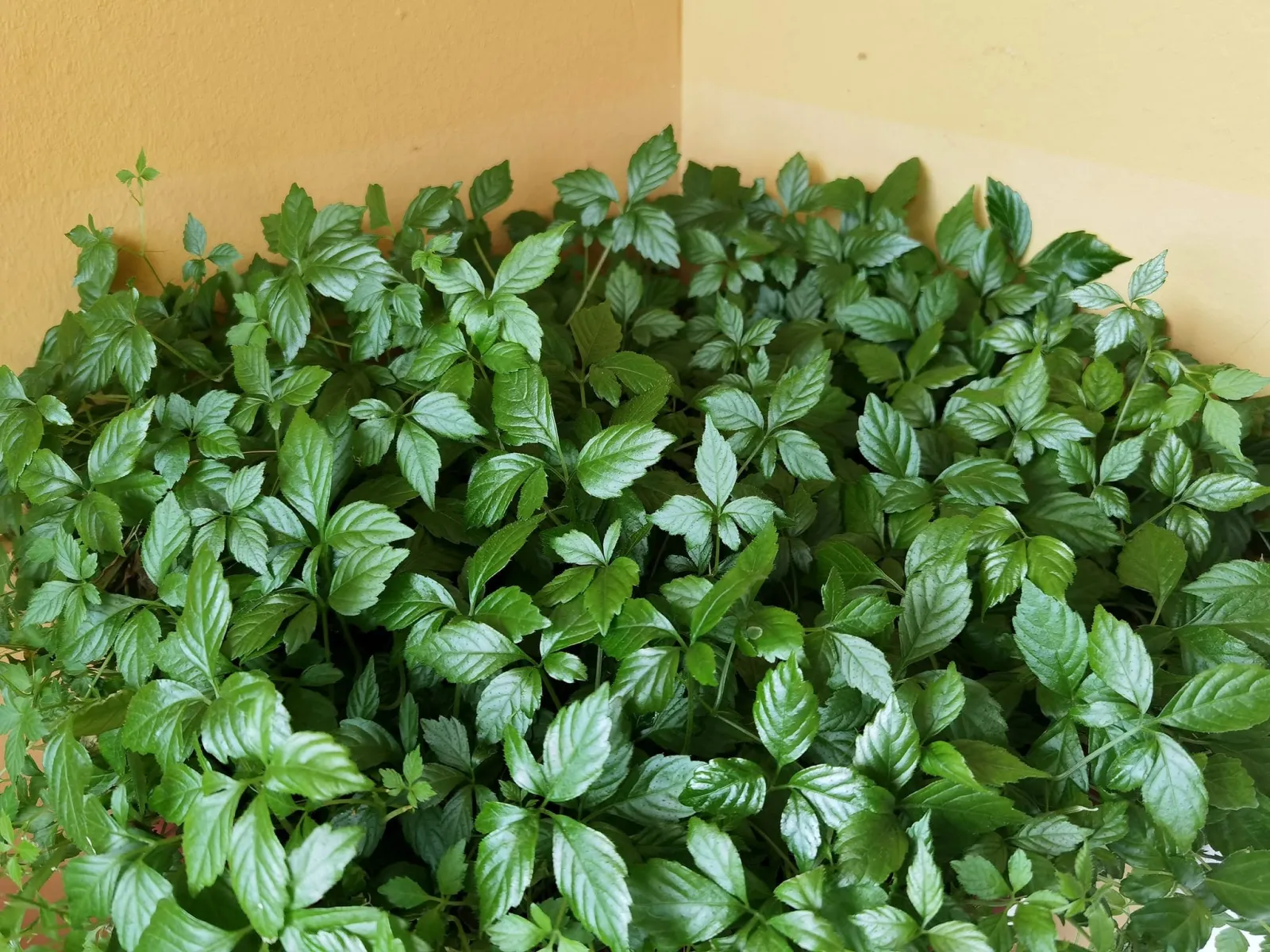
Chinese ethnobotany: Jiaogulan / jiǎogǔlán / Gynostemma pentaphyllum (Thunb.) Makino
Jiaogulan is a perennial herbaceous climber in the gourd family (Cucurbitaceae), which also includes cucumbers, pumpkins and melons. In China, it is known primarily as 绞股蓝 (jiǎogǔlán), a plant whose young leaves and shoots are used as vegetables, while its leaves are also used to make tea.
In modern popular literature, it is often called “southern ginseng” or “five-leaf ginseng”, although it is not botanically related to ginseng. The name refers mainly to the similarity between some of its active compounds and those found in true ginseng.
Jiaogulan is interesting precisely because it brings together different ways of relating to a plant: food, tea, folk medicine and modern pharmacological research.
The plant and its environment
Gynostemma pentaphyllum is a climbing plant that can grow over other plants and cling to supports. Its leaves consist of several leaflets, most often five, which also gave the species its English name five-leaf ginseng. The number of leaflets can, however, vary between individual plants.
The species is dioecious, meaning that male and female flowers generally develop on separate plants.
In China, it grows in forests, shrubland and along paths on mountain slopes, at elevations of approximately 300 to 3,200 metres above sea level. It is widespread in many Chinese provinces, as well as in other parts of South and East Asia, including Japan, the Korean Peninsula, India, Nepal, Vietnam, Laos, Myanmar, Malaysia and New Guinea.
Although we can also grow it at home, in a pot or in the garden, it is worth knowing that it is a perennial plant in its natural environment.
A plant for times of famine
One of the most interesting early mentions of jiaogulan is connected with the work Jiuhuang bencao 《救荒本草》, compiled in 1406 by Zhu Xiao (朱橚).
The very title of this work – Bencao for Famine Relief or Herbs for Times of Famine – tells us something important about attitudes towards plants at the time. The book was devoted not only to medicinal plants, but also to plants that could be used as food during periods of scarcity.
Jiaogulan was thus described in a historical source as an edible wild plant. This is an important part of its story: its history is not only that of a medicinal herb, but also one of food and survival.
Later Chinese pharmacopoeial literature also attributed various medicinal uses to the plant. Within the traditional framework, jiaogulan is described as a plant with a slightly bitter taste and a neutral nature; traditional medicine attributes to it, among other things, the ability to “clear heat”, detoxify and support qi. These descriptions should be understood within the traditional Chinese medical system and should not be equated with modern medical diagnoses.
From vegetable to tea
Jiaogulan leaves can be used fresh, mainly as a vegetable, or dried to prepare a drink.
The tea has a distinctive taste that can be described as bittersweet. Its usefulness as an everyday drink is important to understanding its place in Chinese culture.
Jiaogulan is a good example of a plant for which the boundary between food and medicinal plants is not entirely clear. In traditional cultures, a plant is not necessarily first and foremost a “medicine” used only when illness occurs. It can be part of the daily diet, a tea or a household tradition of herbal knowledge, while its use also has significance for health.
Why “southern ginseng”?
Although jiaogulan is not related to ginseng, the comparison is understandable.
The plant contains numerous dammarane saponins called gypenosides (绞股蓝皂苷, jiǎogǔlán zàogān). Some are similar in chemical structure to the ginsenosides characteristic of the genus Panax.
This is precisely why jiaogulan is often presented in modern literature as “southern ginseng”.
In addition to saponins, research has identified various polysaccharides, flavonoids and phytosterols in the plant. Gypenosides are among the most extensively studied constituents of jiaogulan.
Jiaogulan in modern research
Modern interest in jiaogulan extends far beyond its traditional use as a tea.
Researchers are primarily studying its potential effects on glucose and lipid metabolism, oxidative stress, inflammatory processes, and the functioning of the cardiovascular and nervous systems and the liver. Much of this research is conducted in cell cultures and animal models, so its results cannot be directly extrapolated to humans.
There are also clinical studies. One randomised study, for example, examined the consumption of Gynostemma pentaphyllum tea in people with type 2 diabetes and found improvements in certain measures of blood glucose and insulin sensitivity.
A systematic review of 22 randomised studies involving more than 2,400 participants examined the use of jiaogulan for blood lipid disorders. The results were interesting, but the certainty of the evidence was rated as low to very low, and the quality of many studies was limited.
It is therefore important to distinguish between traditional use, promising laboratory research and clinically confirmed effects when considering jiaogulan. Modern science has shown considerable interest in the plant, but not all traditional claims about its effects can yet be regarded as proven treatments for disease. More recent reviews also highlight the lack of standardised preparations and sufficiently high-quality clinical data.
Jiaogulan as an everyday tea
We can use dried leaves to prepare the tea.
Preparation by infusion
Place approximately 1 teaspoon, or 1.5 g, of dried leaves in a cup and pour around 200 ml of hot water over them. The recommended temperature is approximately 80–90 °C, with a steeping time of 3–5 minutes.
Preparation by heating
The leaves can also be placed in approximately 200 ml of cold water and slowly brought to the boil.
The drink may taste more distinctly bitter at first, followed by a characteristic sweetish sensation.
A plant between tradition and modernity
Jiaogulan is interesting precisely because its history cannot be reduced to a single label. It was a wild edible plant that could help people survive food shortages. It became an herbal tea and an ingredient in traditional medicine, and today its chemical constituents and possible biological effects are being studied intensively. The relationship between old Chinese knowledge and modern science is therefore not a simple choice between the “traditional” and the “modern”. The plant remains the same, while the questions people ask about it change. Perhaps this is one of the distinctive features of ethnobotany: plants are not merely objects in nature, but also part of human history, food, healing, language and memory.
Name
Chinese: 绞股蓝
Pinyin: jiǎogǔlán
Latin: Gynostemma pentaphyllum (Thunb.) Makino
Family: Cucurbitaceae – the gourd family
English: jiaogulan, five-leaf ginseng, southern ginseng
Rector Yuan Weiqi of the Slovenian Daoist Temple
Sources:
Zhu Xiao, Jiuhuang Bencao 《救荒本草》, 1406.
A review of modern research on the chemical composition and pharmacological properties of Gynostemma pentaphyllum.
Flora of China, entry for Gynostemma pentaphyllum.


