Daoist Studies
Commentary: The Contemporary Value of Daoist Culture, Cross-Cultural Communication and Pathways to Practice
Zhang Xuesong (张雪松), pen name Yushan (雨山), holds a PhD from the Department of Cultural and Religious Studies at the Chinese University of Hong Kong (香港中文大学文化及宗教研究系) and is a professor and doctoral supervisor at the School of Philosophy, Renmin University of China (中国人民大学哲学院). Zhang has published seven academic monographs and four translated works, including 《天蓝色的彼岸》, in Taiwan (台湾), China (中国), and on the mainland.
This group of 13 papers explores the contemporary value of Daoist culture, its dissemination overseas, cultural transmission and the wisdom of harmony. Topics include philosophical principles, religious transformation, scriptural practice, cross-cultural translation, environmental protection, the safeguarding of intangible cultural heritage, social governance and dialogue between civilisations. Taken together, the papers are distinguished by their integration of scriptural interpretation with contemporary issues, their connections between Chinese experience and overseas practice, and their equal attention to theoretical reflection and case studies. The authors come from various countries and regions, including China, Brazil (巴西), Slovenia (斯洛文尼亚), the Netherlands (荷兰) and Venezuela (委内瑞拉). They include university scholars, leaders of Daoist organisations and practitioners from Daoist temples, reflecting the open, diverse and mutually enriching academic spirit of the World Daoist Forum (世界道教论坛). The following brief review considers four aspects.
First, through discussions of the Dao, virtue, non-action, contentment, scriptural practice and modern transformation, these papers explain the significance of Daoist philosophy for spiritual grounding today, ethical development and religious self-renewal.
The papers on this theme have solid philosophical foundations and clearly defined questions, making this the most philosophically substantial part of the collection.
Zhang Guangbao (张广保)’s paper takes a broad perspective, beginning with the “Dao” as a defining symbol of Chinese culture. It systematically examines the spirit of immanent transcendence in Daoist philosophical accounts of the Dao, the distinctive role of “transtheism” in Daoism’s religious foundations, the cosmology of following and reversing the natural course in the alchemical study of inner nature and life, and the ecological wisdom contained in the concept of grotto-heavens and blessed lands. Placing Daoism within a framework of comparison between civilisations, the paper argues that its emphasis on realising the Dao through techniques and uniting techniques with the Dao is rooted in Chinese civilisation’s practical rationality, which values lived practice and empirical verification.
Xiao Dengfu (萧登福)’s paper begins with the proposition that “Daoism carries forward Chinese culture”. It emphasises that, given the vast number of Daoist scriptures, the finest should be selected for transmission. It specifically identifies Daode jing, Taishang ganying pian, Qingjing jing, Huangting jing, Zhouyi cantong qi and Duren jing as classics deserving focused study. It also offers practical recommendations for simplifying and classifying Daoist rituals and applying cultivation methods in contemporary life. By addressing the transmission of scriptures, the adaptation of ritual and temple-based practice in concrete terms, it reflects conscious consideration within Daoism of “what to transmit and how to transmit it”.
Guo Wu (郭武)’s paper directly addresses the fundamental question of “whether Daoism should change in modern society, and how it should change”. Drawing on both history and present circumstances, it argues that transformation is a normal feature of Daoism’s development. It cites “When a limit is reached, change follows; with change comes a way forward” from Yi zhuan, and “The Dao follows what is naturally so” and “Through non-action, nothing is left undone” from Daode jing, to show that renewal in response to circumstances and flexible adaptation are inherent in the logic of Daoist thought and religion. It proposes three principles for transformation: responding to actual needs, engaging with contemporary mainstream culture and preserving Daoism’s “true spirit”.
Kang Pulei (康朴雷) begins with Laozi (老子)’s understanding of virtue, diagnosing “the loss of the Dao and virtue” as a self-reinforcing structure of desire, competition and force. The paper presents contentment, knowing when to stop, non-action and non-contention as paths to cultivating virtue, extending this discussion to the question facing technological civilisation: “Just because we can do something, should we?”
Zhang Xingfa (张兴发) examines Daoist views of the cosmos, life, human existence, morality and ecology from the perspective of philosophy as a discipline, and discusses Daoism’s potential in global governance. Together, these five papers demonstrate that Daoism does not belong solely to historical texts. Its core philosophical principles can respond to spiritual anxiety, escalating desires and imbalanced relationships in modern society, providing a sound philosophical basis for the creative transformation of Daoist culture.
Second, by focusing on overseas Daoist organisations, translation and interpretation, and dialogue between civilisations, these papers explore ways of transmitting the Daoist tradition while maintaining its continuity in different cultural settings.
Beginning from the perspective of practitioners in overseas Daoist organisations, the papers on this theme deepen “dissemination” into “transmission of tradition”, “translation” into “interpretation”, and “dialogue” into “coexistence”. This is the part of the collection with the strongest international perspective.
Tian Xinshan (田信善)’s paper draws on the overseas practice of the Daoist Society of Brazil (巴西道教协会). It highlights the particular value of Chinese Daoist priests travelling to the West (西方) for exchanges, enabling people there to encounter Daoist teachings and cultivation practices directly. Many people lack the means to travel to China, spend years learning Chinese and then undertake systematic practice. Daoist priests who have settled and begun teaching in the West provide opportunities for systematic study to adherents in Europe (欧洲), North America (北美), Central America (中美) and South America (南美), enabling some to become Daoist priests and carry forward traditional knowledge. The paper further advocates establishing and strengthening traditional paths of study and practice, using the dissemination and translation of scriptures to build bridges between different cultural worlds. In this way, the study of Daoism need not remain confined to fragmentary or inadequate explanations, but can sustain traditional transmission and preserve teachings passed down through successive generations of lineage masters. Beginning with the questions of “what is needed overseas and how those needs can be met”, this discussion combines practical awareness with a concern for continuity in the Daoist tradition.
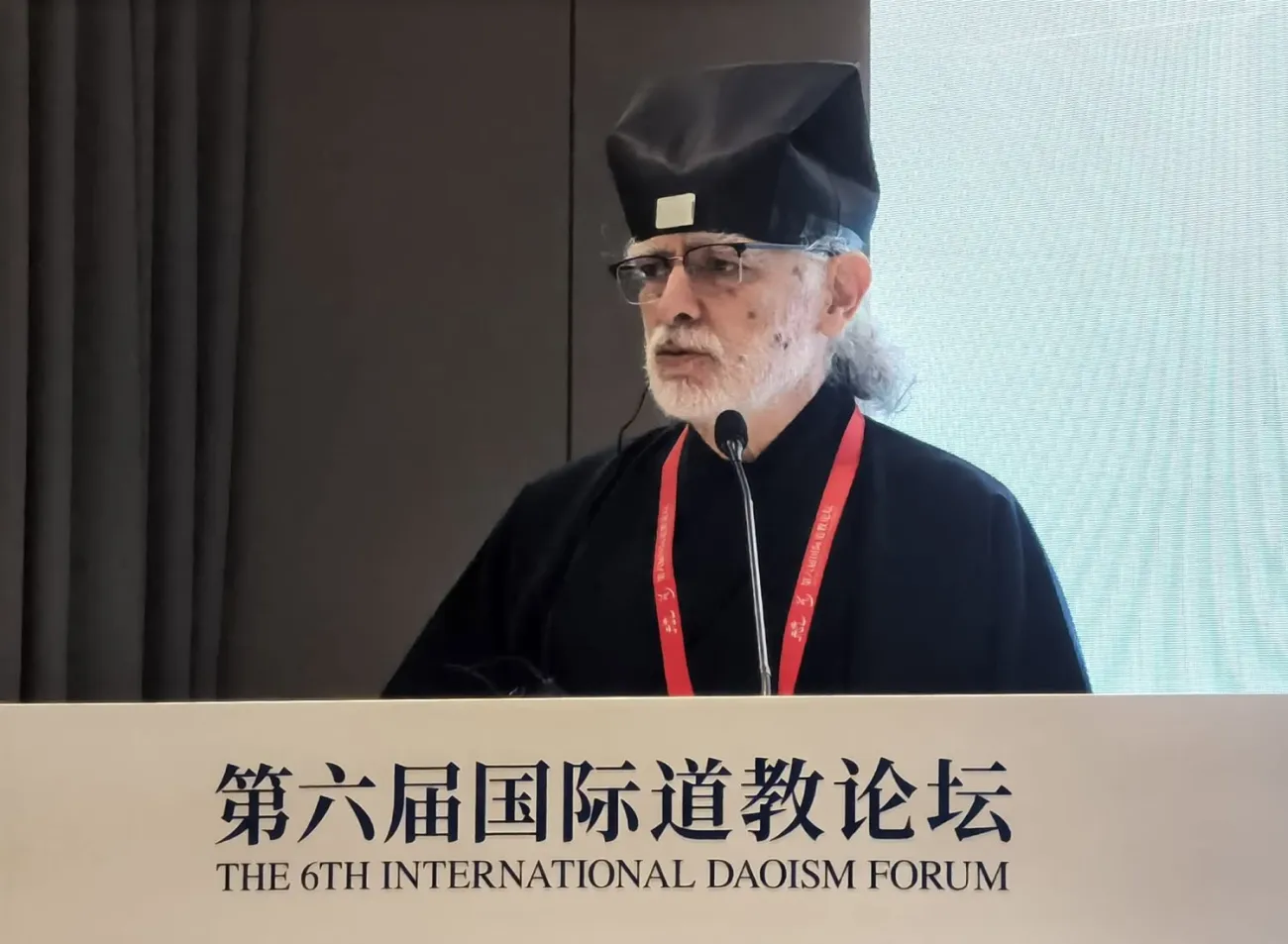
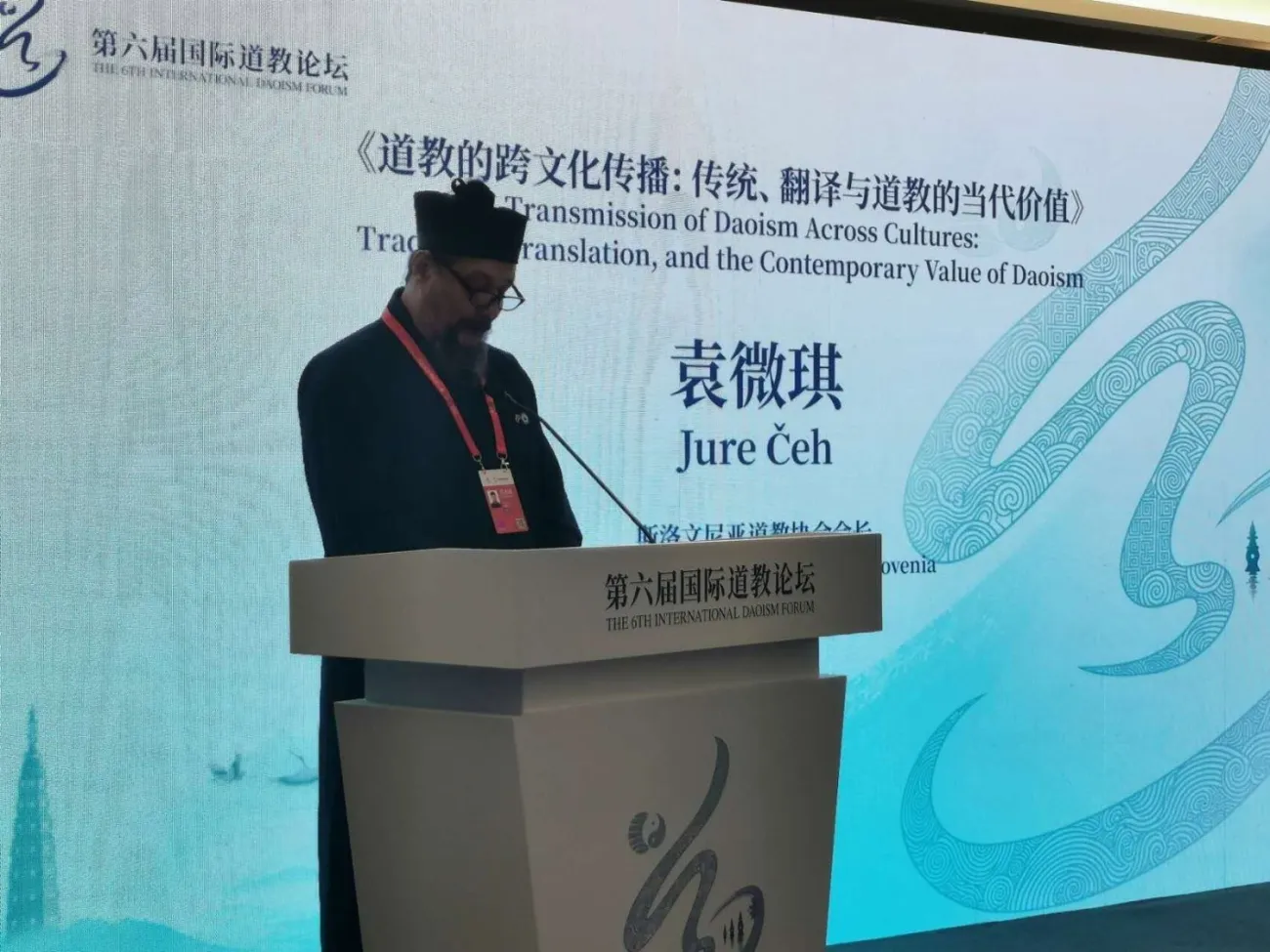
Yuan Weiqi (袁微琪)’s paper develops the discussion further through the specific case of the Slovenian Daoist Temple of Supreme Harmony (斯洛文尼亚道教太和宫). It distinguishes between “historical cultural heritage” and “a continuing religious tradition”, arguing that preserving Daoism does not mean reproducing unchanged every particular form it has taken in Chinese history. Nor, however, should a new cultural environment be allowed to reshape Daoism arbitrarily. The real work of transmission is to find new forms through which the tradition can be sustained while preserving continuity. The author offers an illuminating perspective on translating “virtue”: “cultivating virtue” is not the accumulation of moral qualities, but a transformation in how a person exists and acts in the world. In discussing “non-action”, the paper likewise emphasises that the focus is not on “not acting”, but on a way of acting that does not depend on forceful intervention. The paper also describes the Slovenian temple’s establishment of friendly relations with Chongdao Gong (崇道宫) in Yichun (宜春), Jiangxi (江西), China; members’ participation in training in Daoist ritual music at Chongdao Gong; cooperation with the University of Ljubljana (卢布尔雅那大学) and the University of Primorska (普利莫斯卡大学); and the development of a multilingual website. These efforts pursue “encounter without assimilation”. Through these examples, “cross-cultural dissemination” moves beyond the advocacy of principles and emerges as an integrated practice encompassing education, ritual, music, scholarship, digital platforms and community life.
Ye Sushi (耶稣士)’s paper approaches the subject through geometry and topology, critiquing the “one true God”-style division of the world into “non-intersecting” domains. Using the intertwined underground root systems of tropical rainforests as a metaphor, it explains a Daoist topological perspective of “non-empty intersections”, symbiosis and mutual learning. Drawing on personal experiences of wearing Daoist robes and promoting interdisciplinary exchanges at universities and an academy of sciences in Venezuela, the author illustrates the practical significance of “flowing like water”. Together, these three papers show that the overseas dissemination of Daoism is not simply the export of teachings. It involves preserving differences through translation, embodying transmission through practice, sustaining lineages through institutional cooperation and achieving “harmony without uniformity” through dialogue between civilisations. Overseas Daoist priests and organisations are becoming an important force in sustaining and preserving the Daoist tradition.
Third, through examples of environmentally responsible temples, ritual music as intangible cultural heritage and regional cultural development, these papers demonstrate the practical vitality of Daoist ecological ethics, cultural preservation and service to society.
Huang Renxian (黄任贤) uses the environmentally friendly Cihang Jingyuan (慈航静苑) and the Daode jing Stele Garden (《道德经》碣石园) to show how “green Daoist practice” can be realised in architecture, ritual and public education.
Wu Bingzhi (吴炳鋕) systematically reviews the integrated “family—association—school” system for transmitting Daoist ritual music in Macao (澳门), providing a practical model for the living transmission of intangible cultural heritage.
Jin Chongjing (金崇景) draws on the development of Daoist culture in Zhejiang (浙江) to discuss honouring the Dao and valuing virtue, the Dao’s accord with nature, equal concern and compassion, and innovation grounded in foundational principles. All three papers are rooted in concrete practice, offering vivid and specific accounts of Daoist ecological wisdom, cultural transmission and public service. They reflect Daoist culture’s commitment to “the unity of knowledge and action”.
Fourth, moving from self-cultivation and firm foundations, through responsibility for family and country, to harmony throughout the world, these papers discuss how Daoist wisdom on harmony aligns with efforts to build a community with a shared future for humanity and a community with a shared future for Chinese businesspeople.
Li Shaohua (李绍华)’s paper begins with the Daoist community’s own practice and responsibilities, proposing three dimensions: “self-cultivation and firm foundations, responsibility for family and country, and harmony throughout the world”. Its structure is clear and its aims are high-minded. The paper connects internal Daoist cultivation, a sense of community for the Chinese nation and a community with a shared future for humanity. It reflects both the practical perspective of a religious organisation’s leader and a broad awareness of contemporary concerns.
Liao Junqiao (廖俊侨) centres the discussion on “generation through the Dao, transformation through virtue, and harmony throughout the world”, examining the cultural support that Daoist wisdom on harmony can offer to global governance, international economic and trade cooperation, and the building of a community with a shared future for Chinese businesspeople. Both papers take a broad perspective, connecting Daoist principles with contemporary concerns such as the community of the Chinese nation and a community with a shared future for humanity. They demonstrate Daoist culture’s constructive engagement in global dialogue between civilisations.
Overall, these 13 papers are thematically focused, rich in perspective and diverse in style. They offer both in-depth interpretations of the Dao, scriptures and religious transformation, and an integrated consideration of the path from self-cultivation and firm foundations to harmony throughout the world. Alongside concrete accounts of overseas dissemination, ecological practice, the safeguarding of intangible cultural heritage and service to society, they provide broader perspectives on how Daoist wisdom can contribute to global governance and mutual learning between civilisations. Taken together, the papers give equal weight to preserving foundational principles and pursuing innovation, combine theory with practice, and connect Chinese concerns with a global outlook. They offer a fairly comprehensive scholarly picture of the contemporary value of Daoist culture, as well as useful reflections on the Daoist community’s participation in building a community with a shared future for humanity.