

 Daoist Studies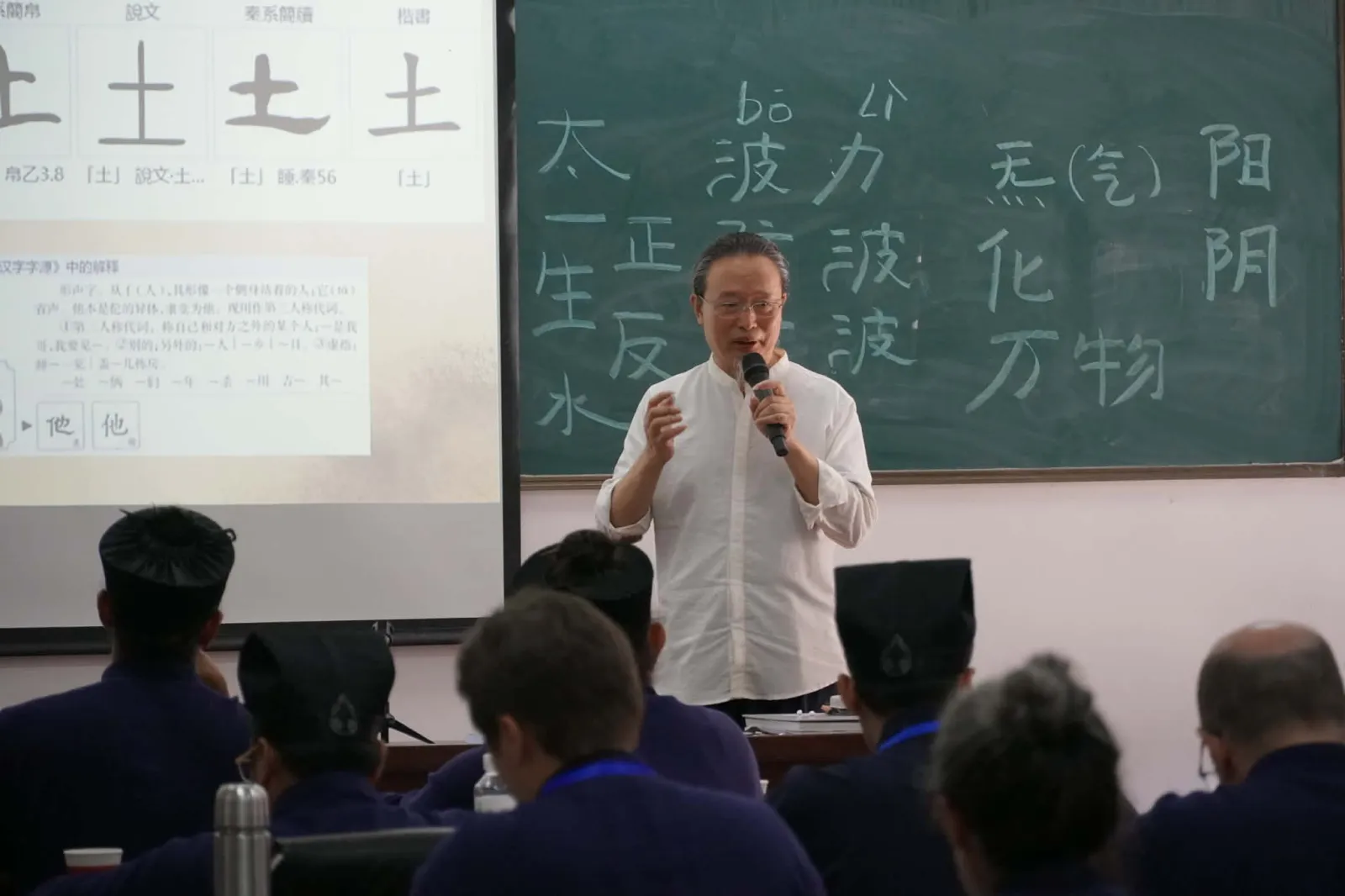
Qianzi wen 千字文 (Thousand Character Classic): a concise encyclopedia of Chinese culture
We often first think of Chinese as a language of complex characters. Yet Thousand-Character Classic shows that these characters are not merely signs for writing words, but gateways to a different way of thinking: a world in which the cosmos, Earth, human beings, nature, government, ethics and everyday life are connected within a single symbolic system. This is precisely why this ancient text is much more than a textbook. It is a condensed map of Chinese culture, encompassing everything from the macrocosm to the microcosm: from the origins of the universe to human beings, their place in the world and their everyday lives.
“Heaven is dark blue, Earth is yellow; the cosmos is chaos, immeasurably vast and new.” (Tiān dì xuán huáng 天地玄黃, yǔzhòu hóng huāng 宇宙洪荒).
This is the very verse that opens Qianzi wen 千字文 (Thousand-Character Classic), one of the best-known and most widely circulated Chinese texts. Alongside the Three-Character Classic, it served for 1,400 years as a foundational text for teaching literacy in China and beyond. It is therefore regarded as a monument to Chinese literacy.1
It was written around 1,500 years ago by the scholar Zhou Xingsi at the request of Emperor Wu of the Southern Liang dynasty (Nán Liáng). The emperor’s aim was to teach his courtiers and his own children to read and write through calligraphy drawn from the works of the renowned master Wang Xizhi. He instructed Zhou to select a thousand characters from these works and combine them into a poem that would be easy to memorise. No character was to appear more than once.
Zhou did indeed succeed in composing a rhyming text from a thousand characters, each unique and therefore appearing only once in the entire work. Deng Xuelin, a professor at the Wudangshan Daoist Academy, emphasised at the Second International Daoist Culture Seminar in Danjiangkou that, even today, the text remains “an exceptionally effective and engaging starting point for learning Chinese and getting to know Chinese culture”. It brings together a wide range of subjects: cosmology, nature, history, self-cultivation, family ethics and the philosophy of life. Because the characters follow a precise, universally familiar sequence, the Classic was used for centuries to number documents, examination papers and official archives.
The poem’s strictly symmetrical text, interwoven with Confucian thought, is given a steady rhythm by its 250 four-character lines. Every second line rhymes. The alternating tones characteristic of Chinese create a natural melody. This allowed pupils to sing the text or recite it rhythmically, making it easier to memorise.
By reading the text in pinyin, the official system for representing the pronunciation of Chinese characters in the Latin alphabet, we seminar participants were also able to experience the rhythm and structure of Chinese.
The lecturer did not present this unique work—which he described as a small encyclopaedia of Chinese culture—solely from a linguistic perspective. He also introduced us to its astronomical, ritual and Daoist background, where inner transformation, the rhythms of nature and observation of the heavens take centre stage. He clearly explained how characters developed from observing nature, natural phenomena and human activities.
In the first lecture, he focused on the etymology of the first eight characters, which I chose to open this article. When reading the text, it is important to consider each character in relation to the others and to the verse as a whole, which, as mentioned, consists of two parts of four characters each.
1. Cosmology and nature
The first verse of the Classic addresses cosmology and nature: 天地玄黃 Tiān dì xuán huáng, which can be understood literally as: “Heaven, Earth; dark, yellow”. It describes the separation of Heaven and Earth, with Heaven becoming dark blue and Earth yellow.
天 tiān means Heaven and represents the spiritual world, the higher laws of nature and the universe.
地 dì means Earth or ground; it represents the material world, our planet and fertile soil.
玄 xuán means dark blue, as well as mysterious or profound. It describes the almost black colour of the night sky far from city lights, while in Daoism it also signifies something unfathomable or mysterious.
黃 huáng means yellow and represents the colour of fertile, life-giving earth.
The four characters in the verse 宇宙洪荒 yǔ zhòu hóng huāng express the boundlessness of space-time and the primordial chaos before the emergence of stars, nature and human beings. The verse can be translated as: “The cosmos was a vast, chaotic and primordial expanse.”
The term 宇宙 yǔ zhòu denotes space and time, while 洪荒 hóng huāng describes the primordial state of the world.
宇 yǔ means space. According to Professor Deng, it derives from the image of a roof or a space encompassing “above, below and the four directions”, and defines the physical space of the cosmos.
宙 zhòumeans time; the character represents a supporting beam or, figuratively, a linear timeline extending from the distant past to the present.
洪 hóngmeans immense, flood or boundless. In this context, it describes the limitless, flooded or chaotic state of the primordial world. The character consists of two parts. The first comprises three drops of water (氵, the water radical or indexing component); the second is the word for shared or together, 共 gòng.
In the past, flood control was essential to the survival of communities, especially along Rumena reka (黄河 Huáng Hé). According to an ancient account, the ruler Yu the Great (大禹Dà Yǔ), “the one who controls the waters”, tamed the river through a system of embankments, drainage and the diversion of watercourses. The river flows across the vast Planota rumene zemlje (黄土高原 Huángtǔ Gāoyuán), which gives it its characteristic yellowish colour and is regarded as one of the cradles of Chinese civilisation.
The character 共 gòngdepicts two hands holding a vessel and placing it on the riverbank. It represents a scene of making an offering or paying respect to ancestors. This component is therefore also used in connection with offering rituals and ancestor worship (gòngfèng 供奉).
The character 荒 huāngcan mean, among other things, a deserted, empty or uninhabited place. Professor Deng highlighted another important detail here. During the Zhou dynasty, for example, places far from the bustle of cities, known as huāng, served as ancient astronomical observation sites. The character 荒 is therefore closely associated with astronomy. 洪荒 hóng huāngin the Thousand-Character Classicthus describes the primordial laws of nature. Observations of these laws provided the basis for a calendar and a system of 24 solar terms, from which the Taiji diagram also originated.
In its earliest form, the character 荒 huāng also appears in “oracle bone script”, known as jiǎgǔwén甲骨文. This earliest known form of Chinese writing, and one of the oldest writing systems in the world, was used for divination and ritual purposes. It dates from between the 16th and 11th centuries BCE, during the reign of the Shang 商dynasty. The bone inscriptions were discovered in the late 19th century. Interestingly, unlike Egyptian hieroglyphs, this script did not die out but represents a direct stage in the development of modern Chinese writing.
The great wilderness, huāng, is also discussed in an important chapter entitled Dahuangjing 大荒经 (Classic of the Great Wilderness), which forms part of one of the oldest Chinese texts, believed to have been composed between the 1st century BCE and the 4th century CE: the Shanhaijing 山海经 (Classic of Mountains and Seas).
Today, this character is used to describe something abandoned or a barren land. In contemporary Chinese popular culture and cinema, the term 洪荒 / hóng huāngdenotes a particular genre of epic mythological fantasy. The first two verses also contain a play on words. The words for “yellow” (huáng) and “wild, barren” (huāng) sound almost identical. This could have been a useful aid in helping pupils learn the connections between abstract ideas, such as the origins of the universe, and the real river beside which they lived.
2. Cyclical time, the universe and inner transformation: “The Sun sets, the Moon waxes; the stars and constellations are arranged and spread across the sky.”
The verses 日月盈昃,辰宿列張 / Rì yuè yíng zè, chén sù liè zhāngdescribe cyclical time.
Each day, the Sun reaches its highest point and then declines; the phases of the Moon follow a regular sequence; and the fixed constellations maintain order and predictability in the night sky. These are, in fact, the foundations of the rhythm of our lives. The verse speaks of continual change, the alternation of yin and yang.
We explored the characters 日 rì and 月 yuè, Sun and Moon, in greater detail.
The earliest forms of the character 日 rì — Sun — were also found on oracle bones (jiǎgǔwén 甲骨文), where it was depicted as a circle with a dot in the centre. The Sun represents the original yangprinciple and the source of primordial yángqì 阳气. Sun worship has a tradition stretching back thousands of years in China, as elsewhere in the world, Professor Deng explained. As an example, he highlighted a ritual performed in the magnificent Oltar neba complex (Tiāntán 天坛 ) in Beijing, built by the Ming dynasty in the 15th century and later expanded by the Qing dynasty.
The Moon is associated with a well-known ancient Chinese story about the beautiful Cháng’é 嫦娥 and her husband, the hero and archer Hòu Yì 后羿. As a reward for shooting down nine of the ten suns that threatened life on Earth, he received an elixir of immortality from the Queen Mother of the West (Xīwángmǔ 西王母). There was enough for one person to become a full-fledged deity and ascend to heaven, or for two people to gain longevity on Earth. Cháng’é, however, drank it all herself—there are various explanations as to why—and ascended to heaven, choosing the Moon as her home so that she could watch over her husband.
The Mid-Autumn Festival (Zhōngqiūjié 中秋节) is closely associated with this myth and with the Moon. It is celebrated in the middle of the eighth lunar month, in autumn. Its distinctive feature is mooncakes (yuèbǐng月饼).
For Daoists who practise internal alchemy (nèidān 内丹), the Sun and Moon are important sources of qi. Professor Deng mentioned a method of gathering or absorbing qi, caiqi 采气, which he learned from a master in Jingzhou, Hubei province. It includes cultivation practices at noon and midnight.
2.1. Noon cultivation practice: the wǔshí 午时 hour
The period between 11 am and 1 pm is known as the wǔshí 午时hour. This is when the Sun is highest and its strength reaches its daily peak. At this time, the Grandmaster would stand in direct sunlight and turn his gaze towards the Sun. As Professor Deng emphasised, this practice does not involve staring forcefully or actively at the Sun, which would damage the eyes, but rather a passive openness in which one allows the Sun to “look at/shine upon” oneself. The eyes are not an active tool for seeing, but an open receiver of solar energy. Professor Deng tried the method but could manage only a few minutes, whereas the master could continue this cultivation practice for several hours at a time. It should be noted that this description merely presents a traditional practice; it is not a recommendation to attempt it independently.
2.2. Midnight cultivation practice: the zǐshí 子时 hour
The zǐshí 子时hour covers the period between 11 pm and 1 am. In the Daoist tradition, the wǔ (noon) and zǐ(midnight) hours are two key points of the day, which is why many people choose these times for meditation.
According to this master, the zǐhour is ideal for connecting with the Moon (yuè月), which represents the yinprinciple, and with its energy (yīnqì 阴气). The exercise follows the same principle as the noon practice, but is directed towards the Moon. For this reason, meditation and internal alchemy (nèidān 内丹) are said to be most powerful at this time.
2.3. Dragon Boat Festival (Duānwǔ Jié 端午节)
The students were also interested in the meaning of the Dragon Boat Festival (Duānwǔ Jié 端午节), which coincided with the seminar and takes place each year on the fifth day of the fifth lunar month. Professor Deng therefore began by discussing the character for the number five, whose earliest form is connected with astronomy. Alongside five, the number nine is also very important in Chinese symbolism.
The expression jiǔ wǔ zhī zūn 九五之尊 denotes supreme imperial authority. Within it, the number nine (jiǔ 九) represents the ultimate peak, the furthest reach and the greatest strength of yang or yángqì. The Double Ninth Festival (Chóngyáng jié 重阳节), celebrated on the ninth day of the ninth lunar month, is dedicated to it.
In central China, large numbers of insects, pests and dangerous animals, including snakes, emerge around the fifth day of the fifth lunar month. This is a time when poisonous, toxic energy (dúqì 毒气) is thought to accumulate. During the Dragon Boat Festival, ancient Chinese people therefore ritually drank spirits or fermented wine (xiónghuáng jiǔ 雄黄酒) with added realgar, an orange-red arsenic mineral (arsenic sulphide) that is itself toxic. They believed it repelled snakes, scorpions, insects and other “poisonous” influences of summer, protected against illness and drove away impure energy.
The tradition of dragon boat racing and preparing rice dumplings (zòngzi 粽子) during this festival originates in popular commemorations of Qu Yuan (屈原), a patriotic poet, senior state official and member of the royal lineage of the state of Chu (楚). The principal historical source for the study of his life and death is Shiji 史記 (Records of the Grand Historian) by Sima Qian (司馬遷). This work records that Qu Yuan was dismissed by King Hua (懷王) as a result of slanderous intrigue. Although he lived in exile, he remained loyal to the state of Chu and its ruler, hoping that the political situation would change. After King Hua’s death, he was exiled again because of his opposition to the minister Zilan.
In the famous dialogue with a fisherman on the riverbank, Qu Yuan refused to adapt to a world he regarded as morally corrupt. According to tradition, he declared that “everyone is tainted and drunk”, while he alone remained “pure and sober”. He therefore refused to “go with the flow” of social decline. He preferred death to allowing his inner purity to be sullied. The themes of death, being misunderstood and the impossibility of living in a morally corrupt world recur in his poem Huai sha 懷沙 (Embracing Sand). Sima Qian goes on to report: “Then he clasped a stone, threw himself into Miluo and drowned.”
According to folk tradition, local people tried in vain to rescue him in their boats. They drove away the fish by making noise and striking the water with their paddles, and threw them rice dumplings wrapped in bamboo leaves (zòngzi 粽) to feed them and thus protect Qu’s body, at least in part, from harm.
From Sima Qian’s account, we can therefore infer that Qu’s suicide was connected with his political marginalisation, his disappointment with conditions in the state of Chu and, above all, his unwavering determination not to make moral compromises with a political environment he perceived as corrupt. It is important to note, however, that Sima Qian does not explicitly give a single reason for Qu’s death. The account of his motivations is dispersed throughout the narrative and emerges primarily from Qu Yuan’s own statements and excerpts from his poetry.
From the perspective of historiographical methodology, Sima Qian’s biographical account provides neither a precise date of death nor an unambiguous explanation of its cause. The traditional dating of his suicide to 278 BCE, immediately after the capture of the capital Ying (郢) by the Qin general Bai Qi (白起), as recorded in the chronological tables in Chapter 15 of the Shiji, is the result of a later historiographical reconstruction, rather than a direct, explicit statement in the source. Qu Yuan’s literary and intellectual work must be interpreted within the context of the indigenous culture of the state of Chu, characterised by an interweaving of ancient shamanic ritual practices (wū 巫), distinctive cosmological concepts and early currents of Daoist philosophy.
The Dragon Boat Festival was originally associated with sacrificial and protective rituals; today, it is an official public holiday in China. Since 2008, we have also marked it in Slovenia with the Dragon Boat Festival in Ljubljana. The event is organised on the Ljubljanica river by the Confucius Institute and the Slovenian Canoe Federation. Interestingly, this year the competition formed part of the national championships for the first time, with the winning team awarded the title of Slovenian national dragon boat champions. Visitors can also sample zòngziat every edition of the festival. Some of today’s representatives and members of the Slovenian Daoist Temple of Supreme Harmony (SDT) took part in the first competition and several subsequent ones.
2.4. The traditional Chinese calendar grew out of observations of the movements of the Sun and Moon
Let us briefly consider the fourth verse of the Thousand-Character Classic: 辰宿列張 Chén sù liè zhāng, which can be translated as “the stars and constellations are arranged and spread out”. The verse describes the perfect order and structure of the cosmos. For the ancient Chinese, the heavens were not chaotic, but a precisely organised system in which every star, planet and constellation had its place.
They divided the celestial sphere into 28 celestial mansions, 二十八宿 èrshíbā xiù, linked together in a celestial coordinate grid. Astronomers used it to observe the movements of the Sun, Moon, planets and other stars. On this mathematical basis, they established the 24 divisions of the solar year, or 二十四节气 èrshísì jiéqì, and the 28 mansions of the Moon’s monthly cycle.
This gave rise to the traditional Chinese calendar, which can be described as a lunisolar calendar. For thousands of years, it has guided agricultural work and the observance of traditional festivals, and continues to do so today, although the Gregorian calendar is now used for everyday life in China. Some farmers in Slovenia also use a calendar of lunar phases for planting, sowing and harvesting. The ancient Chinese, however, realised that the Moon alone was not enough for successful farming. The Moon determines the monthly rhythm, while the Sun determines the changing seasons.
This system rests on four key astronomical points: the two equinoxes and the two solar turning points, or solstices, 二分二至 èr fēn èr zhì:
Spring equinox – 春分 /chūnfēn: day and night are of equal length; this is the time for sowing and the beginning of work in the fields.
Summer solstice – 夏至 / xiàzhì: the longest day of the year, the peak of light and yang.
Autumn equinox – 秋分 / qiūfēn: day and night are of equal length; this is the time for harvesting and bringing in the crops.
Winter solstice – 冬至 (dōngzhì): the longest night of the year, the peak of yinand the beginning of the rebirth of yangenergy.
In the traditional Chinese calendar, each month begins with the new Moon. Chinese New Year is therefore not celebrated on 1 January according to the Gregorian calendar; its date depends on the new Moon, usually falling between late January and mid-February. The dates of other traditional Chinese festivals also follow this calendar. An ordinary Chinese year has 12 lunar months, while a leap year has 13.
The traditional Chinese calendar thus offers a window into an understanding of time, nature and human beings. It reflects thousands of years of awareness of seasonal rhythms and an ecological outlook focused on living in harmony with the environment rather than dominating it.
2.5. The Taiji symbol
Astronomical observation and empirical measurement of the Sun’s movement are woven into the Taiji symbol itself. Astronomers placed a vertical pole in the ground and measured the length of its shadow at noon throughout the year. The shadow is longest at the winter solstice, representing the peak of yin, while yang reaches its peak at the summer solstice, when the shadow is shortest. When the year’s measurements, taken using a sundial or measuring rod (gnomon), were plotted on a circular diagram, they produced the characteristic S-shaped curve that separates yangand yin—the light and dark halves of the Taiji symbol.
Tianxing Xu and Qin Wang provide a more detailed explanation of the formation of the Taiji symbol in relation to the 24 solar terms in their article On the formation of taiji diagram from the perspective of twenty-four solar terms.
3. What the saying “virtue is like water” really means
In the final part of the lecture on the Thousand-Character Classic, Professor Deng focused on two key characters, 上shàngand 王 wáng. Through their etymological and philosophical differences, he revealed a deeper meaning of the famous Daoist saying shàng shàn ruò shuǐ 上善若水, usually translated as “the highest virtue is like water”.
3.1. The archetype of self-sacrifice: Emperor Shang Tang
To understand the saying in its full scope, we must first consider the background of ancient sacrificial rituals, since the Chinese understanding of power and responsibility is inseparable from the concept of self-sacrifice. Such an act, performed by a ruler or a high-ranking official such as Qu, is not merely a religious ritual but a fundamental principle of responsibility: those who hold power are prepared to give their lives for the welfare of the people.
Professor Deng described the example of Emperor Shang Tang (汤王), founder of the Shang dynasty. After years of drought in his land, he decided on an extreme act: he offered himself as a sacrifice to Heaven. He tied himself to a post, lit a pyre beneath him and asked Heaven to punish him rather than his people. Historical sources and archaeological finds attest, Professor Deng explained, that rain began to fall just before the emperor would have died. The drought ended, and the emperor survived. The story also illustrates the belief that the ruler mediates between Heaven and the people.
3.2. The etymology of, and distinction between, the characters 上 shàngand 王 wáng
Using ancient oracle bone script (jiǎgǔwén), the professor clearly illustrated the structure of the two characters and the difference in their meanings.
The character 王 wáng represents an earthly ruler who governs a territory and its people. The three horizontal lines, linked by a vertical line, represent Heaven 天, Humanity 人and Earth 地. The ruler is therefore the one who connects and understands all three levels, knows astronomy and geography, and knows how to govern people. He is the most important person within a given territory. For example, Zhou Wenwang, who wrote the Yijing 易經 (Classic of Changes), was called Wenwang—that is, a ruler. This designation corresponds to a king today, the supreme leader of a state.
The character 上 shàngmeans above or upper. The lower line represents the ground, while the shorter line at the top represents what is above it. Shàngis a cosmic level that transcends the human sphere and touches the heavenly order. It appears in designations such as huángshàng 皇上— emperor, tiānshàng 天上 — heaven, tàishàng 太上— supreme, that which transcends all, and shàngdì 上帝— the supreme deity, the ruler of heaven who stands above the earthly emperor.
3.3. A new interpretation of the saying 上善若水 / shàng shàn ruò shuǐ from the Daode jing 道德经 (Classic of the Way and Its Power)
The professor drew attention to a common misinterpretation of this famous saying from Laozi’s Daode jing. Most people, he said, translate the phrase shàng shàn as “the highest goodness” or “the highest virtue”. Yet shàng in this saying does not simply mean “high”; it denotes “the ruler / supreme leader”, while shàn refers to his “virtue, policies and way of governing”.
The saying should therefore be read as follows: The ruler’s virtue (way of governing) should be like water: quietly, unobtrusively and without coercion, it should nourish and nurture all things.
Water here serves as a model of perfect governance, in which the ruler does not compete with the people or impose himself, yet still accomplishes everything and enables growth. This is the ideal Daoist ruler, whose highest form of action rests on the principle of wú wéi / 无为, or action without coercion.
3.4. The imperial naming taboo and the Mawangdui version
The lectures also touched on historical versions of the Daode jing. The Mawangdui silk manuscripts, dating from the 3rd century BCE, contain the wording 上善治水 / shàng shàn zhì shuǐ, meaning “the ruler’s virtue governs water”. In the work of the later commentator Wang Bi, from the 3rd century CE, we find 上善若水/ shàng shàn ruò shuǐ, or “the ruler’s virtue is like water”.
According to the professor, the replacement of the character 治 zhì— “to govern” — with 若 ruò — “like, similar to” — resulted from the imperial naming taboo (bìhuì 避讳). Because 治formed part of the name of the ruler at the time, copyists replaced it with another character, gradually altering the nuance of the saying’s meaning. This example clearly illustrates how social and political circumstances influenced the transmission and interpretation of classical texts.
5. From the Classic to modern literacy teaching
Modern literacy teaching in China naturally differs from learning through classical texts such as the Thousand-Character Classic. Yet the fundamental challenge remains distinctive: Chinese writing is not based on a small number of letters from which words are formed, but on the gradual acquisition of a large number of characters.
Learning to read and write Chinese and learning the Latin alphabet follow different underlying principles. Latin letters represent sounds, while Chinese characters generally combine a syllable with meaning. In the Latin alphabet, words are built from a limited set of letters. In Chinese, alongside pronunciation—now supported by pinyin—a learner must gradually master the forms, meanings and internal structures of individual characters.
According to the Chinese Language Institute, the first few hundred characters already allow a basic grasp of simple written material; around 1,000 make everyday content easier to read; and roughly 3,000 of the most common characters cover the vast majority of everyday texts. This does not, however, mean that every sentence and nuance of meaning will be understood.
This is also what makes Chinese writing distinctive: a character is not merely a sign, but a meeting point of form, sound, meaning and cultural memory. Through the Thousand-Character Classic, Professor Deng showed that learning characters means entering a world in which language is connected with cosmology, ethics, history and everyday life. The Classic is no longer a textbook in the usual sense, but a key to understanding a culture: it opens a window onto a way of thinking in which writing, nature, society and the human place in the world are inseparably connected.
Lea Širok, director of Media center of SDT
Sources and references:
Chinese Language Institute. (2020). How many Chinese characters do I need to learn? https://studycli.org/chinese-characters/how-many-characters-do-i-need-to-learn/
Chinese Language Institute. (n.d.). The Chinese calendar. https://studycli.org/chinese-zodiac/chinese-calendar/
Deng, X. (2026). The Thousand-Character classic. In Course materials for International Daoist Culture Seminar (The Second Session) [Unpublished teaching materials]. World Federation of Daoism, Danjiangkou.
Hong Kong Observatory. (n.d.). The Chinese agricultural calendar explained. https://www.hko.gov.hk/en/education/astronomy-and-time/time-service/00413-the-chinese-agricultural-calendar-explained.html
Sima, Q. (1959). Shiji 史記 (Records of the Grand Historian), Juan 84: Liezhuan Qu Yuan Jia Sheng 屈原賈生列傳 (Biographies of Qu Yuan and Jia Sheng). Zhonghua Shuju. [English translation: Sima, Q. (1993). Records of the Grand Historian: Han Dynasty II (B. Watson, Trans.). Research Centre for Translation, Chinese University of Hong Kong / Columbia University Press.]
Tseng, C.-C., Hu, J.-F., Chang, L.-Y., & Chen, H.-C. (2022). Learning to read Chinese: The roles of phonological awareness, paired–associate learning, and phonetic radical awareness. Reading and Writing, 35(5), 1125–1148. https://pmc.ncbi.nlm.nih.gov/articles/PMC9533290/
Xu, T., & Wang, Q. (2017). On the formation of taiji diagram from the perspective of twenty-four solar terms. Saudi Journal of Biological Sciences, 24(5), 1113–1119. https://doi.org/10.1016/j.sjbs.2016.09.006
Footnotes
- 1In this article, general and contemporary Chinese terms are usually given in simplified characters, while historical quotations, titles of classical texts and older written variants are preserved in traditional characters.


