

 A Garden Without an East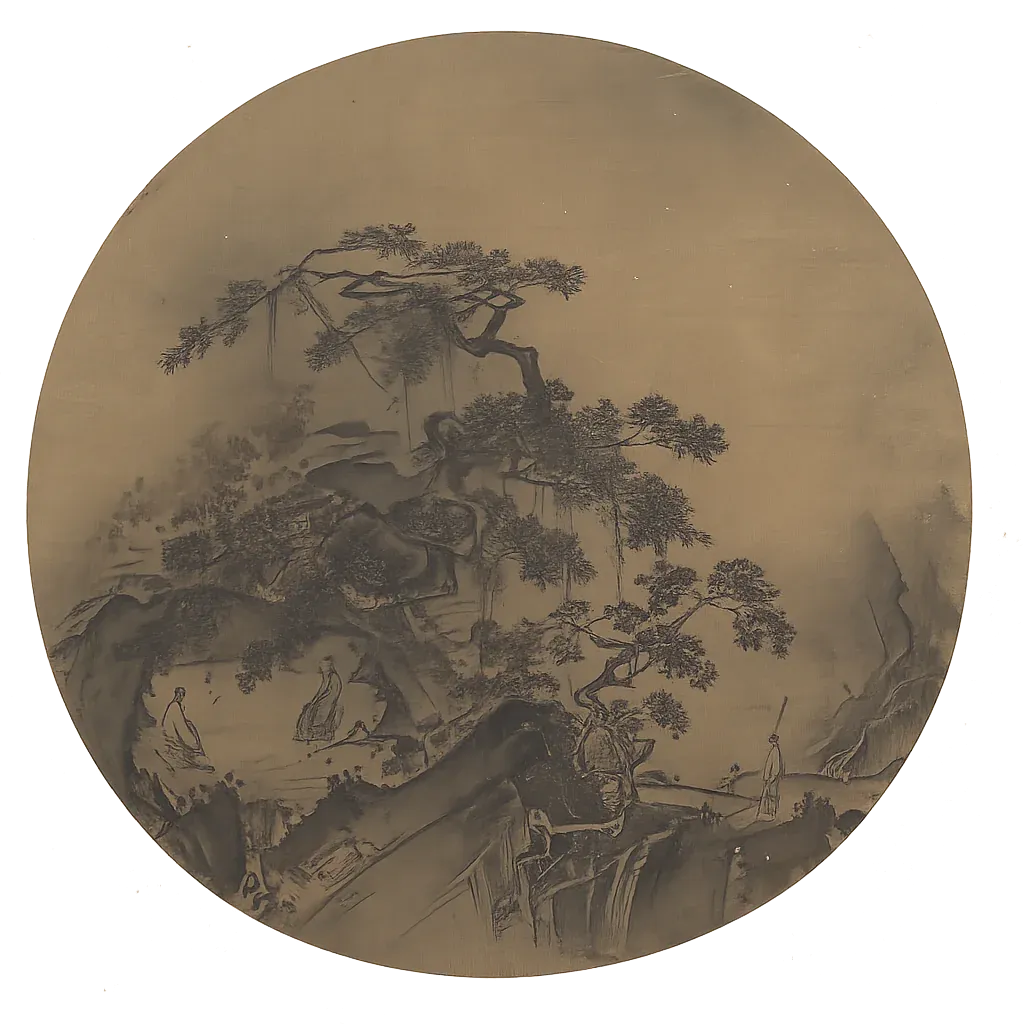


Garden Without an East (Part 10)
“Then immortality is not the continuation of the individual?” Spinoza asked.
But there was no desired answer. The voice dissolved into silence, mist descended upon the grass between them, and the characters went out like fireflies.
Laozi smiled quietly.
Hipatija gazed into the space where the mist had vanished. The question remained unanswered. Beyond the pine, a view opened among the trees that had not been there before. Beyond the garden rose mountains without roots. They hovered above the earth and bottomless waters, as though someone had torn them from the ground and surrendered them to the wind. With no discernible order, they drifted past one another, slowly and soundlessly. From behind the mountains appeared a being borne by the wind. It was not a bird. Her dark robe billowed against the blue sky. Her hair hung loose and seemed part of the sky itself. The woman stopped in the garden, touched the bark of the pine, and looked at the water. Then she looked at those gathered there.
“You were speaking about what remains,” she said.
Her voice was calm and could not be entirely distinguished from the rustling of the trees.
Hipatija nodded.
“We were.”
The woman smiled.
“Then you were speaking about something that cannot be kept.”
Spinoza looked at her attentively.
“And who says it must be?”
“No one.”
She was silent for a moment.
“But people try to do so.”
Bruno stepped closer.
“Do what?”
“They fear their own transience.”
Hipatija asked:
“Who are you?”
The woman looked towards the rootless mountains that the wind was slowly carrying across the sky.
“ʿĀʾisha—ʿĀʾisha al-Bāʿūniyya,” she added.
“And where do you come from?”
Ajša looked towards the mountains.
“From where mountains have no roots.”
Demokrit frowned.
“That is impossible.”
Ajša looked at him.
“You yourself said that the world is made of something no one can see.” Hipatija looked towards the mountains.
“What are these mountains?”
Ajša was silent for a while.
“Perhaps they are questions people carry for so long that they forget they are carrying them.”
Spinoza watched her.
“And the wind?”
“That which moves them without possessing them.”
Zhuangzi nodded quietly.
Hipatija smiled, pointed to the stone beside her, and invited her to sit among them.
“Then you will feel at home here,” she said.
The wind rose again. One of the rootless mountains slowly glided across the sky. For a moment it dimmed the sun’s rays, and the garden grew dark. When the light returned, ʿAjša was using a stick to inscribe beautiful, undulating characters in the sand between them:
وَمُذْ تَجَلَّى فَنَيْتُ عَنْ كَوْنِي
وَعَنْ وُجُودِي وَسَائِرِ الْأَكْوَانِ
وَفِي فَنَائِي وَفِي الْبَقَاءِ لِوَصْلِي
فَصِرْتُ عَيْنًا تُشَاهِدُ الرَّحْمَنَ
“What do these characters tell us?” Konfucij asked.
“And when He revealed Himself, I vanished from my being, from my existence, and from the existence of all worlds. And in my vanishing and in my abiding for union, I became an eye beholding the Merciful,” she said. She erased what she had written, wrote a shorter sentence, and explained it:
وَفِي فَنَائِي وَفِي الْبَقَاءِ لِوَصْلِي
“And in my vanishing and in my abiding for my union...”
A man who had joined them unnoticed during the brief darkness asked Ajša for the stick, then drew different characters in the sand:
মন দিয়েযারনাগালনাহিপাই,
গান দিয়েসেইচরণছুঁয়েযাই,
সুরের ঘোরেআপনাকেযাইভুলে।
“And what does that mean?” Plotin asked.
“The one whom I cannot reach with the mind, I touch through song. And in the rapture of the melody, I forget myself,” the man replied.
“And who sings when you vanish from yourself?” Kuzanski asked.
“They called me Rabindranath Tagore,” he said, placing the stick back in the sand. For a moment, no one spoke. Then a woman in a long, dark robe appeared from behind the pine. Her presence was so quiet that no one noticed her until she stepped into the light.
She gently stroked the bark of the pine, looked at the traces in the sand, and then said:
“Et illa apparuerunt omnia in viriditate plena. And all things appeared in the fullness of greenness.”
Ajša breathed: “Hildegarda, full of greenness.”
The woman smiled as though, after a long time, her name had once again found its way back to her. The wind stirred the branches of the pine. A few dry needles fell onto the sand and covered part of Tagore’s characters. Then a man’s voice sounded from behind the trees:
“Eins zu sein mit allem, das ist das Leben der Gottheit, das ist der Himmel des Menschen. To be one with all—this is the life of divinity, this is humanity’s heaven.”
They all turned. A man stepped out of the shadows. He was youthful, almost frail, and there was something distant in his face, as though his gaze were often directed towards a world that others could not see. He looked at the tree, the water, and the people gathered around the sand. Two long-tailed squirrels playfully climbed the pine and watched those assembled. Spinoza looked at him attentively and asked:
“Is it possible to live like that?”
The man looked towards the water.
“Perhaps not all the time. But for a moment, a person can forget that they are separate.”
Zhuangzi quietly raised his eyes.
“And when you remember?”
The man smiled.
“Then the song begins.”
Hildegarda looked towards the pine.
“And who speaks of humanity’s heaven?” she asked.
“Friedrich Hölderlin.”
Liezi opened his palm, in which lay an acorn. One of the squirrels carefully descended the trunk, took it, and vanished among the branches.
Hölderlin watched it for a while.
“Perhaps it, too, does not know that it is separate from the world.”
Liezi smiled and closed his hand. The wind blew again, and a little sand covered the edges of Tagore’s text.
Then another man emerged from behind the trees. He walked slowly, like someone who had long pondered words. He looked at the sand, where different languages intertwined, then at the sky, and finally stroked the bark of the pine.
“What are you looking at?” Hipatija asked him.
The man was silent for a while.
“I am trying to understand how people classify the world.”
Konfucij looked at him.
“And what have you discovered?”
The man smiled.
“No hay clasificación del universo que no sea arbitraria y conjetural. There is no classification of the universe that is not arbitrary and conjectural.”
Zhuangzi raised his head.
“Then names do not belong to things?”
“Perhaps they belong to us,” the man replied. “We merely give them to things.”
Hipatija looked at the sand.
“But without names, we could not speak about the world.”
“That is true.”
“Then we need them.”
“We need them,” the man said. “But we must not forget that they are not the world.”
The man looked towards the water, where the sky broke apart among the ripples.
“Whose words are these?” Hipatija asked.
“Jorge Luis Borges.”
Drugpa, who was chewing the herb of longevity, addressed those gathered: “You vanished from yourselves. You became one with all. You forgot yourselves. You touched what the mind cannot reach. You saw everything and discovered that you can see nothing.”
Borges smiled.
“That is quite a good summary.”
Drukpa continued chewing, then glanced at the squirrel.
“But there is something I would like to know.”
Hipatija waited curiously for the divine fool’s question.
“Which of you offered the squirrel the acorn?”
Zhuangzi and Laozi smiled. Then Hipatija, and after her everyone else.
“Liezi,” Zhuangzi said.
Liezi merely shrugged and said:
“The squirrel took it.”
“That is not what I asked,” Drukpa said.
“Then what did you ask?”
Drukpa pointed to the squirrel, which had already vanished among the branches.
“Who offered the acorn?”
Liezi looked at him for a while.
“I did.”
“Why?”
“Because I had it.”
“And how did you come to have it?”
Liezi smiled.
“Because I found it.”
Drukpa nodded.
“Then we may already be mistaken about the very first thing.”
Hipatija frowned.
“Which thing?”
“That the acorn was his.”
Spinoza looked towards the branches.
“But it was in his palm.”
“That does not mean it was his.”
Borges raised his eyebrows. Then he burst into loud laughter.
“Excellent.”
Drukpa looked at him.
“What?”
“You have just opened a labyrinth.”
“I am talking about an acorn,” Drukpa said.
“Precisely.”
Borges stepped closer to the sand.
“First you say: his. Then we ask what it means to have something. Then what it means to find something. And before we know it, we no longer know where the path began.”
Drukpa chewed his herb and watched him.
“And where does it lead?”
Borges looked towards the rootless mountains.
“Perhaps nowhere.”
He was silent for a moment.
“Or into an abyss.”
Drukpa smiled.
“And is there anything in it?”
Borges looked at the squirrel, which briefly peered out from among the branches.
“That is the best part of the question.”
Zhuangzi quietly looked at Borges.
“You truly love abysses.”
“Yes,” Borges replied. “Because they have a habit of disappearing precisely where one expects to reach rock bottom.”
Drukpa looked at the sand.
“Then the labyrinth has no centre either.”
Borges laughed.
“Perhaps the centre is merely another word we needed so that we could lose ourselves within it.”
Konfucij looked at the squirrel.
“But the squirrel knew that the acorn was food.”
Zhuangzi shook his head.
“Perhaps, or perhaps it simply took what came within reach.”
“And what is the difference?” Hipatija asked.
Zhuangzi looked at her.
“For the squirrel, perhaps none.”
Hipatija was silent for a while.
“Then people add more to the world as they come to know it.”
“Or less,” Borges said.
“Less?”
“Perhaps the world already contains everything we try to give it through names. By doing so, we merely narrow it.”
With the tip of his shoe, Borges lightly blurred one of the characters in the sand.
“Every name is a door,” he said.
Hipatija looked at him.
“And where does it lead?”
“Into another room.”
“And from there?”
Borges looked at the web of traces in the sand.
“Into the next.”
“But if we name nothing, we cannot ask questions,” Bruno replied.
Laozi smiled.
“Perhaps that is why we must also know how to remain silent.”
Meanwhile, the mist had descended a little lower. Plotin looked towards the water and said:
“Then is silence closer to truth than words?”
“No,” Zhuangzi said.
“Why not?”
“Neither one nor the other. Do not seek truth on the other side of an opposition.”
No one answered. The mist lay low over the grass. The water moved almost imperceptibly, as though it, too, did not wish to break the silence. A single needle fell from the trees and touched the sand. Borges looked at the traces of words that the wind had almost erased.
“Then we are back where we began.”
“No,” Hipatija said.
She looked towards the water.
“This time we know what we do not know.”
Zhuangzi smiled.
“That is already quite a lot.”
No one continued. For a long time they did not speak, yet the silence between them was not empty. Then a faint sound came from behind the pine. Not footsteps. More like the rustling of cloth against grass and almost inaudible breathing. She looked at none of them. She looked at the water, then the pine, then the sand, where traces of Arabic and Bengali letters were still visible, and listened to the space in which German and Spanish words echoed. Then she listened to a pine needle bidding farewell to the tree, swirling through the air, and landing upon Mother Earth. Silence can be heard. For a moment she stood still. Then she sat a little apart from them. The assembled company watched her with interest, but one person smiled with his eyes closed.
“Who are you?” the laughing Demokrit asked.
The woman did not answer immediately. Her eyes remained closed. She listened to the wind moving the branches above them.
“Does it matter?”
Hipatija looked towards the sand, where the different scripts were slowly dissolving into one another.
“I do not know,” she said.
The woman opened her eyes.
“Then the question was not in vain.”
For a moment, she looked at everyone gathered there.
“But if you wish to know, they called me Wei Huacun.”
Zhuangzi looked at her attentively.
“魏華存.”
The woman nodded.
“That is how they wrote my name.”
“And what should we call you?” Hipatija asked.
Wei Huacun looked at the pine needle lying on the sand.
“Whatever you wish.”
“Did you hear our conversation?” Plotin asked her.
“I see less than you think. But I see what may be imperceptible to your eyes. I see clarity, the light made possible by dispersion, and the forgotten mother who burns away for its sake, and I wonder where this clarity comes from. Perhaps clarity is the mother’s self-giving. I hear more than you utter. I hear transience seeking a path towards eternity and the meaning of its brief existence, and the anguish that accompanies the short life of all that appears.”
Hipatija looked at her and asked: “And do you feel?”
Wei Huacun placed her palm upon the earth and turned her face towards the sky.
“Much more. What I neither see nor hear, I perceive in other ways.”
Silence followed.
“What is it that you perceive?” Kuzanski asked.
Wei Huacun kept her palm upon the earth and quietly replied:
“The harmony of the eternal flow of transformations.”
(to be continued)
Yuan Weiqi; Rector, SDT


