

 Music Department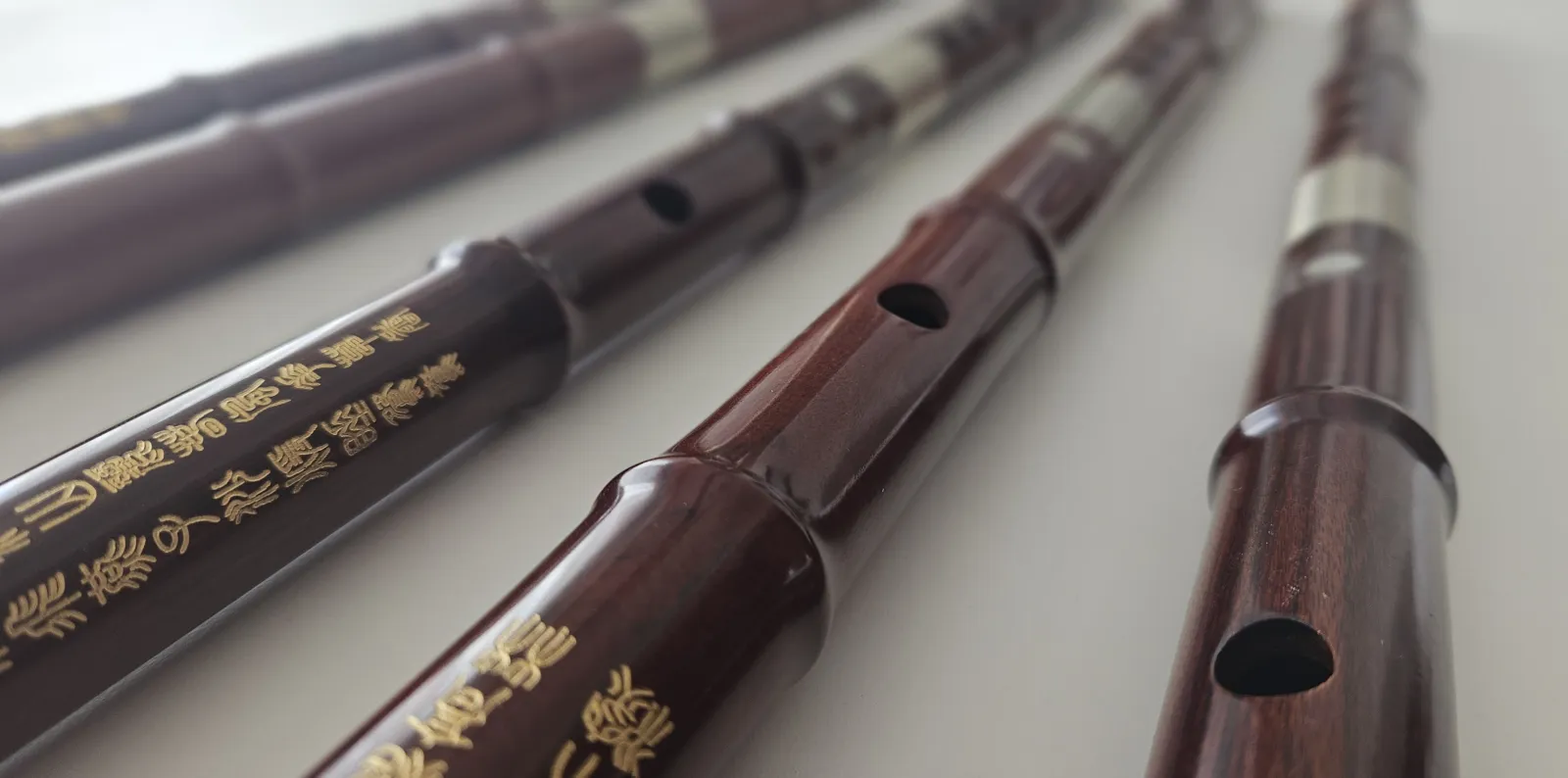
Traditional Chinese Musical Instruments: Dizi 笛子
Name: 笛子 dízi – transverse bamboo flute
八音 Bayin (the traditional Chinese classification of musical instruments by eight materials): 竹 zhú, bamboo
Description
The dízi is a transverse bamboo flute whose ethereal sound and vivid tonal palette embody the cultural beauty and sonic elegance of ancient Chinese heritage. It is one of the most expressively versatile wind instruments in traditional Daoist ritual practice.
It is made primarily from bamboo—竹 zhú—mainly because of its natural resonance, tonal warmth, and rustic timbre. Aged and treated bamboo further improves the instrument’s resonance and durability.
It belongs to the aerophone family of instruments, meaning that it produces sound from air blown into a tube, causing the air column to vibrate. It is held sideways, like other transverse flutes.
Playing techniques include diaphragmatic breathing for air control, blowing across the embouchure hole by directing the airstream partly into and partly across it, fingering by covering and uncovering six holes, and tonguing for articulation.
Sound characteristics and distinctive features
The dízi has a unique feature that distinguishes it from many other flutes: a special hole located between the embouchure hole and the finger holes, covered by a thin membrane called 笛膜 dimo.
The membrane is traditionally made from the inner fibres of bamboo or reed and vibrates as air passes through the tube. It gives the dízi its distinctive bright, vibrating, and buzzing undertone, which is not harsh but enriched in timbre by upper overtones. The skill of applying the dimo membrane before playing is crucial. Dimo must be properly moistened and carefully affixed over the hole using a type of natural glue called erliao to achieve the desired tension and buzz, which improves sound projection.
The sound of the dízi can vary considerably depending on the flute’s key—it may be tuned to C, D, F, G, and others—the thickness of the bamboo, and the tension of the dimo membrane.
It consists of one, or more commonly two, sections joined by a metal connector for portability and tuning adjustment.
Two additional holes at the lower end of the dízi are sometimes used for tuning or attaching decorative tassels.
History and origins
The history of this instrument stretches back more than 2,000 years. Early forms were discovered from the Warring States period (475–221 BCE). Archaeological finds such as bone flutes and bamboo instruments resembling the modern dízi show that bamboo flutes have been part of Chinese culture since ancient times. During the Han dynasty (206 BCE–220 CE), the dízi became a well-established instrument in Chinese court and folk music. One of the most important developments in the design of the dízi occurred during the Tang dynasty (618–907 CE), when the dimo membrane was added, significantly influencing the instrument’s sound and expressive qualities.
During this period, the instrument spread throughout East Asia and influenced the development of similar instruments in Korea, Japan, and Vietnam. In modern times, particularly during the 20th century, the dízi underwent further improvements, including a standardised tuning system, more precise hole placement, and the use of new materials. These changes helped integrate it into modern Chinese orchestras, making it a core instrument in both traditional and contemporary Chinese music.
The dízi is not merely a bamboo flute. It is a voice of Chinese culture and a testament to centuries of musical innovation. It can express lyrical beauty and a broad emotional range, from joy and playfulness to melancholy and dreaminess. This expressive versatility makes the dízi an ideal instrument that retains its timeless charm and distinctive sound. Its relatively simple design conceals profound complexity and expressive range, making it suitable for both beginners and experienced musicians.
Use
In traditional and contemporary Chinese music, it is used as a solo instrument and in ensembles and orchestras. It holds an important place in folk music, Chinese opera, and instrumental music, and is also used for theatre and ritual music and to accompany dance and storytelling. In Daoist settings, it may form part of liturgical ensembles, accompanying ritual melodies and vocal recitations.
Daoist context
In Daoist ritual practice, it primarily serves as an accompanying wind instrument in liturgical ensembles. Its bright and agile sound blends with vocal recitations, ritual melodies, and processions, helping to shape the ritual’s soundscape. In Daoist music, it has not only a musical but also a ritual function: music regulates the progression of the ritual and establishes harmony between the individual, the community, and the cosmic order.
Variants and related instruments
Qǔdí 曲笛 is a softer, deeper-toned dízi traditionally associated with the southern Chinese kūnqǔ style.
Bāngdí 梆笛 is a shorter, higher-pitched dízi characteristic of northern Chinese musical styles, with a more penetrating, brighter sound.
Xīndí 新笛 is a modern form of the dízi with an extended tonal range and standardised tuning.
Related instruments include the xiāo 簫, a vertical bamboo flute without a membrane, and the chí 篪, an ancient transverse bamboo flute related to early forms of the dízi.
Alenka Zupan, member of the Slovenian Daoist Temple of Supreme Harmony
Sources:
What Is The Dizi? History, Sound & Playing Techniques - Musicalinstrumenthub.com
Dízi (笛子) – Duke University Musical Instrument Collections
"Transverse Flute (Ti-Tzu)." 2020. Smithsonian Institution. 2020. https://www.si.edu/object/transverse-flute-ti-tzu:nmnhanthropology_8468295
"Oldest Musical Instruments Dated." 2022. Archive.org. 2022. https://web.archive.org/web/20160114055016/https://www.bnl.gov/bnlweb/pubaf/pr/1999/bnlpr092299.html
Anne, Laura. 2022. "Jiahu (Ca. 7000–5700 B.C.) | Essay | the Metropolitan Museum of Art | Heilbrunn Timeline of Art History." The Met's Heilbrunn Timeline of Art History. 2022. https://www.metmuseum.org/toah/hd/jiah/hd_jiah.htm
"Di | Musical Instrument | Britannica." 2022. In Encyclopædia Britannica. https://www.britannica.com/art/di
Goodman, Howard L. Xun Xu and the Politics of Precision in Third-Century AD China. Leiden: Brill, 2010.
"2nd International E-Conference on Studies in Humanities and Social Sciences: Conference Proceedings." December 2018. https://doi.org/10.32591/coas.e-conf.02
Beyond the May Fourth Paradigm: In Search of Chinese Modernity. United States, Lexington Books/Rowman & Littlefied, 2008.
陳正生 (22 October 2001). 談談民族管樂器聽覺訓練在演奏中的作用 (in Chinese).
Lau, Frederick. Music in China: Experiencing Music, Expressing Culture. New York: Oxford University Press, 2008.


