

 Music Department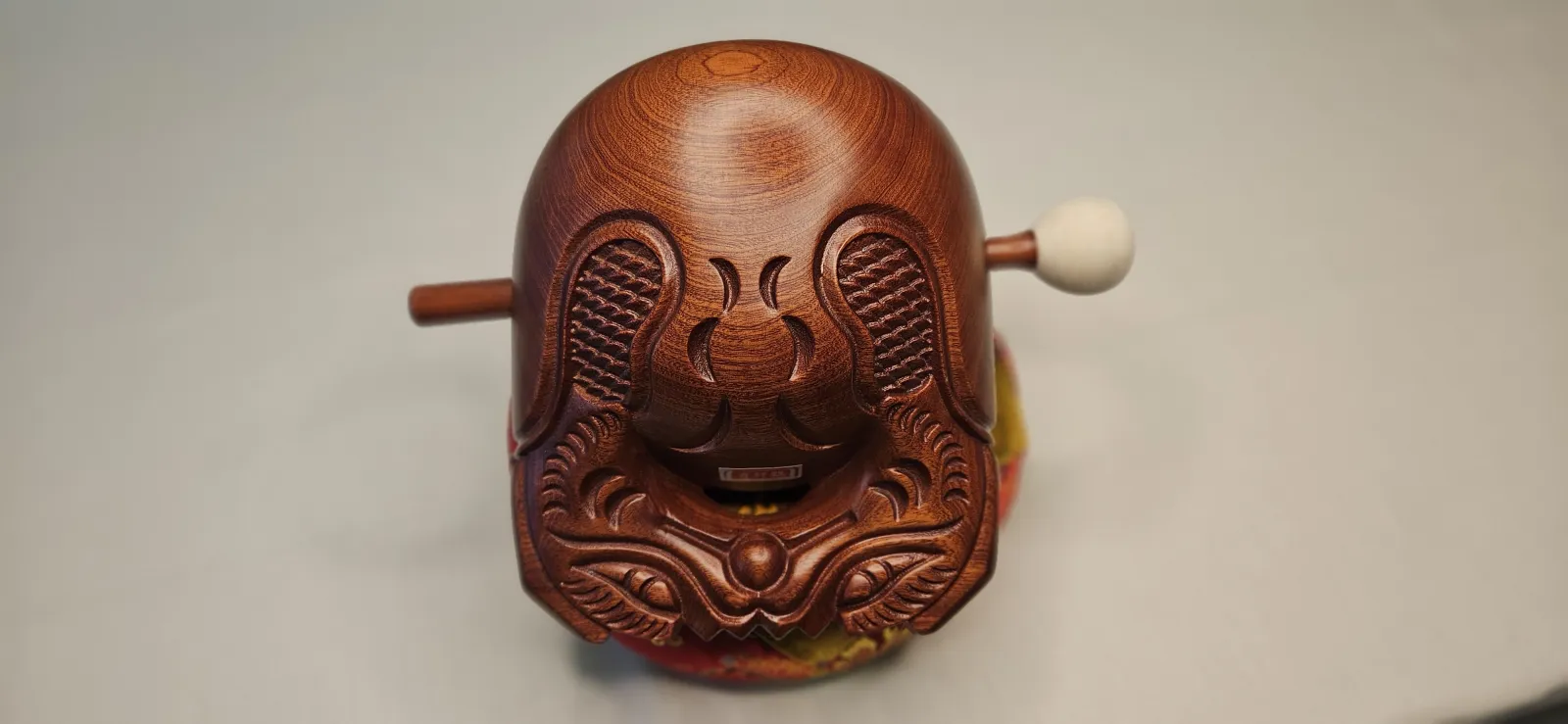


Traditional Chinese musical instruments: mùyú 木魚
Name: 木魚 mùyú - wooden fish
八音 Bayin (the traditional Chinese classification of musical instruments by eight materials): 木 mù - wood.
European scientific classification of musical instruments (Hornbostel-Sachs system): idiophones - percussion instruments.
Description
The wooden fish (木魚, Mùyú) is a traditional Chinese percussion instrument made of wood. This ritual temple instrument is round, with a hollow interior and an elongated opening at the front, and a handle at the back.
We play it with a wooden beater whose tip may be wrapped in a softer material to cushion the impact and soften the sound. There are two types of wooden fish: a round one and an elongated one with
a dragon-shaped head and a fish-shaped body, which is usually hung in the temple courtyard. Playing
it announces a special ritual or a meal.
The instrument is made from dense wood, usually camphor wood (Lat. Cinnamomum camphora), rosewood (dalbergia) or teak.
The wooden fish is one of the most common East Asian percussion instruments. Today, its use is primarily associated with ritual music, while in the past it was also used in traditional music.
When playing, the musician strikes the centre of the wooden fish with a wooden beater. The force and manner of the strike affect the volume and tone colour. We generally play the instrument in a steady rhythm, as we primarily use the wooden fish to maintain, speed up or slow down the rhythm of recitation and singing.
Sound characteristics and distinctive features
The sound of the wooden fish could be described as short, clear, penetrating, woody and hollow. Its distinctive sound is clearly distinguishable from that of other ritual instruments. Despite being quieter, it stands out during rituals among the many
sounds of percussion instruments, most of which are metal. The use of the muyu is almost exclusively rhythmic rather than melodic.
Specific sequences of strikes on the wooden fish announce the beginning or end of a ritual and certain transitions between its sections. In a Daoist setting, its sound has both practical and symbolic significance. Steady striking of the instrument supports focus and concentration. In the classical text Wushang Miyao 無上秘要 (Supreme Secret Essentials), we can read that the sounds of the wooden fish and the ritual bowl awaken the dusty world (chenshi 塵世 or hongchen 紅塵), that is, the worldly, transient realm in Chinese tradition. The repetitive rhythm and resonance of the wooden fish guide listeners and the performer away from everyday thoughts towards a calm, attentive and focused state.
History
The first record of the use of the wooden fish in Daoist temples dates to the Tang dynasty, specifically the 8th century. Before this, stone fish and blocks were used in Daoist temples.
The muyu is not solely a Daoist ritual instrument; it is also used in Buddhism. Both traditions use it to set a precise rhythm during the recitation of ritual texts and as a symbol of constant spiritual alertness, since a fish never closes its eyes.
Related instruments
The wooden fish belongs to the family of wooden percussion instruments. It comes in various sizes, from small handheld versions to large temple instruments that can measure over a metre in diameter. A larger wooden fish produces a deep sound, while a smaller one has a higher, more penetrating sound. Common related instruments include woodblocks and wooden clappers, which we also use to produce short, rhythmic, penetrating wooden sounds. The latter, however, are not used in ritual settings.
Since the muyu is used to set the rhythm, the drum and bell are related ritual instruments. The drum produces a powerful, softer and deep sound, while the bell produces a short, bright and metallic sound.
Daoist context
The wooden fish has been used in Daoist practice since the 8th century. It accompanies recitations and ritual music, and signals the stages of a ritual. Music plays an important role in Daoist ritual. Despite its simplicity, the muyu is an important instrument, creating an atmosphere conducive to singing, recitation, ritual and connecting with divine forces. During longer rituals, rhythmic striking allows performers to maintain a steady tempo and focus on the text or ritual.
The use of the wooden fish in Daoist ritual shows how music in this tradition is not intended solely for listening, but can also support concentration, ritual practice and the creation of a connection between people, nature and the spiritual world.
Head of the Department of Daoist and Traditional Chinese Music Maj Dolšak Fabris.


