

 Music Department
Traditional Chinese musical instruments: èrhú 二胡
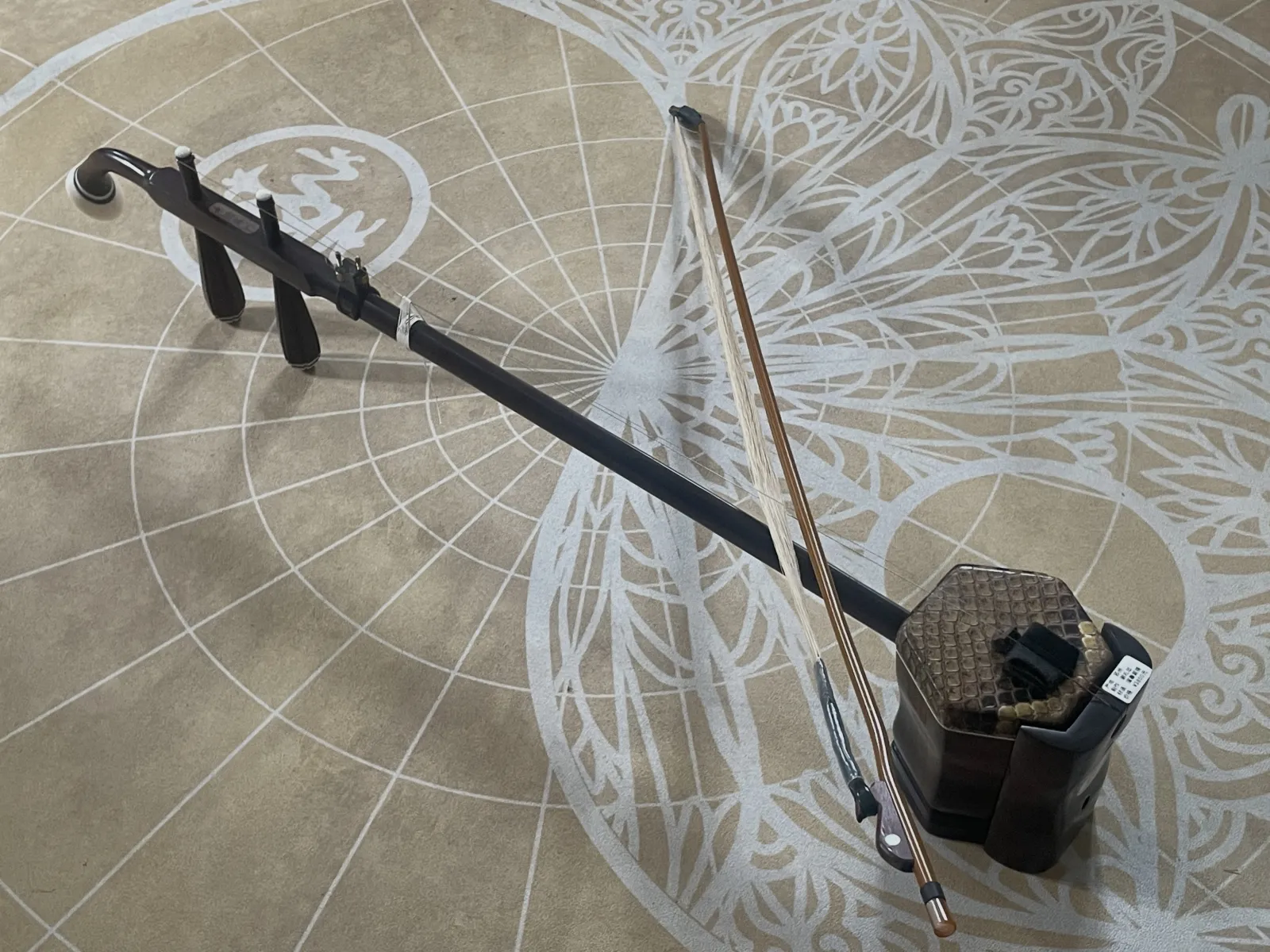
Name: 二胡 èrhú – a two-stringed, long-necked bowed instrument (stick fiddles), also known as the Chinese violin.
Traditional Chinese classification by eight materials 八音 Bāyīn: It belongs to the category 丝 (sī) – silk. Although the èrhú has a wooden body and is partly covered with snakeskin, its strings were traditionally made from twisted silk. Since the strings produce the sound, this system classifies it as a silk instrument.
European scientific classification of musical instruments (Hornbostel-Sachs): Chordophones (string instruments).
Description of the instrument
The èrhú is a traditional Chinese bowed instrument with a long neck. With its thousand-year history, it ranks among China's most important musical instruments and is distinguished by its simple, elegant design.
It consists of several parts:
Resonating body | 琴筒 (qíntǒng)
The soundbox at the bottom, which amplifies the sound. It is made of hardwood (rosewood, ebony, padauk or red sandalwood) and is hexagonal, octagonal or cylindrical in shape. The back has a decorative wooden grille.
Snakeskin | 琴皮 (qínpí)
A python-skin membrane (sometimes synthetic today) covering the front of the body. It is crucial to the tone colour; ideally, it is of medium thickness with uniform scales.
Neck (shaft) | 琴杆 (qíngǎn)
A long, vertical wooden rod that runs through the entire instrument and serves as the main support for the strings. The upper part is often decorated with a carved dragon's head or has a contemporary design.
Tuning pegs | 琴轴 (qínzhóu)
Two large wooden pegs at the top of the neck, used to tension and tune the strings.
Strings | 琴弦 (qínxián)
Two steel strings, which replaced silk strings in the 20th century because of their greater volume and stability. The thicker inner string (nèixián) is tuned to D4, while the thinner outer string (wàixián) is tuned to A4.
Bow | 琴弓 (qíngōng)
Made from a bamboo stick and horsehair. The hair is permanently threaded between the two strings, so the bow cannot be separated from the instrument while playing.
Cord (loop) | 千斤 (qiānjīn)
A cord tied around the neck and strings below the tuning pegs, which sets the vibrating length of the strings (acting as a nut).
Bridge | 琴码 (qínmǎ)
A small wooden piece in the centre of the python skin, which transfers the strings' vibrations to the membrane.
Damper (pad) | 琴垫 (qíndiàn)
A piece of cloth or felt below the bridge that dampens unwanted noise and ensures a clear tone.
Base | 琴托 (qíntuō)
A wooden piece at the bottom of the soundbox, designed to stabilise the instrument when played on the lap.
Sound characteristics and distinctive features
The erhu is recognisable by its exceptionally expressive sound, which resembles the human voice. Its range extends from three to three and a half octaves, while its practical playing range is two to two and a half octaves. It can express a wide range of emotions, from deep melancholy and sadness to playful joy. Master players can even recreate sounds from nature on the erhu, such as birds chirping or horses neighing.
Its unique sound comes from the instrument's distinctive construction, and although it is often called the Chinese violin, it differs greatly from the violin in structure.
- No fingerboard: The erhu has no wooden fingerboard beneath the strings. The player places the pads of the fingers on the freely suspended strings without pressing them against the neck. Too little or too much pressure immediately changes the pitch, requiring an exceptional sense of intonation.
- Captive bow: The bow is permanently held between the two strings. While bowing, the fingers of the right hand actively push the bow hair outwards or inwards, depending on which string is being played.
- Posture: The erhu is generally played seated. The instrument rests upright on the left thigh, close to the lower abdomen. The left hand holds the instrument and fingers the strings, while the right guides the bow as evenly and horizontally as possible. A naturally relaxed body is essential throughout. Some contemporary styles also involve playing while standing, with the instrument attached at the waist.
History
The erhu originated in Central Asia, from where it reached China more than a thousand years ago. The first known bowed string instrument mentioned in Chinese literature and regarded as an ancestor of the erhu is the xīqín 奚琴 from the Tang dynasty (618–907 CE).
Later, these instruments became known by the collective term húqín 胡琴, in which hu 胡 refers to the nomadic peoples of northern and western China, while qin 琴 means a string instrument. During the Ming dynasty (1368–1644 CE), the huqin became the leading instrument in Chinese opera orchestras. Several variants developed within this family, but the specific name erhu only became established in the 20th century, when the modern solo repertoire also began to develop. Today, it is taught at all levels of education, from primary schools to prestigious academies and conservatoires throughout Asia, as well as at some universities in the West.
Related instruments
The huqin family includes several close relatives of the erhu:
- Gaohu 高胡 has a smaller soundbox and is tuned a fourth or fifth higher. It has a distinctive high, bright tone and is the leading bowed instrument in Cantonese opera.
- Zhonghu 中胡 is tuned a fourth or fifth lower, has a larger body and produces a deep, melancholy sound.
- Sihu 四胡 is a variant with four strings tuned in two pairs, with the bow passing between the two pairs of strings. It is particularly popular in Mongolian folk music.
Daoist context
In the Daoist tradition, the erhu is regarded as a sacred instrument (法器, fǎqì), playing a key role in connecting the human world with the spiritual world. In the Quanzhen tradition, where percussion and ritual chanting otherwise predominate in rituals, the erhu provides important melodic accompaniment during major celebrations and ceremonies.
Lea Širok, Director of the SDT Media Centre
Sources:
1.Ma, L. (2016). Lingjichu xue erhu (Erhu za popolne začetnike). Southwest China Normal University Press.
2. Museum of Art. Musica and Art of China. Available at:
https://www.metmuseum.org/essays/music-and-art-of-china
3.Encyclopedia Britannica. Chinese music: Classification of instruments. Available at:
https://www.britannica.com/art/Chinese-music/Classification-of-instruments
4.Shen Yun Performing Arts. Chinese instruments: Erhu. Available at:
5.Lan Tung . Erhu - the crossroads between East & West. Available at: https://www.lantungmusic.com/erhu/


