Daoist Practices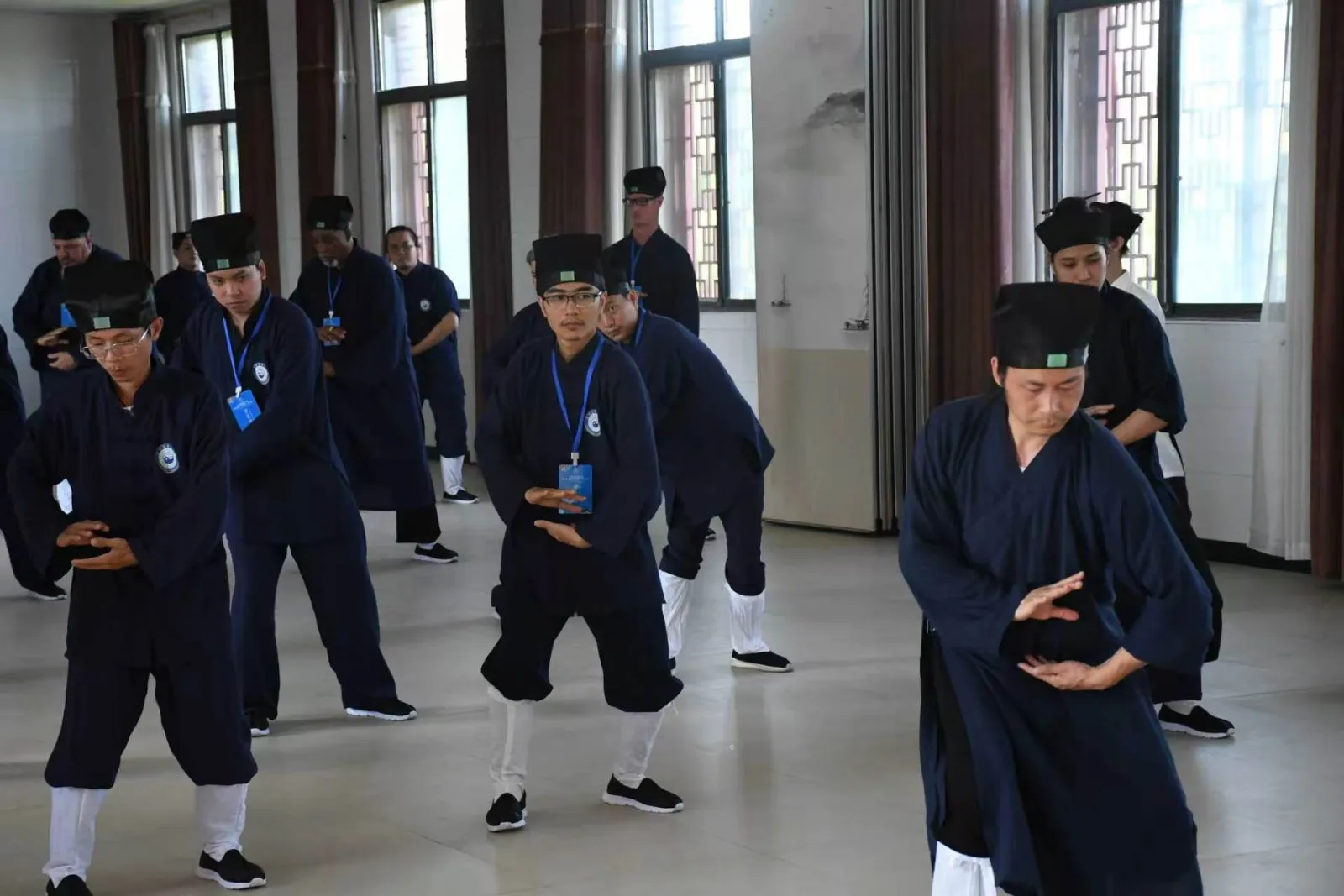
Wudang martial arts and Daoist culture
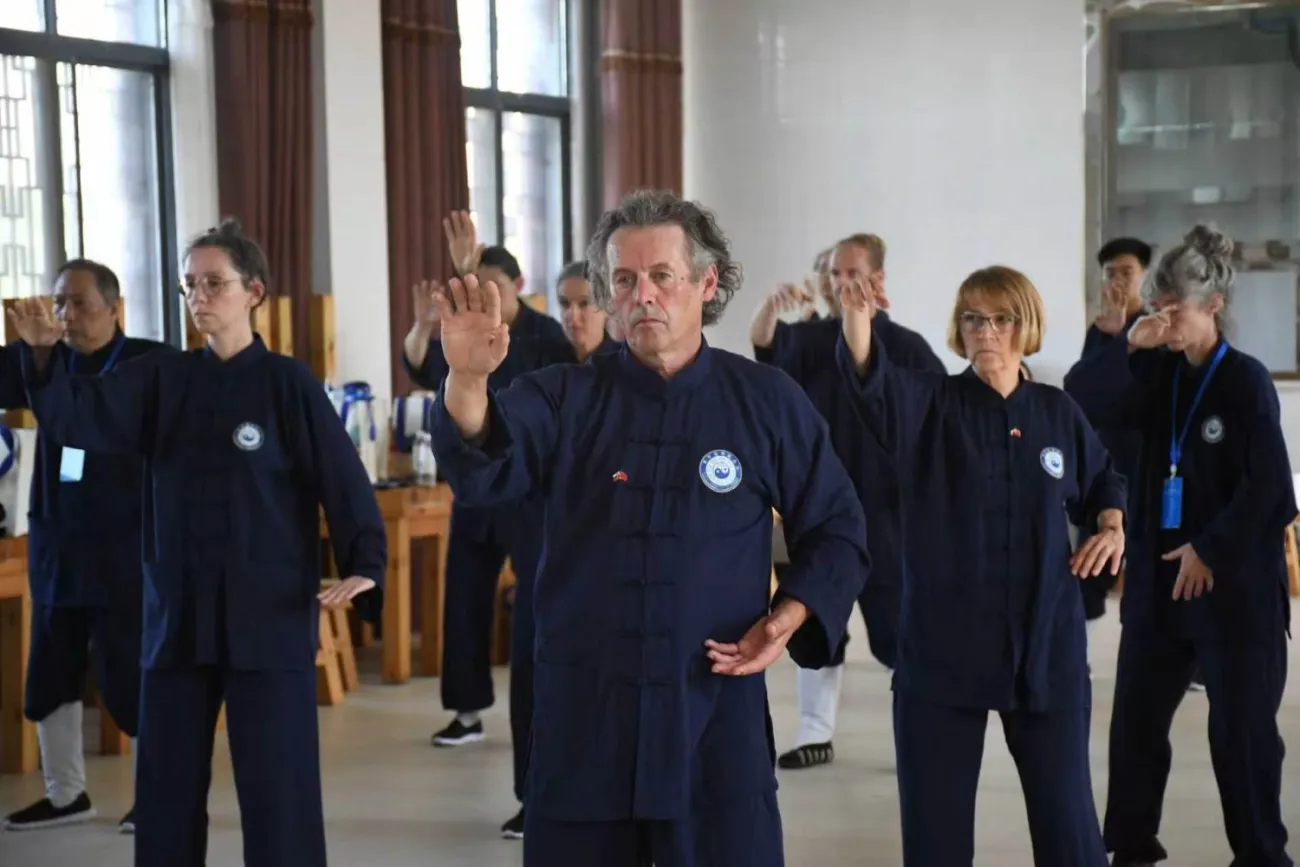
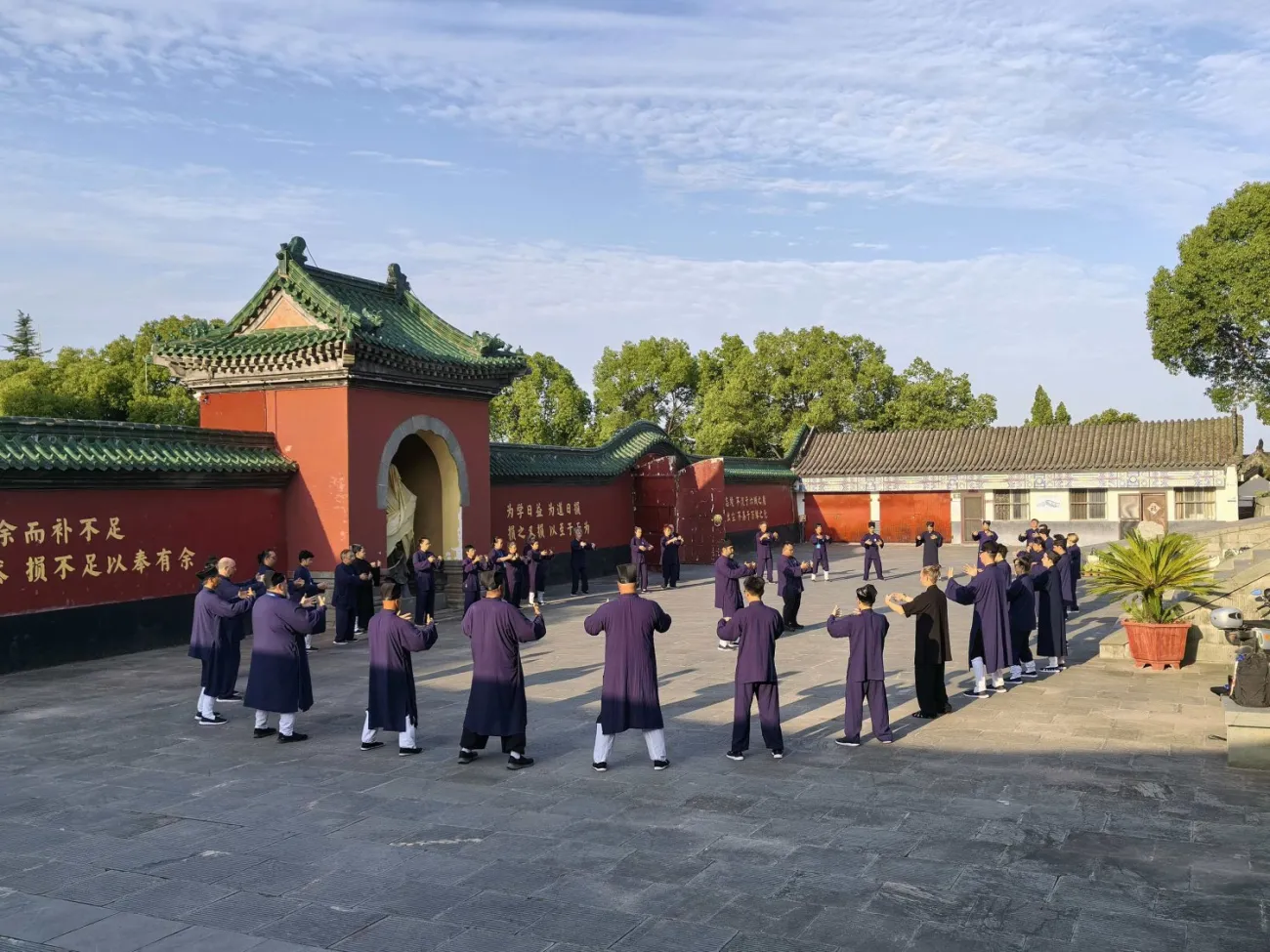
During our 18-day stay at the second International Seminar on Daoist Culture in the city of Danjiangkou in Hubei Province, held in the Jingle Palace complex (Jīnglè Gōng 淨樂宮), the two main themes were Wudang zaowan gongke jing 武當早晚功課經 (Wudang Morning and Evening Ritual Chanting), under the guidance of master and Daoist priest Wu Junli (武俊丽), and Wudang taijiquan (Wǔdāng Tàijíjüán 武當太極拳), under the guidance of master Zhang Weishen (张微神).
I. The Historical Origins of Wudang Martial Arts and Their Connection with Daoism
Wudang martial arts (Wǔdāng wǔshù 武當武術) are an internal style of Chinese martial arts (nèijiāquán 內家拳) originating in the Wudang Mountains (Wǔdāng Shān 武當山) in Hubei Province and closely connected with Daoism (dàojiào 道教). Unlike external styles (wàijiāquán 外家拳), such as Shaolin (Shàolín 少林), internal martial arts focus on internal energy (qì 氣), slow and circular movements, breathing, and harmony between yin and yang (yīn yáng 陰陽), reflecting the Daoist principle of natural balance.
These arts, including taijiquan (tàijíjüán 太極拳), xingyiquan (xíngyìquán 形意拳), and baguazhang (bāguàzhǎng 八卦掌), developed over the course of the tradition to support spiritual growth, preserve health, and provide self-defence. It is essential that every movement be fully coordinated with the mind (yì 意).
The Legend of Zhang Sanfeng
The historical origins of Wudang martial arts (Wǔdāng wǔshù 武當武術) are closely intertwined with the legends and historical facts of ancient China. Although early forms of martial practice already existed in this area, Wudang martial arts formally took shape during the Ming (明朝) dynasty (1368–1644), when Daoist monks developed them further and also used them to protect their monasteries. Wudang martial arts have older roots in Daoist practices of physical training, but as a recognisable and systematically developed tradition, Wudang wushu emerged primarily during the period (Yuán mò Míng chū 元末明初) spanning the end of the Yuan dynasty and the beginning of the Ming dynasty. Martial arts were also connected with practical self-defence, but their role in the Wudang tradition was not limited to combat. They developed in close connection with Daoist internal cultivation, physical training, daoyin, and the idea of harmonising body, breath, and spirit. See: China’s official intangible cultural heritage website: https://www.ihchina.cn/art/detail/id/13787.html
One of the most frequently cited stories attributes the founding of Wudang martial arts to Zhang Sanfeng (Zhāng Sānfēng 張三丰), a Daoist sage about whose life and activities little factual information is available. According to one version, he is said to have lived as a hermit on Mount Wudang, reached an age of more than 200 years, and attained spiritual immortality (xiān 仙). During the transition between the Yuan and Ming dynasties, he is said to have combined Daoist philosophy with martial arts, thus creating taijiquan.
While contemplating, he is said to have observed a fight between a crane (symbolising yang) and a snake (symbolising yin). This led him to realise that softness overcomes hardness (róu kè gāng 柔克剛). The snake does not use brute force, but evades the attack, adapts flexibly, and thereby overcomes its opponent. On this basis, he is said to have developed slow, flowing movements that redirect force. These arts also stem from Daoist philosophy, in which the main aim is to achieve harmony with nature (zìrán 自然) and nurture internal energy (qì 氣).
Although Zhang Sanfeng’s historical existence is the subject of scholarly debate, he is regarded as the spiritual father and symbolic founder of internal martial arts.
While Zhang Sanfeng represents the philosophical foundation of Wudang arts, Chen Wangting (Chén Wángtíng 陳王廷, c. 1600–1680), a general from the end of the Ming dynasty, is regarded as the creator of the first historically documented system of Chinese martial arts, from which the Chen style later emerged. A military officer from the late Ming and early Qing periods, he is regarded as a key figure in shaping the early tradition from which Chen-style taijiquan (陳式太極拳) later developed. Both approaches stem from the same fundamental principles (yin-yang, the use of internal energy, qi), but the Chen style developed out of military needs and family techniques, while the Wudang tradition originated in the spiritual and monastic practices of Daoist monks. The claim of being the first historically documented system is incorrect. See: https://www.bjcc.gov.cn/article/50184306.html 《吕氏春秋·论威》 Lǚshì Chūnqiū – Lùn Wēi, 3rd century BCE… see also the website of the General Administration of Sport of China: https://www.sport.gov.cn/n322/n3407/n3417/c564916/content.html
The Sacred Wudang Mountains and the Symbolism of Xuanwu
It was in the Wudang Mountains, which reached their greatest flourishing during the Ming dynasty and became a major spiritual centre and centre of martial arts, that the distinctive Wudang style developed. The ancient architectural complex in the Wudang Mountains, inscribed on the UNESCO World Heritage List in 1994, remains a sacred place devoted to spiritual cultivation (xiūliàn 修煉) and a global centre for learning internal martial arts.
The Ming emperors revered Wudang as the “central imperial Daoist temple”. The main deity of the mountains was Great Emperor Xuánwǔ (Xuānwǔ Dàdì 玄武大帝), protector of the Wudang Mountains, depicted as a combination of a tortoise and a snake joined together. The tortoise is by nature calm, composed, and reserved, symbolising yin, tranquillity, and the element of water. The snake is agile, flexible, and constantly in motion, representing yang, the sun, movement, and fire.
(In this context, the snake represents the active component in the sense of rising energy, although it is itself yin). The intertwined tortoise and snake (guī shé hé yī 龜蛇合一) symbolise the meeting and interaction of yin and yang and the union of water and fire (shǔi huǒ jì jì 水火既濟), a central Daoist symbol.
II. Daoist Principles in Martial Arts
Daoism reveres Laozi (Lǎozǐ 老子) as its founder. Founderfounder . Among other things, he wrote:
“Human beings follow the earth, the earth follows heaven, heaven follows the Dao, and the Dao follows what is so of itself.”
(Rén fǎ dì, dì fǎ tiān, tiān fǎ dào, dào fǎ zìrán 人法地,地法天,天法道,道法自然)
+His thought illustrates one of the fundamental principles of Daoism. “The Dao follows what is so of itself (Dào fǎ zìrán)” is also the highest guiding principle of Wudang martial arts. It means that the Dao acts spontaneously and without artificial constraints. All movements arise from observing and imitating nature. For example, traditional forms in taijiquan include movements such as “white crane spreads its wings” (bái hòuliàng chì 白鶴亮翅) or “golden rooster stands on one leg” (jīn jī dú lì 金雞獨立), or the circular movement of drawing a bow in one of the Eight Brocades exercises (bāduànjǐn 八段錦).
Practitioners are advised to follow a natural rhythm and avoid muscular strain and forced postures. Movements should be natural and flowing, the breath deep, and the mind relaxed. Only in this way can qi and blood (qì xuè 氣血) circulate freely through the body.
The principle “my destiny is in my own hands, not in the hands of Heaven” (wǒ mìng yóu wǒ bù yóu tiān 我命由我不由天) is what distinguishes Daoism from many other traditions, including religious ones. Among other things, it means that we must take responsibility for our own health and extend our lifespan through proper practice and a good quality of life. This life-affirming outlook determines the orientation of Wudang internal arts: preserving health (yǎngsheng 養生) takes precedence over martial arts. Zhang Sanfeng is said to have maintained that the purpose of his sword and fist was not to teach people to fight, but to promote health and longevity.
Simultaneous Cultivation of Spirit and Body
The ultimate aim of Daoist practice is to attain the Dao and spiritual immortality by following nature and nurturing life. Here, “innate nature” (xìng 性) refers to a person’s original nature, spirit, and heart-mind, while “destiny / life” (mìng 命) refers to the physical dimension, in which jīng 精 (essence), qì 气 (vital energy), and physical processes play an important role.
Daoism teaches that nature and life are inseparable. True liberation cannot be attained by cultivating only one aspect. Wudang martial arts therefore embody this dual cultivation. Unlike ordinary physical exercise, which focuses solely on building external muscles and physical strength, the emphasis here is on the integrated development of the inner spirit and the physical body, and on bringing them into unity.
At the heart of the Daoist understanding of life are the Three Treasures (Sān Bǎo 三寶):
Jing (jīng 精) is essence, the fundamental life energy and genetic material we receive from our parents at birth. It determines growth, development, and ageing. Jing (jīng 精) means essence, or essential vital substance. In traditional Chinese medicine, innate essence (xiāntiān zhī jīng 先天之精) is associated with the parental inheritance a person receives at conception, as well as with growth, development, reproduction, and the ageing process.
Qi (qì 氣) is vital energy that functions on the basis of jing. It drives all processes in the body and is thereby replenished. Qi (qì 氣) means qi, or the active force of life, a dynamic process that enables and regulates various bodily functions. In traditional Chinese medicine, it is connected with jing (精), blood (血 xuè), and other bodily processes, forming an interconnected functional whole with them.
Shen (shén 神) is spirit, consciousness, or the radiance of life, the psyche. Shen (shén 神) means spirit or spiritual activity; in traditional Chinese medicine, it refers to a person’s consciousness, mental activity, perception, thought, and emotional life. The concept also encompasses the radiance of life expressed in a person’s vitality and mental presence.
Daoists believe that harmony among the Three Treasures, interconnected in a chain of transformation, ensures health and longevity, while their depletion leads to illness and ageing. Ultimately, Wudang martial arts nurture and preserve these three treasures.
Classifying Martial Arts: Internal and External
In the history of Chinese martial arts, there is a clear division between external (wàijiā 外家) and internal (nèijiā 內家) arts. This classification was formalised in the 17th century by Huang Zongxi (Huáng Zōngxī 黃宗羲, 1610–1695), one of the most prominent Chinese thinkers and historians during the transition from the Ming to the Qing dynasty.
In his work Wang Zhengnan mu zhi ming 王征南墓志铭 (Epitaph for Wang Zhengnan), in the chapter on martial arts, he emphasised:
“Shaolin is renowned throughout the world for its martial skill, but its method focuses on direct confrontation with an opponent, which also allows the opponent to exploit it. There is a so-called internal school that controls movement through stillness; whoever attacks it is immediately knocked down as soon as the hand responds. Shaolin is therefore distinguished as an external school.”
In this way, Huang Zongxi helped distinguish between external schools (Shaolin) and internal schools originating in the tradition of Zhang Sanfeng. The latter operate according to a Daoist concept: the use of internal energy, qi and a Daoist approach that takes into account the principles of yin and yang, acting through unforced non-action (wúwéi 無為), and natural spontaneity (zìrán自然).
He connected internal arts with Daoist philosophy, which emphasises the unity of the external and internal, external and internal energy, relaxation, and focus, all of which clearly go beyond physical combat alone. External, or hard, martial arts involve active attacks and explosive power, focusing on training muscles, tendons, and bones. Internal martial arts, by contrast, focus on breathing, and qi and the mind?, which is deeply rooted in Daoism.
At advanced stages, however, the two paths meet. At the highest level, both approaches follow the same principle of yin and yang: Yang and soft Yin are inseparable. Without softness, hardness becomes brittle; without hardness, softness becomes weak. The ultimate aim of both approaches is the same: releasing force (fā jìn 發勁). In internal arts, this force, gathered within the body, is released in an explosive, lightning-fast burst at the moment of contact with an opponent. In taijiquan, however, fā jìn is hidden within soft, slow movements. A strike looks like a “soft touch”, yet contains tremendous internal power.
II. Key Principles of Wudang Taiji
1. The Philosophical Basis of Wuji and Taiji
The term tàijí 太極 appears in the Yijing (Book of Changes), whose origins date to the period between the 12th and 10th centuries BCE. Between the 6th and 5th centuries BCE, it was supplemented with philosophical commentaries attributed to Confucius. The text describes the laws of nature and changes in the universe and human life. Taiji develops from wuji (wújí 無極). Wuji is a fundamental concept in Chinese philosophy and martial arts, representing the state before the emergence of the universe: emptiness, an undifferentiated state, perfect balance in which there are no distinctions, no movement, neither force nor form. From this state of “nothing”, taiji is then born—the first step of movement, in which yin and yang arise. In internal martial arts, the state of wújí (無極) holds an important place, denoting the undifferentiated starting point from which the movement of tàijí (太極) develops. Wújí and tàijí thus do not denote two separate or opposing states, but different aspects of the same process: from undifferentiation, a dynamic yīn–yáng relationship emerges. Internal power (jìn 勁) does not arise simply through hardness or tension, but through the coordinated and dynamic action of the whole body. Without the state of wuji it is impossible to generate true internal power (jin). Wuji is the mother of taiji. Taiji is the state in which yin and yang are not yet separated. It is the axis of movement. The eleventh chapter of Zhōuyì · Xìcí shàng zhuàn 周易·繫辭上傳》 states: Shì gù Yì yǒu Tàijí, shì shēng liǎng yí, liǎng yí shēng sì xiàng, sì xiàng shēng bā guà 是故易有太极,是生两仪,两仪生四象,四象生八卦。Yi has tàijí; from it arise two yí, from the two yí arise four xiàng, and from the four xiàng arise eight guà. Taiji generates two forms, the two forms generate four forms, and the four forms generate eight trigrams. Wuji is a state of complete emptiness and potential. In martial arts, it is the foundation from which every technique is born. Without an understanding of wuji, taiji is merely a sequence of movements; with wuji, it becomes a profound practice connecting body, mind, spirit, and the natural laws of the universe.
2. Overcoming Hardness with Softness
Lao Zi wrote in the Daode jing: “The softest thing in the world overcomes the hardest thing in the world. The softest thing in the world can penetrate the hardest thing. Water can penetrate stone.”
According to the version of Wang Bie (王弼) (226–249), in the Daode jing Laozi is said to have written: “The softest under heaven can penetrate the hardest under heaven.” (A version of chapter 43 of the Daode jing.) In the version of He Shang Gong (河上公) (2nd century BCE), the saying is defined even more precisely: “That which is supremely soft is water. That which is supremely hard is metal and stone. Water can pass through hardness and enter rigidity; there is nothing it cannot penetrate.”
Taiji applies these principles in martial arts. The first step for those practising taiji is complete relaxation: softening and releasing the whole body, from the muscles to the connective tissues and ligaments. When the body reaches a state of complete relaxation, stable and elastic power will arise naturally (nèijìn 內勁). Softness is stronger than hardness, but to achieve it, we must first relax the whole body. When the body is relaxed, it is supple. Only then can firmness and internal power develop (nèijìn內勁).
Neijin requires a state of complete yet active relaxation (sōng 鬆 ). The muscles are relaxed, allowing force to pass unobstructed through the bones and connective tissues. When the body is relaxed, it can become an integrated whole (zhěng 整). A relaxed and integrated body is like a spring: it gathers energy and then directs it through the body with intention (yì 意), releasing it outwards towards the target (fā jìn 發勁). All movements in taijiquan are fluid. Such flowing circular movements prevent joint injuries and redirect the opponent’s power and force. In the context of Chinese martial arts, especially taijiquan, the term four liang (sì liǎng 四兩) is used in the well-known proverb: “Four liang move a thousand jin.” (Liang is an ancient Chinese unit of weight. 1 jin equals 16 liang. 1 liang is 37.5 g. Four liang are therefore 150 g: the weight of a small apple or a slice of bread moves 1,000 jin—600 kg, the weight of a large boulder.)
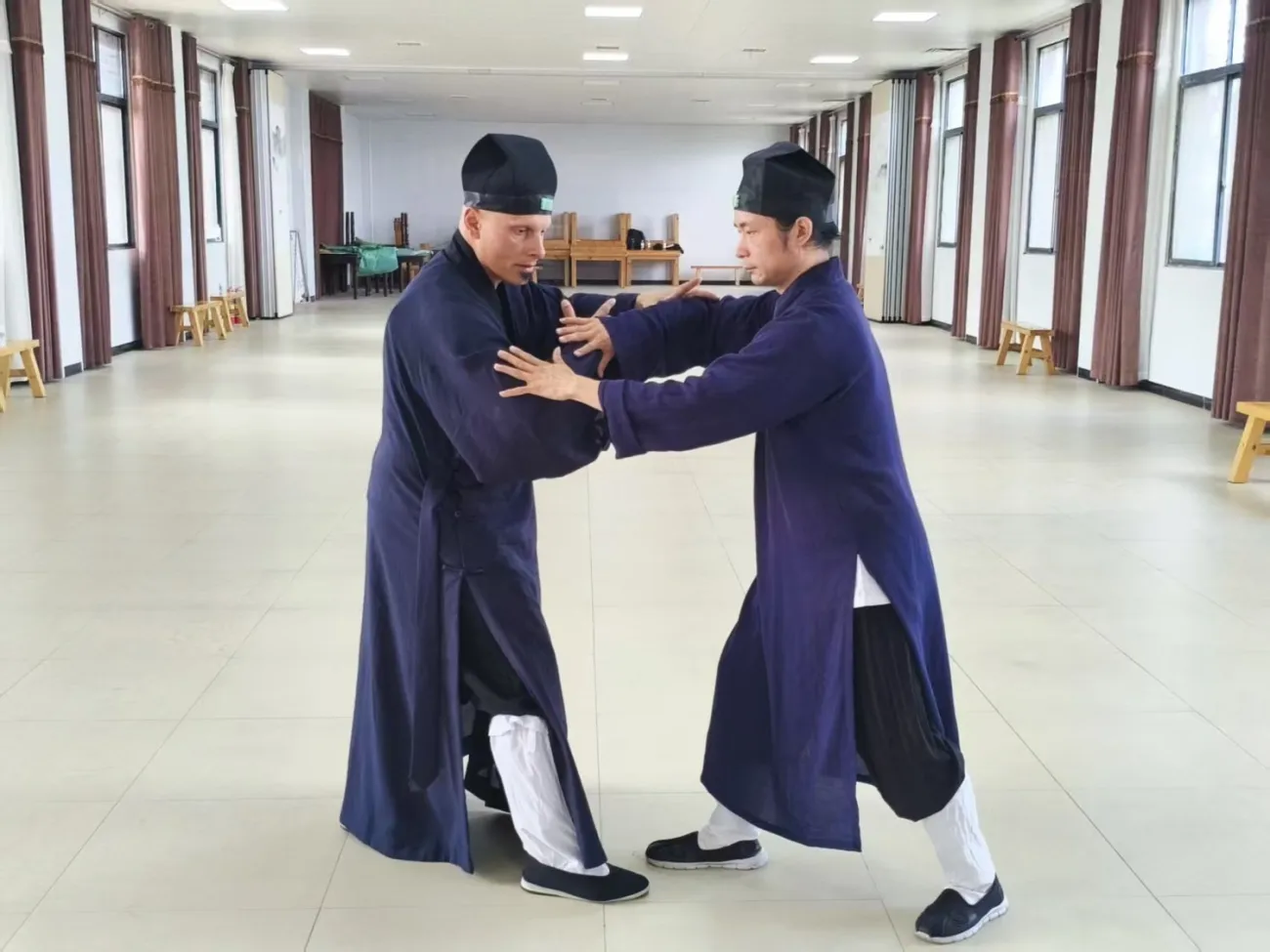
This is a metaphor for the principle of using a small force to redirect a large one. When facing an opponent, practitioners do not attack but listen to the opponent (tīng jìn 聽勁), follow their movement and redirect their energy elsewhere. Ting 聽 means to listen, jin 勁 means force. This means physically and mentally “hearing” the opponent’s intentions, direction, strength, and speed through touch (for example, when the hands make contact) or simply through their movement. Without ting jin it is impossible to apply the principle of “four liang move a thousand jin”.
Long-term taijiquan practice sharpens the body’s perception of an opponent’s force: whether it is hard or soft, where it is moving, where the opponent’s balance lies, and whether their force is empty (lost) or full (strong). Although we seem to act later, we reach the target first; we strike later but arrive first—that is the essence. To achieve this, we must be calm. This does not mean standing motionless, but cultivating calm in our thoughts and keeping the body relaxed. If our mind and heart are not calm, if the body is not relaxed, we cannot sense the opponent’s force. If we cannot sense the opponent’s force, we cannot act later yet achieve the effect first. Stillness in taijiquan is a state of heightened alertness with immediate responsiveness.
When someone pushes us, we do not resist but redirect their force so that the opponent loses their centre of gravity, then seize the moment to counterattack. It is not about overcoming force with physical force (which would require enormous strength), but about redirecting, evading, and making use of the opponent’s energy. It sounds contradictory: how can we be first if the opponent has already moved? The key lies in perceiving, or being sensitive to, the opponent’s force, or ting jin 聽勁.
3. Slowing Movement through Calmness
Movement in Wudang taijiquan is very slow. It must proceedmust proceed at a steady pace, without sudden acceleration or slowing down. Slow movements allow practitioners to control their bodies and feel subtle changes. There are no interruptions during movement. When one movement ends, the next begins immediately. Like flowing water or drifting clouds, everything unfolds smoothly and continuously, allowing blood and qi to circulate freely throughout the body.
4. Using the Heart-Mind (心 xīn) Instead of Brute Physical Force (lì 力)
Distinguishing between emptiness and fullness is a basic principle and requirement of Wudang taijiquan practice. Emptiness means that the body’s weight does not bear down on the leg, while fullness means that the weight rests entirely on the leg. During practice, the centre of gravity constantly shifts from one leg to the other, achieving a state in which emptiness contains fullness and fullness conceals emptiness.
Using internal energy (neijin 内劲) rather than physical force is a basic principle of taijiquan. People usually rely on muscular strength, which is brute force. Taijiquan takes a different approach, requiring practitioners to perform movements with awareness rather than by tensing their muscles. For example, if you want to raise your arm, simply direct your thought towards the target and your arm will spontaneously perform the movement naturally. It sounds mysterious, yet it is just like walking. You do not deliberately contract your thigh muscles; you move naturally. Taijiquan extends this intense yet effortless movement to the whole body. In taijiquan, movement is relaxed but conscious. The body is relaxed, but what matters is intention, the gentle, quiet attention with which we act. (Yi dao, qi dao – Where intention goes, qi follows. Yi bu dao, qi bu dao” – Where intention is absent (or too strong), qi does not arrive.
“Use the heart-mind to guide qi so that it descends, gathers, and penetrates to the bones. Use qi to initiate the body’s movement, keeping it soft so that it can follow the heart-mind,” says Zhang Sanfeng.
Guide qi with a calm mind, allowing it to sink deep into the body, down to the bones. Activate the body in a smooth flow so that movements freely follow the mind. Consciously guide qi, which moves the body and enables unobstructed movement.
Internal alchemy (Nèidān內丹) views the human body as a microcosm. By nurturing jing (essence), qi, and shen (spirit), we can attain a state of unity with the Dao. By cultivating jing into qi, qi into shen, shen into emptiness, wu, we can attain the Dao. Taijiquan represents the transformation of internal alchemy techniques (neidan) from meditation in a static posture into dynamic practice, from a static to a dynamic state.
By harmonising inner transformation, the inner mind, and dynamic practice, we reach the highest level of Wudang taijiquan. It requires complete coordination of breathing, movement, and awareness. Movement is the outward expression, breathing is the internal power, and the heart-mind is the guide. Only by uniting both principles, internal and external, can we fully draw on the power of taijiquan. Only through harmony between the internal and external can we attain the true power of taijiquan.
4. The Value of Taijiquan for Preserving Health
The words attributed to Zhang Sanfeng, that taijiquan supports longevity and vitality, are not an empty phrase. Taiji must be practised with calm awareness of the heart (the heart-mind): “When the heart-mind is calm, the breath regulates itself; when calm endures, the mind settles of its own accord.”
The movements are slow and soft, coordinated with the breath, which massages the internal organs, stimulates blood circulation, and regulates the nervous system. The practice requires calmness, concentration, and relaxation, which help improve well-being, reduce stress, improve sleep, and stabilise emotions. Many chronic conditions, such as high blood pressure, diabetes, and arthritis, can improve significantly through long-term practice.
This is why taijiquan is also called “healing boxing”. Wudang taijiquan requires practitioners to remain attentive and focused during practice and to shut out all distractions. Long-term practice develops concentration and patience, alleviates anxiety, depression, and negative thoughts, and brings the heart-mind into a state of calm.
Uroš Hrastnik, member of SDT