

 Music Department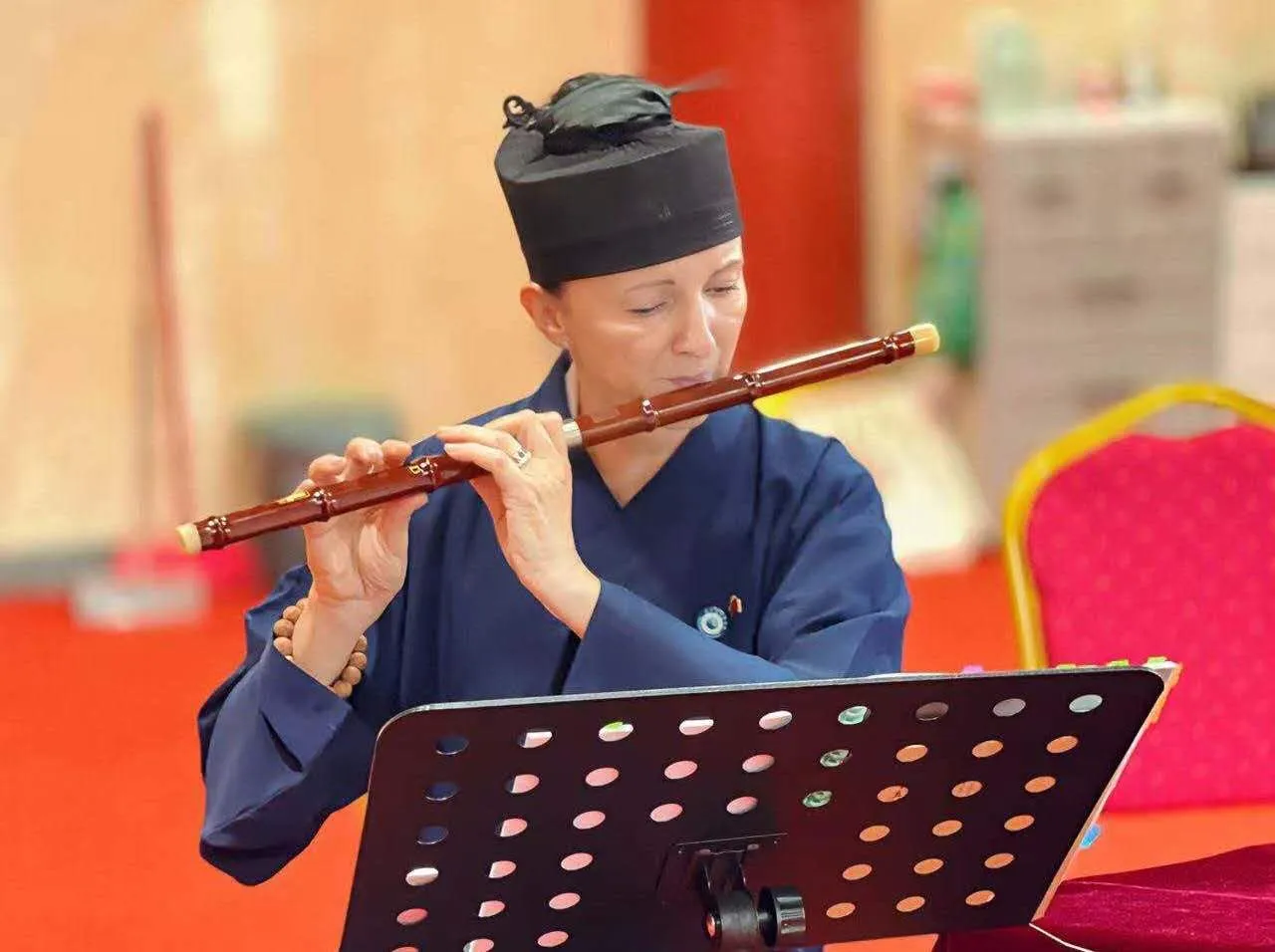

A Journey into the “Unknown” (Part One)
Before I describe in words the incredible, unforgettable experience I had in Chongdao Gong (崇道宫), a temple of the Quanzhen lineage (Quánzhēn pài 全真派), from June 28 to July 12, 2026, I cannot pass over the “chance” events and the path that led to this beautiful and complete experience.
And when I look back, I clearly see how our lives are intertwined and how everything is planned, connected, and supportive — how the mysteries of the Dao reveal themselves each day.
It all began in June 2025, when, after a “chance” meeting, SDT member Maj Dolšak Fabris (YuanXiming) invited me to take part in the Daoist Music Department of SDT. He introduced me to the work plan of the Daoist Music Department and the study of traditional Chinese musical instruments for the period from July 2025 to July 2028.
I responded to the invitation to participate in the Daoist Music Department of SDT with great joy, since, as a professional flautist and teacher, I have always also been interested in a more subtle approach to flute playing, in recreating music, and in discovering and exploring unknown musical realms hidden from the eye.
I did not know what awaited me, so I approached it with curiosity and at the same time with openness to the unknown, and simply let myself be guided. In February 2026, I received three original traditional Chinese DiZi bamboo flutes (tuned in D, E, and F), and my first contact with the flutes was wonderful. The softness of the bamboo, held in the palms of my hands, gave a feeling of familiarity and warmth. In addition, compared with the transverse concert flute, DiZi flutes are light, simple (as they have no keys), and pleasant to hold. On my path as a flautist, I had already encountered various traditional flutes, but I had never held one so refined and soft in my hands.
Blowing into the DiZi is simple, since the hole into which we blow (as when blowing into a bottle), called the embouchure hole, is similar to that of the transverse flute, except that it lies on the same plane as the finger holes (the embouchure hole is not raised as it is on the transverse flute). However, I soon realised that, when playing the DiZi flute, the correct placement of the bamboo membrane (the second hole next to the embouchure hole, to the right) is essential, as it is what enables the DiZi flute to sound at all.
After my first unsuccessful attempts, I realised that the sound of the DiZi does not depend on me, or on the person playing the flute, but on the tension of the fitted membrane, as well as on temperature differences and humidity in the room, which affect the sound. After many gradual attempts, I discovered how it works best, and with that obtained a beautiful, clear, pure, and penetrating sound.
Then a second challenge appeared before me: all the traditional Daoist ritual songs are written in the numbered musical notation system (Jiǎnpǔ 简谱), which was new to me. Since I did not yet know the numbered system or the fingerings, I notated and transposed the songs of the morning ritual, which we practised together, for a specific DiZi flute, thereby making note reading, and thus playing, easier for myself.
Practising at home, rehearsing together in the temple, and taking part in the first musical rituals of SDT brought a different feeling from the one I was used to when playing the transverse flute. The more deeply I entered into the DiZi and became acquainted with the ancient melodic tradition of Daoist ritual songs, the more I felt inner changes that affected me as a whole. My body became increasingly calm and soft; emotionally, I became neutrally “non-acting” and at the same time receptive and in harmony with everything happening around me. Mentally, I deepened my concentration and focus. Everything had a very harmonious and actively calming effect on me. Even though in rehearsals we had to repeat the songs several times in succession, I experienced this inwardly as a meditative state, in which the sound completely permeated and embraced me, and I simply WAS — which is a fundamental principle of Daoist practice.
After several months of introduction, playing, and study of traditional Daoist music, all of this led to a decisive “chance” conversation with the Rector of SDT, Yuan Weiqi 袁微琪, Daoist priest, who informed me of the possibility of in-depth study, education, and close, holistic understanding of original Daoist musical ritual at the sister temple Chongdao Gong (崇道宫). Since this is a three-year collaboration between the two temples, with the aim and purpose of gradually establishing lasting forms of transmitting knowledge of Daoist ritual music and traditional Chinese musical instruments to Europe, I accepted the proposal immediately, with gratitude and great enthusiasm. This was followed by an official invitation from the Abbot of Chongdao Gong (崇道宫), Song Chongdao 宋崇道.
The two months of preparation for the two-week training in Daoist music and traditional folk music were filled with many necessary and practical instructions from the Rector of SDT, Yuan Weiqi 袁微琪, Daoist priest; Vice-rector Yuan Weiheng - 袁微恒, Daoist priest; the head of the music department, Yuan Ximing - 袁希明, Daoist priest; and other members of SDT. The only prerequisite was that I learn the numbered notation system, which would allow me to play Daoist music there without interruption.
I must honestly say that I had always dreamed of being able to live in a temple, surrounded by monks, withdrawn from this materialistic world where problems keep piling up and lead into a vicious circle... And yes, that wish, that inner call, which had waited asleep for the “chance” moment when I would be mature and ready, finally came.
Happy and at the same time a little excited, with gratitude in my heart, I set out on a fourteen-day journey into the “unknown.” It turned out that this journey was A PATH INWARD, A PATH INTO MYSELF, INTO THE KNOWN — the path of unveiling the Dao had begun.
Alenka Zupan, member of SDT


