Music Department
Musical Training (Part 3)
Music has a special ritual and spiritual role in Daoist ceremonies. It is not merely an accompaniment, but is regarded as a means by which initiates establish balance between people, nature, and the cosmos. For all Daoist musicians, music is therefore a form of spiritual practice.
Traditional musical instruments play a central role in Daoist ceremonies, as they are not merely an accompaniment to chanting or prayer, but ritual implements that help establish a connection between the human and divine realms. Each instrument has its own symbolism and a precisely defined place in the ceremony. Traditional instruments are therefore an indispensable part of religious practice in Daoist temples. Without them, ceremonies would not have the same symbolic meaning, as sound is regarded as a means of connecting the visible and invisible worlds and supporting the spiritual purpose of the ceremony.
The Daoist musical and liturgical teachings and insights I received at the temple were a unique and personal experience. I realise that someone else would receive them in their own way, depending on their prior knowledge and life experience. Although I have taught the flute for many years, I began learning traditional Daoist ritual instruments completely “unknowing”, open, and curious, like a small child discovering new knowledge with a spark in her eyes.
I learned that traditional ritual instruments are divided into melodic and rhythmic instruments, each performing an important, specific task in the enactment of a particular ceremony. Melodic instruments enrich, complement, and support the lead singer, adapting to the pitch of the singing. Because melodic instruments are a “colourful extension” of the singer and must not overpower the voice, they are positioned on the left side by the altar, behind the other rhythmic instruments. The melodic instruments used during the ceremonies were the wind instrument dizi 笛 (a transverse bamboo flute) and the plucked-string instrument yangqin 扬琴 (a hammered dulcimer). During the first week, I practised my musical skills on the dizi almost every day at both the morning and evening ceremonies, playing alongside the initiate Ou Dao Daozhang, who accompanied the ceremony on the aforementioned yangqin.
Adapting to the intonation of the lead singer—there were three in total, alternating over the course of two weeks—was sometimes quite challenging, as the singer’s intonation differed from that written in the book. I therefore had to switch between dizi flutes, which are tuned in equal temperament to a particular key, changing from a D dizi to a C dizi and even to a B dizi, which unfortunately I did not have. I later learned that the key indicated for each song in the book serves only as a guide and is not binding for the singer.
Ritual rhythmic instruments are intended to provide structure and regulate the tempo of the liturgical performance. The following were always present at the ceremonies: muyu 木鱼 (wooden fish), yinqing 引磬 (handheld singing bowl), zhong 钟 (handheld ritual bell), qing 磬 (ritual bowl), gu鼓 (drum), dang 铛 (small handheld gong), and three types of ritual cymbals: cha 镲, nao 铙, and bo 钹.
All the rhythmic instruments have a clearly defined, written rhythmic structure. During the prescribed bows and kneeling movements, the rhythmic pattern changes slightly, particularly on the drum and bowl, signalling the changes.
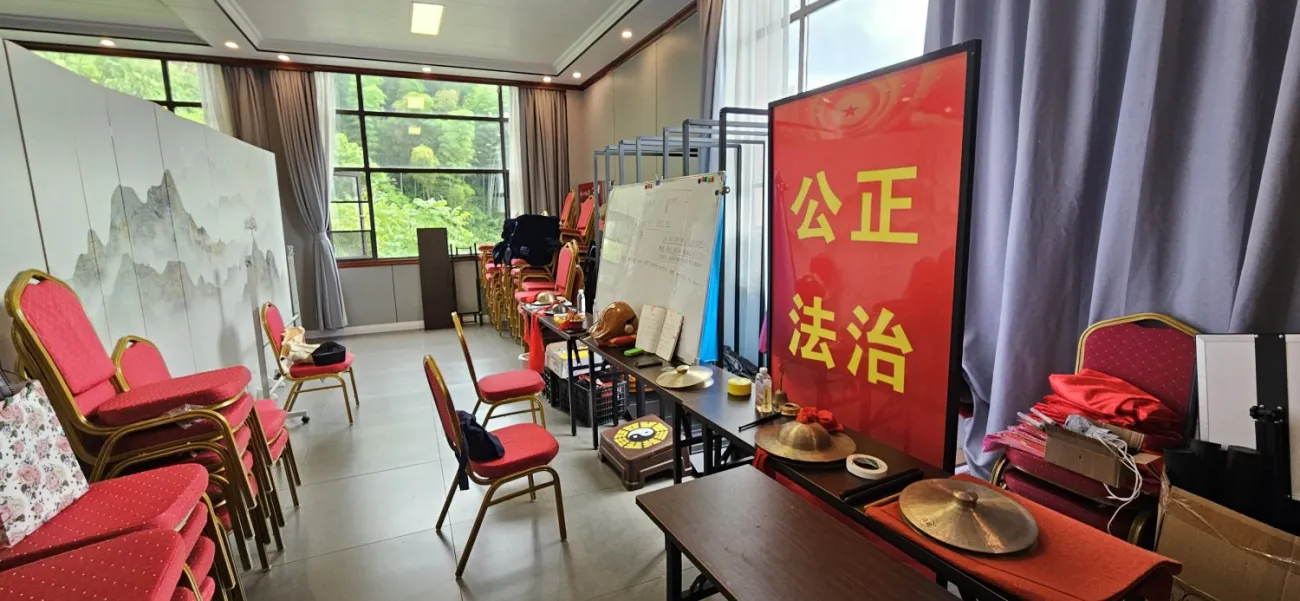
The arrangement of the instruments by the altar is likewise precisely defined. I learned that we always view their arrangement from the altar towards the hall—the deities’ view of the world. An interesting insight was that the instruments arranged on the left are symbolically closer to the deities than those on the right.
On the left, moving outwards from the centre, the instruments were arranged in the following order: muyu 木鱼 (wooden fish) and yinqing引磬 (a handheld singing bowl used to guide the chanting)—both instruments are always played by one musician—followed by cha 镲 (small ritual cymbals), bo 钹 (large ritual cymbals with a red cord), and finally gu 鼓 (drum) with zhong 钟 (ritual bell)—both instruments are always played by one musician.
On the right, moving outwards from the centre, the instruments were arranged in the following order: qing 磬 (ritual bowl), dang 铛 (small handheld gong), nao 铙 (large ritual cymbals), and finally zhong钟 (handheld ritual bell).
Because the entire ceremony was new to me, at first I simply accompanied the other musicians on the dizi flute, listened to the rhythmic pulse and the speed of the songs, and adapted as much as possible. Performing the opening song, all nine main songs, and the closing song during a ceremony lasting approximately 45 minutes is not easy, especially when doing so for the first time in one’s life. Later, through daily practice with the musicians, I became completely immersed in the rhythm and melody and began truly to feel the ritual music.
Harmony and coordination are two of the four principles of performing ritual music. In certain passages, the rhythm of the melody differed from what was written in the book. Later, through study, I played all the songs on the dizi and sang the melodies with the initiate Ou Dao Daozhang, correcting them in the book and mastering them in the process—the third principle: preserving the authenticity of the melodic tradition. Each ceremony was a valuable experience that encouraged me to perform with greater depth. This led to an inner unity with all the musicians and, consequently, to a cohesive whole in sound—the fourth principle: unity between inner orientation and sound.
During my stay at the temple, the initiate Ou Dao Daozhang also introduced me to two more melodic instruments:
Sheng 笙 is one of the oldest Chinese wind instruments, with a history extending back more than 3,000 years. It belongs to the family of free-reed mouth organs and is regarded as the predecessor of modern harmonicas. The sheng consists of pipes arranged in a circle and designed to resemble a phoenix, which symbolises rebirth. The musician blows into a metal mouthpiece at the lower edge, supports and holds the instrument with both hands, and uses the fingers to close or open holes along the sides of the pipes, thereby producing different notes. The sheng has a warm, melodic sound and can produce several notes at once, making it possible to play melody and harmony simultaneously.
For me, the sheng was too heavy an instrument, and I could not imagine playing it throughout an entire morning or evening ceremony. After only a few minutes, my arms hurt so much that I gave up. Yet I am certain that someone will be so enchanted by its sound that they will easily bear its weight as well.
Guzheng 古筝 is one of the oldest and most popular Chinese string instruments, with a history extending back more than 2,500 years. It is a zither with movable bridges, known for its rich, harp-like sound and elegant appearance. It usually has 21 strings stretched across a wooden resonating body. Beneath each string is a movable bridge that allows the musician to adjust its pitch. The musician plucks the strings with the fingers of the right hand, while the left hand presses the strings to the left of the bridges to create vibrato, glissandos, and other musical effects. Unfortunately, there was too little time for an in-depth exploration of the guzheng.
The initiate Ou Dao Daozhang also introduced me to all the rhythmic instruments used during the ceremonies:
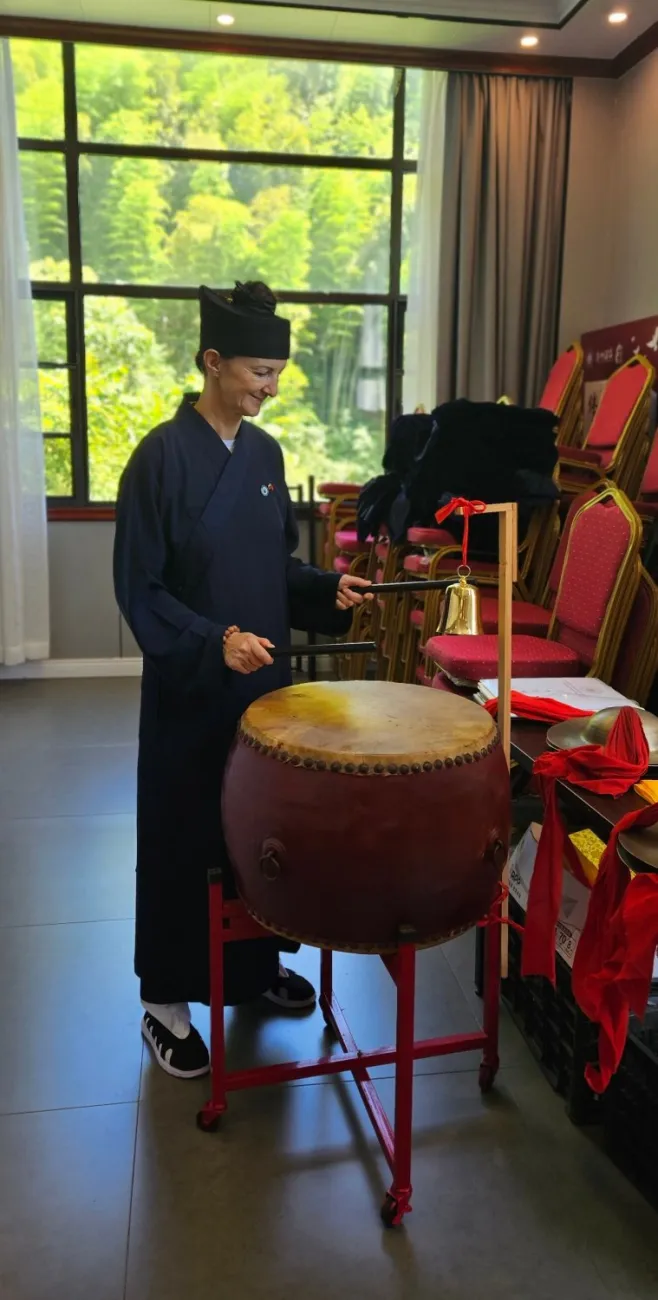
Gu 鼓 (large drum), played with the right hand, and Zhong 钟 (ritual bell), played with the left hand where indicated. These two instruments are always played by one musician, because the ritual bell is not used throughout. When it is not used, the drummer strikes the drum with sticks in both hands—at the beginning of the ceremony, during the opening song, at transitions and special points of emphasis where the rhythm becomes denser, and at the end of the ceremony. Playing these two instruments is the most demanding of all the percussion parts because they complement each other rhythmically. I therefore needed the most time to coordinate the correct rhythmic pattern between my left and right hands.
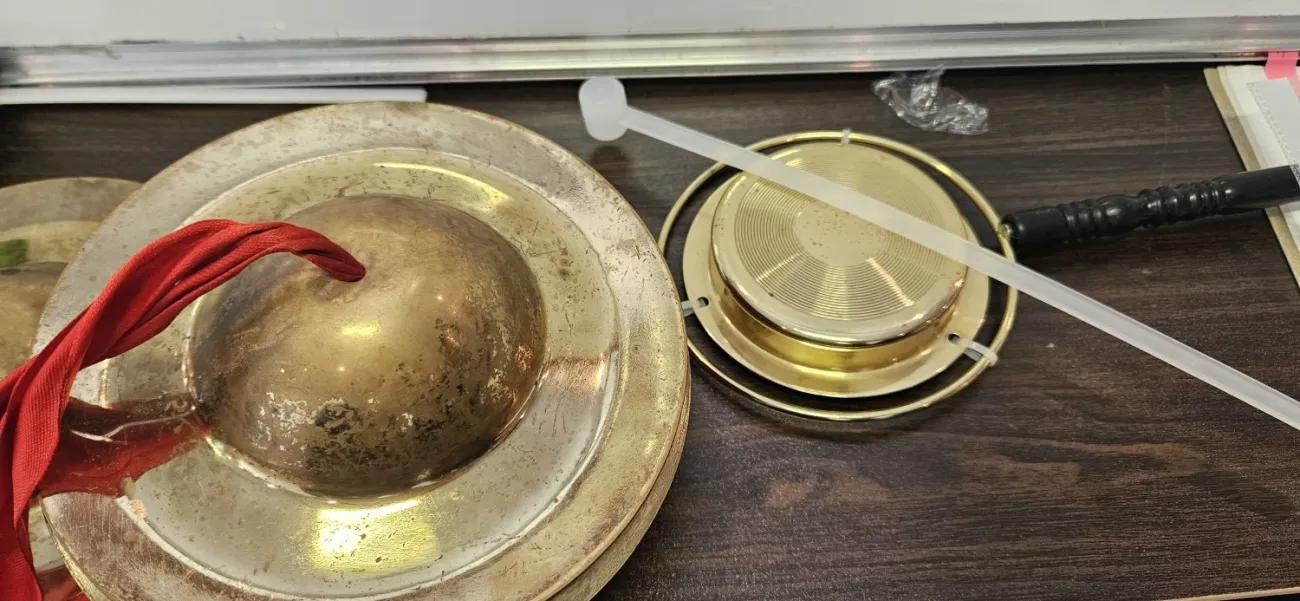
Cha 镲 (small ritual cymbals) and Dang 铛 (small handheld gong), which is struck with a plastic beater on a long handle. Both instruments can be played by one musician. In this case, one cymbal is placed face up in a specially designed stand, while the other is struck downwards with the left hand. With the right hand, the musician rhythmically strikes the small gong, lying flat, with the beater. Only when more musicians are available are the two instruments played separately. I immediately grew fond of both instruments, and alternating between them felt like a game, so I quickly learned all the songs from both the morning and evening ceremonies. I was helped by the initiate Dao Zhang, who also served as the lead singer for the morning and evening ceremonies during the first week, when master Song and master Giochi were absent.
I was very grateful that every evening after the final ceremony, which took place after dinner, he made time for me and taught me everything. He warned me that particular care must be taken with the resonance of the instruments, because where one strikes them matters. For example, the small cymbals must rebound correctly to produce a bright, light sound, using relatively little force. The small gong, meanwhile, must be struck in the centre with the plastic beater so that its sound is clear and brilliant. I admit that I had tremendous fun playing them and rejoiced like a small child. It is remarkable how the sound of certain instruments can awaken happiness and joy within us.
Bo 钹 (large ritual cymbals with a red cord) came quickly to me, and I learned to play every song. With this instrument, too, I received help every evening from the initiate Dao Zhang, who also taught me how to hold it correctly. We used a translation app to communicate so that I could understand all his explanations and instruction. These cymbals are quite heavy, and because they are played with both hands, the red cord must be wrapped correctly around the fingers and palm of the left hand. A different grip is used for the right hand. Only then can both cymbals be used freely throughout the entire ceremony. Playing them was fun, and wrapping the red cords around my fingers and palms caused me more difficulty than performing all the songs themselves.
Muyu 木鱼 (wooden fish). When I began learning the wooden fish, or muyu, on Saturday, 4 July 2026, my teacher was master Giochi, who from that day onwards led all the ceremonies as the principal singer with her beautiful voice and refined energy. I also used a translation app during her lessons. To begin with, we worked through only the first two songs of the evening ceremony. That same day, during the evening ceremony, I played the entire ceremony on a “silent” muyu—a plastic board—beside her as she led the whole ceremony on a real muyu. During the ceremony, I noticed many discrepancies in the rhythmic notation in the book from which I was playing. Over the next two days, we therefore conducted a detailed analysis of the notation in the book, adding material and making numerous corrections. Playing the muyu itself is not difficult, as it simply involves striking the instrument. Playing it throughout every ceremony, however, is demanding and carries great responsibility, because the lead singer plays the muyu and thereby guides the entire ceremony.
Yinqing 引磬 (a handheld singing bowl used to guide the chanting), played together with the muyu, has a very bright, bell-like sound. I only tried playing it. Unfortunately, I did not manage to learn how to play both instruments together.
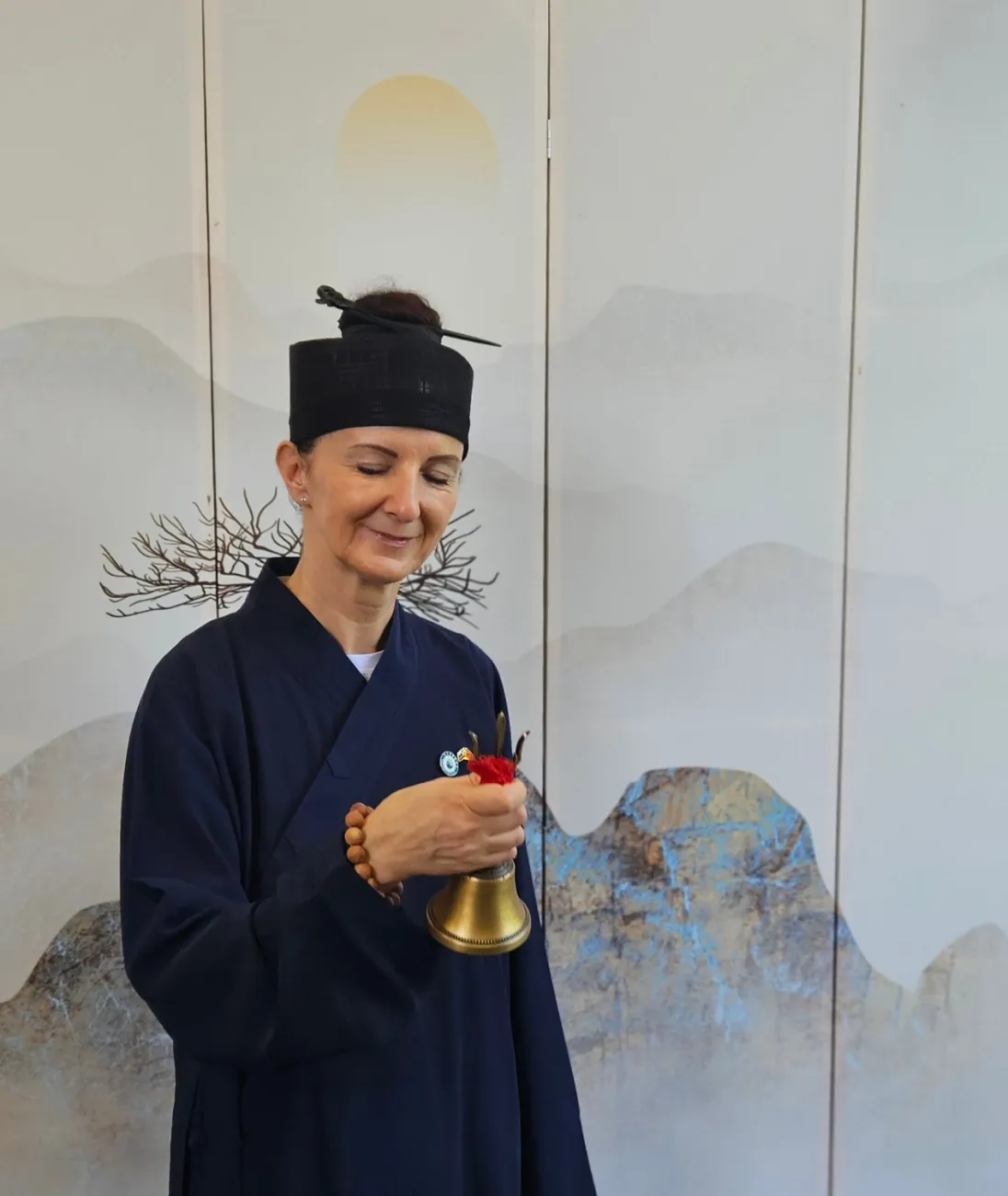
Zhong 钟 (handheld ritual bell) was another instrument I learned with my teacher, master Giochi. She demonstrated the hand position, held at a slight angle, and the different ringing speeds, which must be adjusted appropriately to the tempo of each song. Mastering the correct tempo and maintaining it took me quite a few days.
One might think that ringing a bell is easy, but maintaining a consistent tempo and the same movement is actually quite demanding.
Nao 铙 (large ritual cymbals) have rounded metal handles and are therefore easier to grip. My teacher Ou Dao Daozhang played them so beautifully that I repeatedly admired her elegant hand movements and the sound she produced by sliding them against each other. The sound is created by sliding their edges up and down against each other while rotating them at the same time. The speed of the sliding motion changes according to the rhythmic pattern. Playing the nao was quite demanding, as it requires developing a feel in the wrists for the upward and downward sliding motion while the cymbals touch. I would have needed more time to master the nao fully.
I learned to play all these traditional ritual instruments from three experienced masters: the initiate Ou Dao Daozhang, master Giochi, and the initiate Dao Zhang. I was deeply impressed by their refined sense of sound production, their handling of the instruments, and their ways of striking and playing them. At every moment of learning, I admired their self-discipline, inner calm, and cultivated approach to performing ritual music. Their patience as teachers, the precision of their explanations, and the respect they showed me as I learned everything for the first time, like a small child, never ceased to amaze me.
I am immeasurably grateful to all three of them for every moment and every hour I was given and spent in their presence. Through their energy, passion, and vibration, they inspired and transformed me. I gained new musical knowledge, experience, and insight into the deeper meaning of all these instruments, which serve as ritual “tools” for establishing a connection between the human and divine realms. This was a new discovery for me, one that also enriched my personal musical world and gave it greater meaning. I am aware of the depth and significance of performing Daoist music, in which sound serves as a means of connecting the visible and invisible worlds.
SDT member, Alenka Zupan