

 Articles
Machine-Made and Handmade Incense: What Is the Real Difference?
Authors and Biographies
Xu Xianzeng (徐献增)
Xu has 17 years of experience making traditional Chinese blended incense. He is responsible for the Qingcheng Incense-Making Craft Intangible Cultural Heritage Project in Qingyuan, Guangdong Province, China. His work focuses on traditional aromatic material preparation (paozhi), incense formulas, and hands-on incense making.
Zhang Liang (张亮 / Sam)
Zhang focuses on researching Chinese blended incense culture, studying historical texts, documenting traditional craftsmanship, and writing. His work aims to preserve and organize knowledge of Chinese incense traditions and help make them better understood across cultures.
Xu Xiaoyue (徐晓月)
Xu Xiaoyue is Xu Xianzeng's daughter.
This article is based on Xu Xianzeng's many years of practical incense-making experience and his oral accounts. It was jointly compiled and written by Xu Xiaoyue and Zhang Liang.
***
When people talk about machine-made and handmade incense, they often divide them into two categories: machine-made incense is commercially produced, inexpensive, and may contain synthetic fragrances, while handmade incense uses natural materials, follows traditional methods, and is considered better for one's health. I believe the reality is not so simple. Handmade incense can also be produced for commercial sale, and the use of machines does not necessarily mean that fragrances have been added. In our own incense-making practice, we use machines in many stages of production. If we judge the quality of an incense stick simply by whether machines were used to make it, we may overlook many things that truly matter.
The incense-making process can be divided into ten steps: preparing the aromatic materials, paozhi (traditional processing), grinding, sifting, blending, kneading the dough, shaping the incense, shade-drying, test burning, and aging. The ancients did not have the convenient tools available to us today, so much of this work had to be done by hand. Machines are now widely available, and making incense entirely without modern tools is neither necessary nor a guarantee of better results. Take the preparation of Jiangzhenxiang, for example. Some historical incense texts instruct that it should be filed into pieces about the size of rice grains. Doing this entirely by hand would mean filing the material piece by piece, which takes considerable time and effort. A high-speed grinder can greatly shorten the process, but without careful attention, the granules that need to be preserved can quickly turn into fine powder. We therefore often let the machine run for only about ten seconds, then stop to check the condition of the material. Grinding and sifting can also be done with machines, but some materials, such as Xuanshen (Scrophularia root), do not pass easily through a sieve and sometimes require manual assistance. Machines can make these processes more efficient, stable, and precise, but knowing when to stop and what constitutes a properly finished material still requires human judgment.
Paozhi is considerably more complex. Take sandalwood, for example. We sometimes soak it in green tea for a full day, then stir-roast it until the wood gradually takes on a purplish color. The purpose of this treatment is to adjust the sandalwood's originally dry and sharp qi, making it easier to harmonize with other aromatic materials in the subsequent blending process. Soaking, heating, and stir-roasting can all be carried out with the help of tools, but why green tea is chosen, how far the processing should go, and how the material's qi has changed in the end are not questions a machine can answer simply by completing its operations. Even the same aromatic material can be taken in different directions through different methods of paozhi. The incense maker needs to understand exactly what they are trying to achieve, and what may have been lost along the way. I believe this is precisely what even the finest machines find difficult to replace.
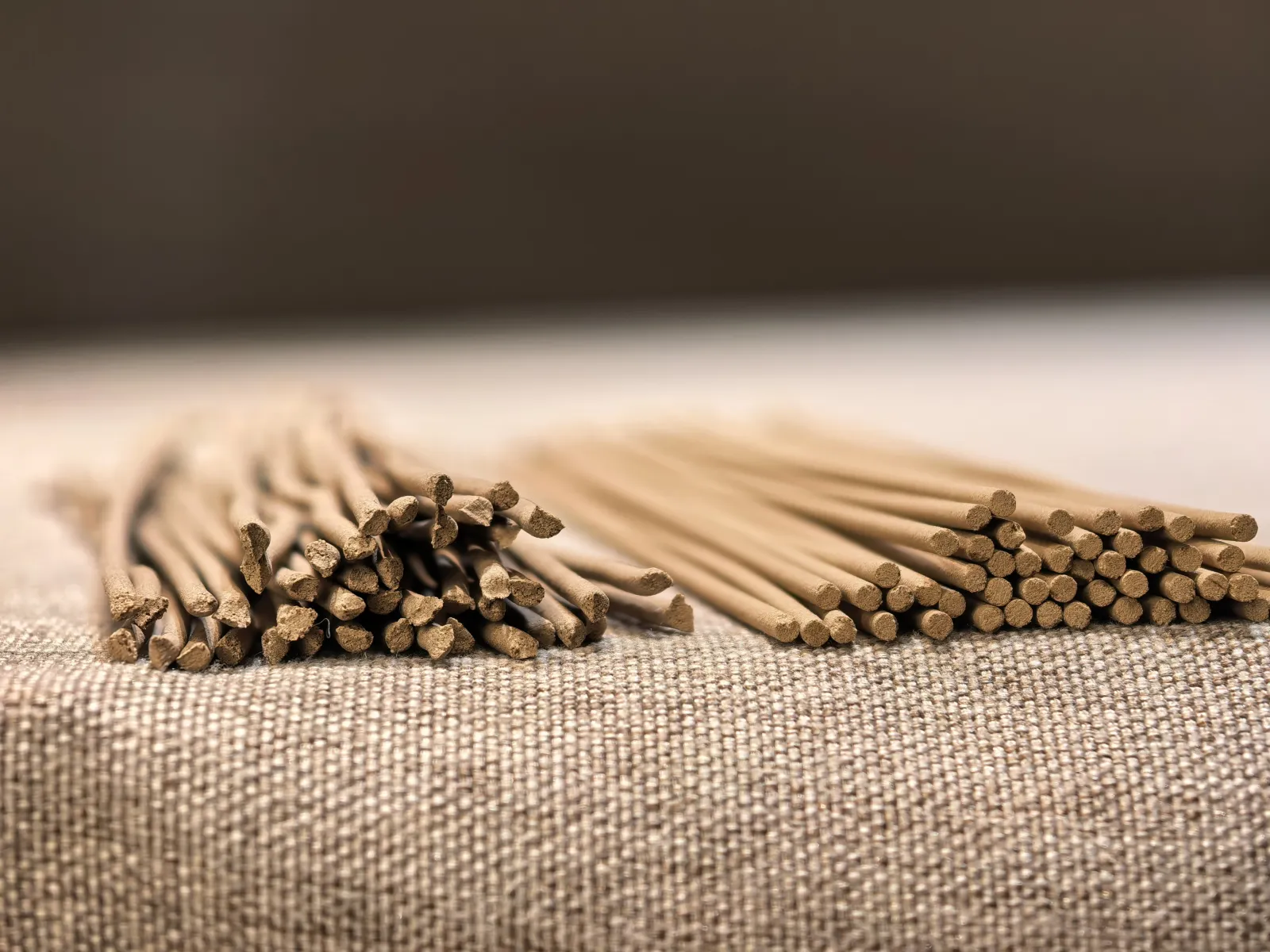
Beyond material preparation and paozhi, kneading and shaping also affect how a finished incense stick performs. When kneading by hand, the aromatic powders must first be thoroughly loosened and mixed. Water is then added gradually, a little at a time, while the dough is repeatedly kneaded and worked so that the different aromatic materials and binding ingredients become fully integrated. The incense maker adjusts the amount of water, the force applied, and the duration of kneading according to the condition of the dough. In machine production, however, the powders can be mixed until they form a loose, flaky mass, then placed directly into an extrusion chamber and shaped under pressure. The required proportions of water and binding powder are therefore different. For single-ingredient agarwood incense, for example, the weight ratio of aromatic powder to water can approach 1:1 when kneading by hand, while a machine-extrusion process may use a ratio of approximately 1:0.7. These differences ultimately affect the density, porosity, and binding structure of the incense stick, which in turn changes how aromatic substances are released during burning. Machine-extruded incense sticks are also generally straighter and more uniform in thickness, making them more likely to retain their shape after drying, while handmade sticks may have slight curves or variations in thickness. Incense that has been thoroughly kneaded by hand often allows its fragrance to unfold and release more freely, producing a clearer and more pronounced scent. By comparison, incense formed by high-pressure extrusion from a loosely mixed powder tends to release its fragrance more slowly and in a more restrained manner.
Commercial production involves considerations of cost and efficiency. Eliminating a single step may save time, labor, and materials, while using machines can increase output and make products more uniform and consistent. But if necessary steps are omitted, or standards for materials and finished products are lowered in order to reduce costs, greater production efficiency may come at the expense of incense quality. Such compromises are not exclusive to machine production; handmade incense can also be produced with shortcuts and inadequate care. What truly matters is how the incense maker makes choices between efficiency, cost, and quality.
People who use incense are naturally concerned about its effects on health. In the philosophy of Chinese blended incense, a stick of incense should, first and foremost, be harmless. To achieve this, the key considerations are the quality of the aromatic materials, whether paozhi has been carried out properly, whether the qi formed through blending is harmonious, and whether the incense is suitable for the person using it. Whether these things can be achieved ultimately depends on the Dao the incense maker holds in their heart, rather than on whether they use machines or make incense by hand.
According to traditional incense-making knowledge, using aromatic materials without appropriate paozhi may have adverse effects on the body. For example, when Jiangzhenxiang has not been properly processed, its oils may produce a noticeable burnt smell during combustion, sometimes accompanied by black smoke. The incense stick may also be more prone to extinguishing before it has burned completely. After processing methods such as boiling in water and removing some of the oils, these problems can be improved, and the clean, gently sweet woody fragrance that was previously obscured can emerge more clearly.
Besides paozhi, the blending of aromatic materials is equally important. Chinese blended incense follows the principle of Jun-Chen-Zuo-Shi (Sovereign, Minister, Assistant, and Envoy), in which different aromatic materials must harmonize with and balance one another. Even when every ingredient in a formula is of high quality, improper blending may still cause harm. For example, if several pungent, warming, and drying aromatic materials are used in excessive amounts without other ingredients to balance them, the qi of the entire formula may become excessively dry and intense. Prolonged exposure to such incense may cause dryness of the mouth and nose, throat discomfort, or even dizziness and a feeling of tightness in the chest. An incense maker approaches incense much as a physician approaches medicine, and an incense formula is like a medicinal prescription. One must understand not only the properties of each individual material, but also the overall qi that emerges when they are combined.
Another frequently discussed subject is the difference between natural incense and incense containing added aromatic substances. In addition to wood, resins, herbs, and other natural aromatic materials, some incense products contain essential oils, hydrosols, or fragrance compounds. Essential oils are aromatic substances extracted from plants, while hydrosols are aromatic waters obtained during plant distillation. Both can be natural products. Fragrance compounds, meanwhile, may be formulated from natural or synthetically produced aromatic ingredients. Some manufacturers add fragrance compounds to mask the initial burning smell or to make incense release a strong scent immediately after lighting. This is itself a formulation choice. However, low-quality fragrance compounds, additives of unknown origin, or excessive amounts of aromatic substances may undergo thermal decomposition at high temperatures, producing irritating substances such as formaldehyde and acrolein that can affect the eyes and respiratory tract.
From the perspective of modern combustion science, we must also consider what aromatic materials actually produce when heated and burned. For example, if a stick of incense continuously produces thick smoke, especially black smoke or a pronounced burnt smell, it should be used with caution. Black smoke often indicates incomplete combustion and the formation of soot. Fine particulate matter in the smoke can also increase the burden on the respiratory system when inhaled.
Beyond harmlessness, what a stick of incense ultimately seeks to achieve is qi and yun. I believe the highest level that traditional Chinese handmade blended incense can attain remains beyond the reach of today's machine production. Chinese blended incense requires not only knowledge of aromatic materials and production techniques, but also a profound understanding of yin and yang, the principles of blending, and the Chinese tradition of incense. The qi of the same aromatic material may vary from one batch to another, and even when following the same formula, adjustments must be made according to the actual condition of the materials. Throughout the process, the incense maker must continually sense, judge, and make choices so that the qi of different aromatic materials can truly harmonize, ultimately forming the qi and yun they seek. Machines can execute predetermined processes with precision, but they cannot independently make the judgments that arise from years of experience and a deep understanding of the art of incense.
From the perspective of Chinese blended incense, the distinction between machine-made and handmade incense goes beyond production methods and burning characteristics. More importantly, it lies in the qi that ultimately takes shape. The qi of a stick of incense can be understood on three levels: first, the qi of the aromatic materials; second, the qi of the formula; and finally, the qi of the finished incense. Through paozhi, the original qi of the aromatic materials changes. When different materials are combined according to a formula, they form the overall qi of that formula. And when the aromatic powders have been kneaded, shaped, shade-dried, and aged, what finally manifests during burning is the qi of the finished incense. Even when the same materials are used, processed in the same way, and blended according to the same formula, machine-made and handmade incense will still exhibit differences in the qi and yun of the finished incense because of differences in kneading and other production methods. By the same reasoning, even among handmade incense, the same incense made by different incense makers will have its own distinct qi and yun.


