

 Daoist Studies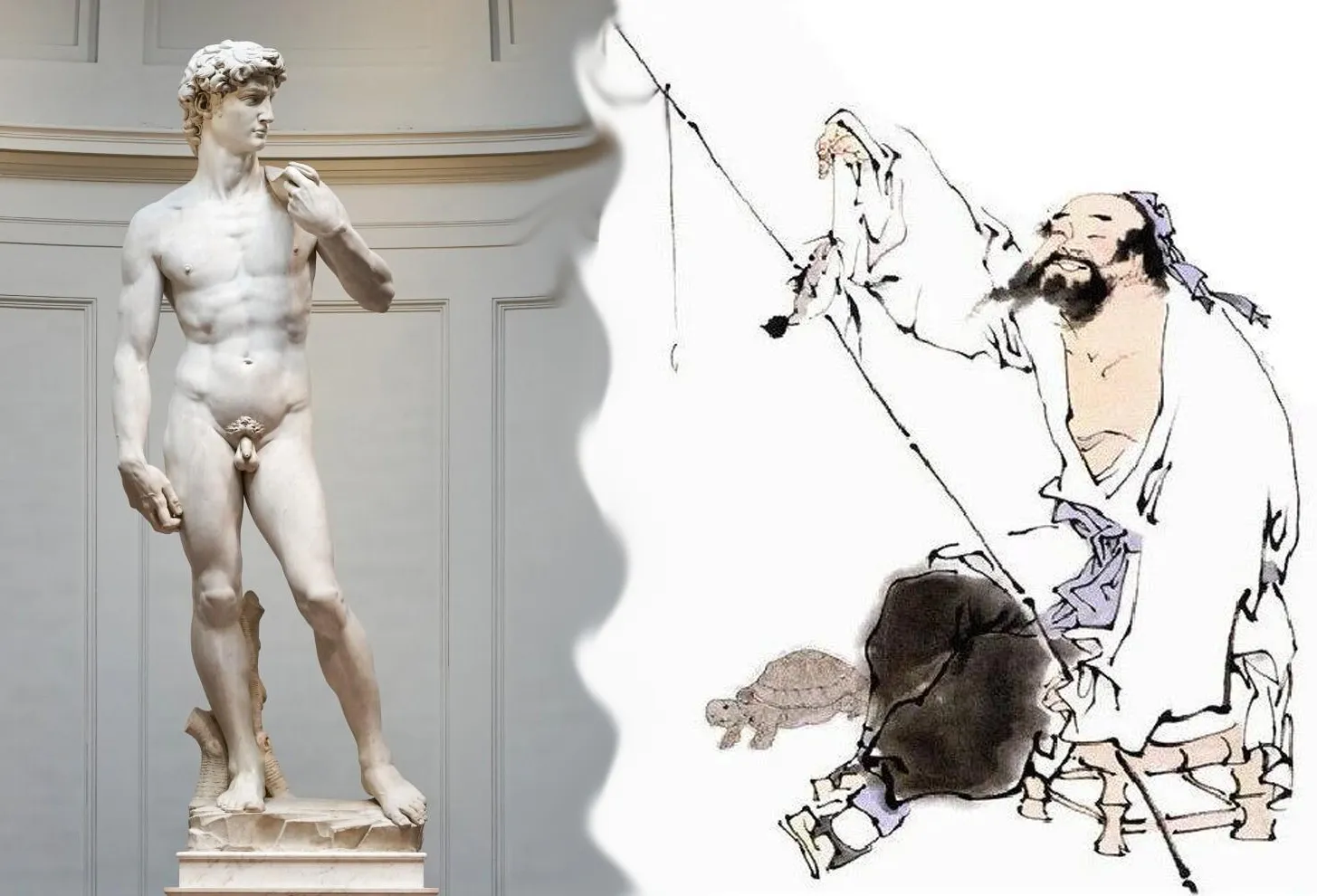
On the Aesthetics of Reality
As we move through the history of European art, the human figure is always with us. The Greek Aphrodite and Apollo, the Renaissance Venus, Michelangelo’s David, Botticelli’s Birth of Venus, Raphael’s Madonnas, even the idealised Jesus—all these images belong to the same long story in which the human body became the privileged locus of aesthetic “beauty.” A beauty revealed in harmonious bodily proportions, a perfect face, balanced movement, and an idealised image of the human being. It is no coincidence that the human body became the central motif of European art. Behind it stands a long philosophical tradition that saw beauty not merely as aesthetic pleasure, but as a reflection of the deeper order of the world.
From Plato onwards, beauty was not understood as an independent value. It was a trace of reality. In the Symposium, physical beauty is only the first step on a path that leads a person from the admiration of a particular body to the beauty of the soul, from there to the beauty of knowledge, and finally to Beauty itself as a transcendent reality. A beautiful body is therefore not the goal, but a sign. The visible is meant to lead a person towards the invisible. (ἄρχεσθαι χρὴ ἀπὸ τῶνδε τῶν καλῶν ἐκείνου ἕνεκα τοῦ καλοῦ ἀεὶ ἐπαναβαίνοντα, ὥσπερ ἐπαναβάθμοις χρώμενον, ἀπὸ ἑνὸς ἐπὶ δύο καὶ ἀπὸ δυοῖν ἐπὶ πάντα τὰ καλὰ σώματα, καὶ ἀπὸ τῶν καλῶν σωμάτων ἐπὶ τὰ καλὰ ἐπιτηδεύματα, καὶ ἀπὸ τῶν καλῶν ἐπιτηδευμάτων ἐπὶ τὰ καλὰ μαθήματα, καὶ ἀπὸ τῶν μαθημάτων ἐπ᾽ αὐτὸ τὸ μάθημα τελευτῆσαι, ὅ ἐστιν οὐδὲν ἄλλο ἢ αὐτοῦ ἐκείνου τοῦ καλοῦ μάθημα, καὶ γνῶναι αὐτὸ τὸ καλόν — Symposium (Συμπόσιον), 211c–211d).
This understanding was adopted and reshaped by the Neoplatonists and later by Christian thinkers. Plotinus sees beauty as the radiance of the One in the world of forms; Pseudo-Dionysius the Areopagite speaks of beauty as a divine emanation; and in the Renaissance, Marsilio Ficino once again links ancient thought with Christian metaphysics, understanding physical beauty as a reflection of spiritual harmony. The Renaissance artist therefore does not merely create a beautiful image, but seeks to reveal the cosmic order within it. Yet it is precisely here that a subtle transformation begins. What for Plato was primarily a path towards the transcendent increasingly becomes, in European art, an object of admiration in its own right. The idealised body gradually loses its symbolic function and becomes an aesthetic ideal. Beauty, which was meant to lead beyond the image, remains trapped within it. This raises a question that Western art history rarely asks: Why did something similar not happen in China? How is it possible that one of the oldest and richest painting traditions in the world developed almost no iconography comparable to Aphrodite, Venus, or Renaissance allegories of beauty? Why did Chinese painters not glorify the idealised human body as the supreme aesthetic expression?
The answer is not to be found in differences of artistic taste or technical skill. Chinese civilisation developed one of the most refined artistic traditions in human history. The difference runs much deeper. It arises not from art itself, but from different understandings of reality. Every understanding of reality creates its own conception of beauty. Aesthetics is therefore not an independent philosophical discipline, but the visible expression of the deepest way in which a civilisation understands the world. For this very reason, it can be argued that every great civilisation creates the kind of art dictated by its understanding of the world. If the West sought its most perfect visible expression in the ideal human figure, it was almost inevitable that the body would become the bearer of beauty. Chinese thought, however, understood reality primarily as relationship, flow, and ceaseless change. It could therefore not seek supreme beauty in the perfect form of an individual body, but in the unobstructed unfolding of the world itself.
Even a cursory glance at the history of Chinese painting reveals a striking fact: the nude body, which more or less boldly shaped European art and its conception of aesthetics, is virtually absent from Chinese art. There, the nude body was used mainly for anatomical, cosmological, or medical illustration. This does not mean that Chinese civilisation did not value human beauty or did not depict women and men. It does mean, however, that the human body did not become the central bearer of metaphysical meaning. The reason is not aesthetic, but philosophical. Chinese thought did not develop from the question of how eternal reality reveals itself in perfect form, but from the question of how a person can live in harmony with the ever-changing order of the world. Even the early Daoist texts do not seek perfection in a static form, but in the capacity to attune oneself to a flow that cannot be definitively defined. The Dao is not an ideal image that can be painted, but the inexhaustible way of becoming from which everything arises and to which everything returns.
From this follows a different understanding of beauty. The beautiful is not that which achieves perfection of form, but that which remains true to its own nature. Laozi therefore does not speak of beauty as a value in itself. On the contrary, in verse 42 of the Daode jing he observes: 天下皆知美之為美,斯惡已..—beauty and ugliness arise together. The very act of establishing a single aesthetic ideal creates its opposite. Daoist thought therefore remains wary of any absolutisation of beauty, since every exclusive definition disrupts the original wholeness of the world. It is in this light that we can understand the concept of ziran (自然), often translated as “natural spontaneity,” although it means much more. It refers not merely to nature in the ordinary sense of the word, but to a mode of being in which each thing spontaneously realises its own way. Beauty is therefore not something that human beings add to the world, but something revealed when things are not forced to become something other than what they already are.
This idea decisively shaped Chinese art. The painter did not seek the perfect body because ideal perfection was never understood as the ultimate reality. Instead, the painter’s gaze turned towards mountains, water, ancient pines, bamboo, mist, birds, and the empty spaces between them. Landscape was chosen not because it was more beautiful than the human being, but because the workings of the Dao could be observed directly within it. A mountain does not compete with a valley, a river does not resist its course, and bamboo does not try to become an oak. Each thing realises its own nature, and its beauty is revealed precisely in this fidelity to itself. Nor is the human being placed at the centre of creation in such a world. A person is one among countless expressions of the same cosmological order. This is why the Chinese landscape painter often depicts the human being as a tiny figure on a path among the mountains or beside a riverbank. This smallness does not express insignificance, but serves as a reminder that true harmony does not arise from humanity’s domination of the world, but from our ability to find our proper place within it.
The difference between Western and Chinese aesthetics is therefore not primarily a difference between two artistic traditions, but between two ways of understanding reality. For centuries, Western metaphysics believed that the eternal order of the world could reveal itself in perfect form. Beauty became a sign of the transcendent, and the human body its most perfect visible embodiment. It is therefore unsurprising that European art repeatedly creates idealised images of the human being—not because it glorifies the body in itself, but because it recognises in the body the possibility of revealing something that transcends it. Chinese thought followed a different path. Its fundamental question was not how the invisible becomes visible, but how all beings remain in mutual harmony. Reality is understood not as a perfect form, but as a continually emerging order of relationships. Consequently, beauty is not primarily a quality of an individual object, but a way in which it exists within the whole of the world. The most beautiful thing is not that which stands apart from others, but that which, without force, realises its own nature while remaining part of the flow and its transformations… Both traditions thus speak of harmony, but understand it differently. The West often seeks it in perfection of form, China in perfection of relationship. The first is realised in the ideal image, the second in unobstructed flow. The first admires perfection, the second harmony. The difference is not aesthetic, but ontological.
The Western ideal of beauty has largely become detached from the metaphysical foundations from which it arose. What was once a symbol of the transcendent has gradually turned into an aesthetic goal in itself. The body is no longer a path to reality, but often becomes reality itself. From this arise the ceaseless pursuit of the perfect appearance, the cult of youth, cosmetic surgery, and the digital idealisation of the human image. This is no longer the revelation of beauty, but its banal production. In this context, the Daoist perspective appears strikingly contemporary—not because it offers an alternative aesthetic ideal, but because it calls into question the very need for idealisation. If beauty arises where things follow their own nature, then it cannot be produced, attained, or forced. We can only allow it, as reality itself, to reveal itself through its own harmony…
SDT Rector Yuan Weiqi


